
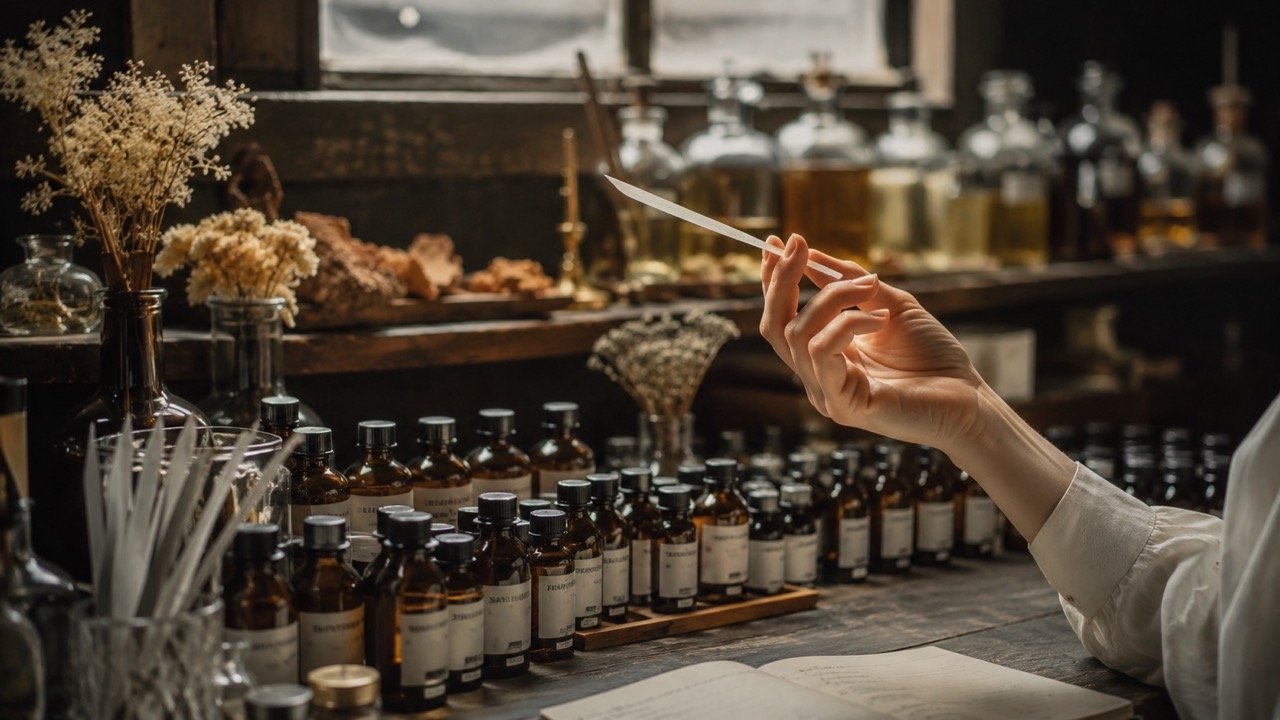
Aesop was founded in Melbourne in 1987. This fact has shaped everything about how the city relates to fragrance — not as a luxury good that carries a house’s prestige from Paris or New York, but as a category that rewards the same analytical intelligence you would bring to wine, coffee, or textile. The company’s founding premise — that the ingredients matter more than the marketing, that a product’s philosophy should be legible in its formula and not just its advertising, that the person using it deserves to be treated as an intelligent adult rather than a desire-object — is so thoroughly Melburnian that it could only have come from here. No other Australian city in 1987 had the European-inflected intellectual culture, the coffee-and-design seriousness, the indifference to status-brand logic that Aesop required as its context.
The consequence of this founding is that Melbourne has, across the decades since, developed a fragrance literacy that sits at the sophisticated end of the Australian spectrum. The city’s serious perfume buyers understand the difference between natural and synthetic musks, between a linear fragrance and one that develops across its drydown, between a concentration labelled eau de parfum and one that actually performs at parfum weight. They know that a fragrance composed with rare Australian botanicals — lemon myrtle from Queensland, wattleseed from South Australia, desert rosewood from the Centre — is making a specific argument about where this country’s olfactory intelligence lives, and that argument is worth following. They have the patience for fragrance in the way that they have the patience for a long-form text: as something that unfolds over time and reveals itself in layers.
Melbourne’s fragrance culture does not fetishise rarity or exclusivity as end-points. What it respects is coherence: the perfume whose concept is fully resolved in its formula, in which every element serves the central olfactory idea rather than hedging toward mass appeal. This is why Aesop’s approach — a small range, deeply considered, reworked across years rather than expanded for growth — resonates so strongly here. It is also why the independent perfumers and niche houses that populate Melbourne’s serious fragrance retail are not there to sell aspirational status but to offer the kind of considered alternative to mainstream luxury that Melbourne’s cultural institutions have always valued.
Aesop: The Founding Intelligence
Aesop stores in Melbourne — there are several, with the Emporium flagship and the CBD laneway locations both worth visiting — are designed with the same architectural seriousness as the formulations: each store is designed individually, using materials specific to its location, and the experience of entering one is the experience of entering a considered room rather than a chain retail environment. The staff know the range in the way that good sommeliers know a wine list: they can distinguish between the citrus-forward sharpness of Hwyl and the animalic density of Marrakech Intense, recommend one against the other based on a conversation about how you wear fragrance, what you already wear, what time of year it is.
The Aesop fragrance range is small by design — deliberately so, because each new addition requires the same development rigour as the cosmetic range. Tacit is a dry, cedar-forward study in restraint. Othertopias is a more recent creative direction, structured around extraordinary specific environments rather than conventional perfume categories. Buying an Aesop fragrance in Melbourne has the specific satisfaction of being at the source: the company is now owned by L’Oréal but remains headquartered in Melbourne, and the city retains the institutional memory of what the brand meant before it became global.
Multiple Melbourne locations. aesop.com
Libertine Parfumerie: Armadale
Libertine Parfumerie, established in 2008, operates as Australia’s most serious niche fragrance retailer — a house with genuine curatorial intelligence, stocking the fragrance equivalent of a specialist bookseller’s range: not everything, but the right things, selected by people who know why they are right. The Armadale flagship at 1023 High Street is the most significant Melbourne location, a boutique that functions as a perfume library in the truest sense: the bottles are not display objects but working references, each available to be worn and considered in the context of its house, its nose, its specific compositional ambition.
Libertine stocks Goldfield & Banks — an Australian fragrance house created by French-Belgian entrepreneur Dimitri Weber, who arrived in Australia and became, as such arrivals sometimes do, more alert to what was here than people who had grown up with it. The Goldfield & Banks botanical series — Desert Rosewood, Bohemian Lime, White Sandalwood — draws on rare Australian essences processed at the olfactory standard of the great French houses: Australian ingredients, European technique. These are fragrances that make a geographical argument that Melbourne buyers, with their interest in place and provenance, are well positioned to understand.
1023 High Street, Armadale. libertineparfumerie.com.au
Goldfield & Banks: The Australian Botanical Proposition
Goldfield & Banks as a house deserves attention beyond its availability at Libertine. Weber’s project — to bring Australia’s extraordinary botanical wealth into the mainstream of serious international perfumery — is not a novelty exercise but a considered argument about what this continent’s flora actually smells like when treated with the compositional rigour of a trained nose rather than the promotional instinct of a marketing department. Lemon myrtle, used correctly, is not a gimmick; it is a citrus note with a complexity that Sicilian bergamot achieves only in its finest pressings. Desert rosewood has a warmth and specificity that generic ‘wood’ bases cannot replicate.
The Botanical Series in particular — sample kits are available at Libertine — is worth working through systematically before committing to a full bottle. The fragrances are distinct from one another in a way that demonstrates genuine compositional range rather than line extension; the house is not producing variations on a single theme. For the Melbourne buyer interested in fragrance as a form of local knowledge, Goldfield & Banks is the most direct available argument that Australia has something specific to contribute to a category that has been dominated by European and American references for a century.
Stocked at Libertine Parfumerie. goldfieldandbanks.com
The Nicholas Building Perfumers
Among the independent practitioners in the Nicholas Building are, periodically, perfumers working at the bespoke end of the spectrum — makers who will produce a fragrance for an individual, taking as their starting point a conversation about memory, material preference, and olfactory history. This is fragrance as portraiture rather than product: the resulting composition is not reproducible in the way a commercial fragrance is, and the price reflects the time and material cost of custom formulation.
The tradition of bespoke perfumery in Melbourne is not large — there are perhaps a handful of practitioners capable of working at this level — but it is serious. Approaching a Nicholas Building perfumer is the same protocol as approaching any building studio: direct contact, patient conversation, willingness to attend multiple sessions as the fragrance is developed and adjusted. The result, if you commit to the process, is an object that is entirely yours.
37 Swanston Street, Melbourne CBD. nicholasbuilding.org.au
The Protocol of Buying Fragrance in Melbourne
Never buy a fragrance without wearing it. Wear it for a full day — morning through evening — before deciding. The top notes that seduce you in the first ten minutes are the least important part of the fragrance; the drydown, which takes three to four hours to fully develop on most skins, is what you will actually be wearing. The Libertine staff will tell you the same thing and will not hurry you.
Start with the Australian botanical houses before you orient toward European ones — not because the European canon is not worth knowing, but because the local olfactory references will teach you something about your response to material that the conventional perfumery canon, built around Mediterranean and Central Asian references, will not. The question is not which fragrance is best but which one tells you something true about the place you are in and the season you are wearing it through.