
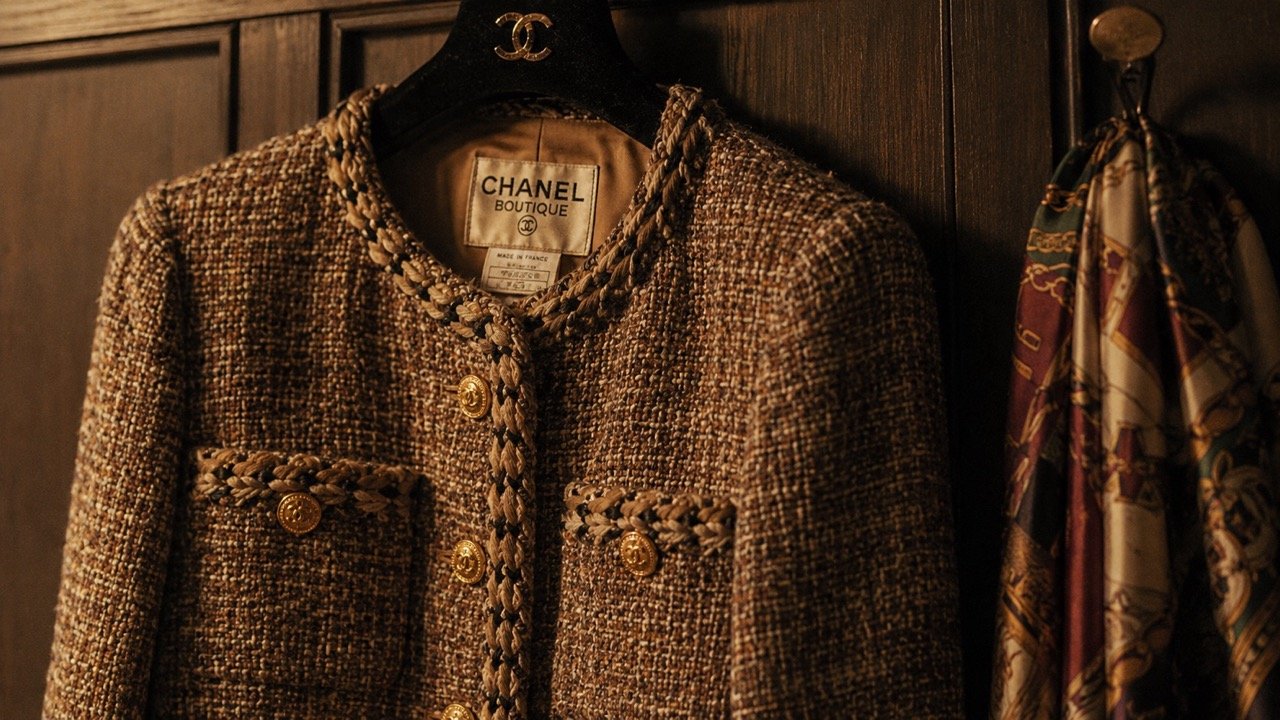
The word vintage has been so thoroughly colonised by the mass market that it requires recalibration before applying it to the rooms and dealers discussed here. What follows has nothing to do with weekend markets, pre-loved racks, or the thrift culture that has been rebranded for aspirational consumption. This is about something else entirely: authenticated, provenance-documented, investment-grade archival fashion acquired through relationships built over years, stored with museum-standard care, and offered to buyers who understand what they are purchasing.
The distinction matters because the object matters. A 1970s Chanel tweed suit from the house’s most celebrated period, authenticated, condition-graded, and fairly priced, is not a piece of second-hand clothing. It is a primary source document of one of the twentieth century’s most significant design languages. Treating it as such — acquiring it with care, maintaining it correctly, understanding its place in the history of the house — is a different activity entirely to buying vintage for aesthetic points.
The Standard: What to Look For
Before the rooms, a brief taxonomy of quality in the archival fashion market.
Authentication: The piece can be traced to its original source — ideally with a receipt, a provenance record, or photographic documentation. For major houses, authentication certificates from recognised specialists (Christie’s, Sotheby’s, or house-specific authentication bodies) provide the firmest ground.
Condition grading: Reputable dealers grade their inventory using consistent terminology — mint, excellent, very good, good — and can explain the condition discrepancies that distinguish each grade. A piece described as excellent should have minimal wear with no repairs. Very good permits light wear but no damage.
Pricing transparency: The archival market is complex, and prices for identical pieces can vary enormously between dealers. The best dealers explain their pricing relative to comparable sales and offer genuine guidance to buyers who ask.
Curation depth: A room that contains forty exceptional pieces is more interesting than a room containing four hundred average ones. The edit is the editorial opinion.
Circa Vintage, Armadale (Melbourne-origin, Sydney clientele)
Circa Vintage is technically a Melbourne institution — established in 2009 and operating from Armadale — but its reputation among Sydney’s most serious collectors is such that it warrants inclusion as the national reference point for authenticated luxury vintage. The founders have spent fifteen years developing direct relationships with European estate sales, private collections, and a network of specialist buyers across France, Italy, and the UK.
The inventory at any given time includes significant Chanel — particularly pieces from the Karl Lagerfeld tenure of the 1980s and 1990s, when the house’s vocabulary was being rewritten with the particular confidence of a designer who understood both tradition and spectacle. Alongside Chanel, Circa maintains a strong selection of 1990s Prada, Helmut Lang from the same decade (priced with the seriousness the market now attaches to his work), and occasional pieces of significant Margiela.
Sydney clients are encouraged to contact the gallery before visiting, as inventory changes rapidly and reservation of specific pieces for viewing is standard practice.
circavintage.com.au — Sydney viewing by appointment.
Pamela’s Vintage, Potts Point
Pamela’s is a Potts Point institution that has operated from the same Elizabeth Bay Road address long enough to have shaped the local market for archival fashion rather than simply participating in it. The room — small, impeccably organised, lit with the care that the pieces deserve — is where Sydney’s most discerning stylists, fashion editors, and private collectors maintain a standing relationship with the owner, who functions as much as curator and advisor as retail operator.
The focus here is broader than some pure-luxury specialists — Pamela’s carries excellent pieces from across the quality spectrum of the 20th century, from 1950s American sportswear to 1980s European designer, from early 1970s Ossie Clark to mid-period Issey Miyake. The consistent thread is condition and curation: nothing enters the room that isn’t interesting, and nothing stays long.
For the buyer interested in building a genuine archival wardrobe rather than collecting individual statement pieces, Pamela’s offers the kind of ongoing curation that only comes from a sustained relationship with a single trusted dealer.
Elizabeth Bay Road, Potts Point. Open Thursday to Sunday.
Godtfred Vintage, Online with Sydney Presence
Godtfred operates primarily as a digital business — a curated online archive with a newsletter that functions as the most reliable early-access service for significant pieces before they reach the website. The Sydney-based founders have a particular expertise in Japanese designer vintage: Yohji Yamamoto, Comme des Garçons, and Issey Miyake from their most critically significant decades (1980s and 1990s), alongside a strong selection of European intellectual fashion from the same period.
The inventory photographs with the seriousness the pieces deserve: each garment is documented flat and on a form, with detailed close-ups of condition, labels, and construction. For buyers whose relationship with archival fashion is rooted in conceptual design rather than luxury house heritage, Godtfred is the most reliable source in Australia.
The newsletter list is the access mechanism — pieces posted to the newsletter typically sell before reaching the public site.
godtfred.com.au — Newsletter signup on the website.
The Resale Rooms at Harrolds
Harrolds — the Australian luxury multi-brand retailer with flagships in Sydney and Melbourne — operates a curated consignment programme that sits within the main retail environment rather than in a separate pre-loved section. This positioning is intentional: the pieces are treated as inventory rather than cast-offs, priced at fair market value, and condition-graded before acceptance.
The Harrolds programme is strongest for current-season and near-current designer fashion from the brands the store carries — Brunello Cucinelli, Thom Browne, Rick Owens, Valentino. For buyers seeking archival pieces from these houses without the depth of specialist knowledge required in the pure vintage market, the Harrolds consignment programme offers a trusted entry point with the authentication confidence of buying through an established retailer.
Level 2, 142 Castlereagh Street, Sydney CBD. harrolds.com.au
On Building an Archival Wardrobe
The most useful framework for approaching the archival market is the same one applied to any significant collection: depth over breadth.
A coherent perspective in archival fashion means choosing a house, a decade, a designer, or a vocabulary and pursuing it with genuine knowledge. A collection of twenty significant Lagerfeld-era Chanel pieces tells a story and accumulates value — in both financial and cultural terms — that forty pieces from twenty different sources cannot approximate.
The dealers listed here all operate with the patience that serious collecting requires. They will hold pieces for established clients. They will source specific items on request. They will advise on condition, pricing, and relative rarity with the honesty that only comes from relationships built over years.
Begin with a conversation. The best purchases in this market are never transactions.
All prices in the archival luxury market are market-rate and subject to change. Condition and provenance documentation should always be reviewed before purchase. Independent appraisal is recommended for acquisitions above $5,000.