
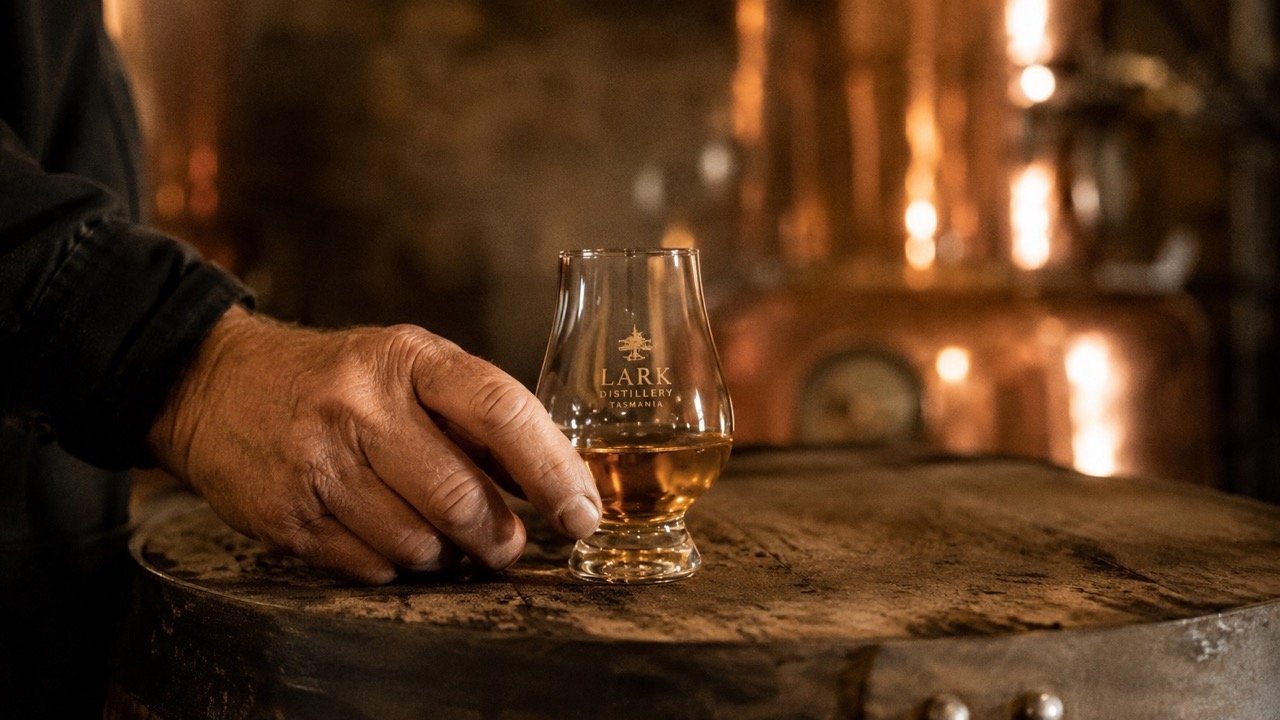
The Scottish will tell you there is only one whisky worth the argument, and in 1990 they would have been largely right. In 2025, the conversation has shifted with a completeness that tends to unsettle those who learned the subject in an earlier decade. Australian whisky — led by Tasmanian producers who began distilling in the 1990s with what looked like provincial ambition and turned out to be world-class product — has won international competitions, attracted the attention of European collectors, and forced a reconsideration of what the category can produce outside the regions that defined it.
This is not novelty. The best Australian whiskies have now been compared, in blind tastings, to Highlands single malts and found to hold their own. The explanation lies in Tasmania’s climate, which produces a maturation environment unlike anywhere else in the Southern Hemisphere: cold winters that retard maturation and preserve delicacy, warm summers that accelerate it, and a barrel-cycling rhythm that produces complexity in fifteen years that Scotch requires twenty-five to achieve.
NSW and Victoria are now producing alongside Tasmania. This is a movement, not a single producer story.
Sullivans Cove, Tasmania
Sullivans Cove won the World’s Best Single Malt at the World Whisky Awards in 2014 — the first time a non-Scottish, non-Japanese whisky had won the category — and the industry has been paying attention since. The distillery operates from the Hobart waterfront, producing small-batch single malts in American oak ex-bourbon and French oak ex-wine casks, with the French oak expression widely considered to be the benchmark.
The French Oak HH expression — available at the distillery and through specialist retailers — is a whisky of unusual complexity for its age: the French oak contributes dried fruit and spice that American oak cannot, and the Tasmanian water adds a mineral quality that separates it from any mainland Australian equivalent. The French Oak HH that sits in the cellar for twelve to fifteen years before bottling is, at its best, one of the finest whiskies produced in the Southern Hemisphere.
Distillery visits are available by appointment at the Hobart facility. The barrel hall tour — limited to small groups — is among the best educational whisky experiences in Australia.
Sullivan’s Cove Whisky, Hobart, Tasmania. Available at fine bottle shops nationally. sullivanscove.com
William McHenry & Sons, Tasmania
The McHenry distillery at Port Arthur occupies a former farm property on the Tasman Peninsula with a view across the historic site that provides the most dramatically situated distillery tasting room in Australia. The whisky is produced in small volumes from Tasmanian barley and Tasmanian water, matured in a combination of port, sherry, and bourbon casks. The port-cask expression — rich, sweet, deeply coloured — is the most approachable of the range for those transitioning from single-malt Scotch; the sherry-cask bottling is more complex and rewards patience in the glass.
The Peninsula location means that distillery visits are naturally integrated into a broader Tasman Peninsula itinerary — the Port Arthur Historic Site is forty minutes north, the spectacular Tasman National Park coastal tracks are immediately accessible. The tasting, conducted in the distillery’s stone cellar, takes approximately ninety minutes.
696 Arthur Highway, Port Arthur, Tasmania. By appointment. mchenrydistillery.com.au
Archie Rose Distilling Co., Rosebery (Sydney)
Archie Rose is the most significant new spirits producer to have emerged from Sydney in the past decade, and while its primary reputation is built on gin and rye whisky, the single malt programme — now releasing its first mature expressions after the necessary patience of proper maturation — is producing whiskies of compelling character.
The White Rye — a clear, unaged rye spirit that also functions as a cocktail base — is the most distinctive product in the portfolio and the one that has most influenced Sydney’s bartending community. The Single Malt releases, available as annual limited bottlings, show a house that understands what its local climate and water produce and is learning how to express it with increasing confidence.
The Rosebery distillery offers guided tours that include the complete production process — grain to glass — and a tasting of the full range. The distillery bar is open to the public without a tour booking for tasting flights.
85 Dunning Avenue, Rosebery. Open Tuesday to Sunday. archierose.com.au
Starward Whisky, Melbourne
Starward is the Australian distillery that has done the most to expand the market for Australian whisky internationally, and the approach — maturing in Australian red wine barrels from the Yarra Valley, rather than the conventional Scotch-maturation oak programme — produces a whisky that is genuinely novel rather than a regional approximation of an existing style.
The Nova expression — the house’s most widely distributed — is approachable in a way that encourages transition from wine to whisky rather than demanding conversion to a new vocabulary: the red wine cask character gives the spirit a fruit-forward quality that wine drinkers recognise, while the base whisky character provides depth. For Sydney retailers, Starward is the most accessible entry point into the category and the most useful conversation starter for those beginning to take Australian whisky seriously.
Available from fine bottle shops nationally. starward.com.au
On Tasting Australian Whisky
The approach to tasting Australian whisky requires a slightly different mental framework than approaching Scotch.
Australian whiskies are typically younger — eight to twelve years, versus fifteen to twenty-five for the benchmark Scotch expressions. The youth is not a defect but a design condition: the Australian climate does more in ten years than Scotland does in twenty. The expectation of age-related complexity should be recalibrated accordingly.
Water: a small addition — five to ten millilitres in a standard nosing glass — opens both Australian and Scottish single malts in the same way, and more is lost in Australian spirits by not adding water than the other way around. The alcohol level at cask strength (typically 58–62%) closes aromatic compounds that the water releases.
Temperature: serve at room temperature, not chilled. Australian spirits served from refrigeration suppress the aromatic character that is the primary argument for drinking them.
Time: allow the glass to sit for five minutes after pouring before nosing. The alcohol volatilises first; the aromatic compounds it was suppressing then surface.
The most efficient path from curiosity to genuine knowledge is a tasting flight at a distillery or specialist whisky bar. The Baxter Inn (covered separately in this edition) maintains the most comprehensive collection of Australian whisky available in a Sydney drinking environment.