
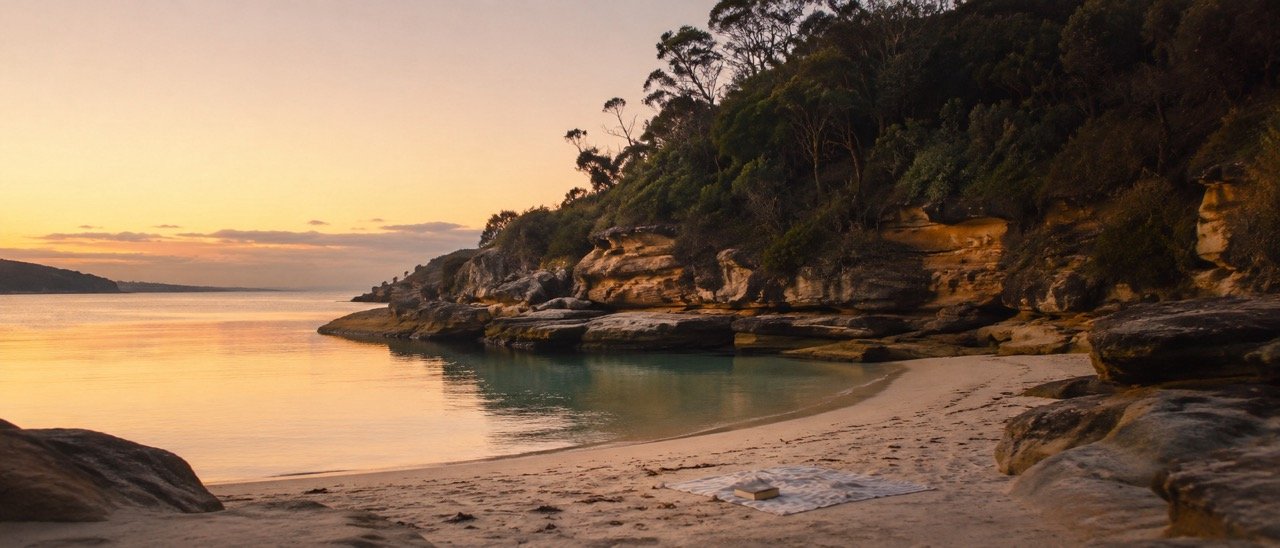
Bondi is extraordinary. It earns its reputation daily — the sweep of white sand, the quality of light in the hour before the crowds arrive, the promenade at dusk when the afternoon swimmers are heading home. None of this is under dispute.
But Sydney Harbour contains 317 kilometres of foreshore. The ocean coastline extends from Barrenjoey in the north to Cronulla in the south, broken at intervals by headlands, coves, and rocky shelves that appear on no tourist map and in no hotel concierge’s standard repertoire. These places exist for those who are willing to walk twenty minutes past where the path ends, or to take a ferry to a wharf with no café, or simply to know where to look.
This is where to look.
Milk Beach, Vaucluse
Milk Beach is the harbour’s best-kept open secret — a small crescent of sand at the end of a fifteen-minute walk from the Hermitage Foreshore Track, tucked below the gardens of Strickland House. The walk itself is as good as the destination: the trail moves through dense bush above the harbour, surfacing occasionally for views across to Balmoral and Middle Head that reward a stopped pace.
The beach faces north across the harbour. In summer, the morning light comes in low and warm, and the water — protected from the open ocean — is calmer than anything on the exposed coast. The sand is coarse and clean. There is no kiosk, no chair hire, no coffee cart.
Arrive before eight on weekdays and you may have it entirely to yourself. Bring water and provisions; the track back to Rose Bay is the closest point of civilisation. The Hermitage Foreshore Reserve walking track connects Milk Beach to Rose Bay in one direction and Nielsen Park (another excellent swim, with a slightly less secluded character but outstanding fig trees and a heritage kiosk) in the other.
Access via Hermitage Foreshore Track, off Chinamans Beach Reserve, Vaucluse. Free entry. No facilities.
Washaway Beach, Manly
The name is unexplained on any official signage. Local knowledge holds that the beach — a narrow strip of sand on the harbour side of Manly, accessible only at low tide — erodes almost completely at certain tidal configurations before reconstituting itself. Whether or not this is mythology, the beach itself is not: it exists, it is genuinely secluded, and the view from the sand across to the Sydney CBD is among the finest in the harbour.
Access is via a rough path that descends from Stuart Street, Manly, through scrub to the foreshore. The walk is short (ten minutes from Manly Wharf) but requires attentiveness — the path is not maintained and the sandstone can be slippery after rain. The reward is a stretch of sand and water that feels completely detached from the Manly promenade activity a short distance away.
Swim only in calm conditions; the harbour current varies here depending on tidal state. The walk back to Manly Wharf takes you past the heritage-listed Quarantine Station — worth a detour to walk the old grounds.
Access from Stuart Street, Manly. Tidal dependent — best at low to mid tide. No facilities.
Watsons Bay: Gibsons Beach
The Green’s Restaurant crowd on a Sunday at Watsons Bay fills the main beach with a civilised, well-dressed energy that is pleasant enough but not solitary. Walk past the naval heritage precinct and down toward the base of the South Head Heritage Trail, however, and Gibsons Beach presents itself: a curved, sheltered bay facing north-west, surrounded by sandstone cliffs of unusual height, with water that sits in a register between green and blue depending on the hour.
The beach is small — perhaps forty metres of accessible sand at low tide — and not signposted from the main wharf. The walk down the cliff path is steep and requires reasonable care. The reward is a swimming spot with natural shade in the afternoon, extraordinary rock formations at the water’s edge, and an almost complete absence of company.
The Gap Bluff Walk above connects Gibsons Beach to the main South Head Heritage Trail, which continues north to the lighthouse at South Head for views across the entrance to the harbour that are, in the right light, genuinely arresting.
Access via Gap Bluff Track from Watsons Bay. 20-minute walk from the ferry wharf.
Chinamans Beach, Mosman
The name is historically contested and likely to change in time, but the beach itself is permanent: a long, north-facing crescent on the Middle Harbour side of Mosman, sheltered from ocean swell, with calm water and a gentle gradient that makes it suitable for all water confidence levels.
What makes Chinamans genuinely exceptional is the quality of the morning light. Facing north-east, the beach catches the early sun at an angle that makes the water almost phosphorescent before eight in the morning — a pale, bright aqua that belongs more to the Whitsundays than to a harbour suburb twenty minutes from the CBD.
The beach has a modest reserve with picnic facilities and a children’s playground, making it slightly more developed than the others listed here. The trade-off is reliability — the water quality is consistently excellent, the facilities are maintained, and the foreshore path east toward Balmoral is one of the finest short harbour walks in the city.
Access via Silex Road, Mosman. Ferry to Balmoral Beach, then 15-minute walk west.
Little Marley Beach, Royal National Park
For those prepared to commit to a half-day — the entry to a category of beach experience that requires genuine effort and delivers accordingly — Little Marley is the reward.
The walk from the Bundeena ferry (Royal National Park) takes approximately ninety minutes through coastal heath and over sandstone ridge, descending finally to a beach that, in any other country on earth, would have a resort on it. The sand is white and deep, the water a colour that has no business existing so close to a major city, and the headlands on either side form a natural enclosure that gives the cove a quality of protected completeness.
There are no facilities. There is no shade at midday. The walk back requires the same effort as the walk in, which means the beach self-selects for those serious enough to earn it. Bring more water than you think you need, food for the day, and a willingness to do nothing for several hours.
The Hacking River ferry from Cronulla to Bundeena — a thirty-minute crossing through mangroves and open river — is itself a kind of prelude, shifting the psychic register from city to somewhere else entirely.
Ferry from Cronulla Wharf to Bundeena daily. Royal National Park entry fee applies. Walk from Bundeena approx. 7km return.
On Timing
The Sydney harbour beaches listed above share a rhythm. Early morning — before eight on weekdays, before nine on weekends — is when they exist most purely as the places described here. By mid-morning on fine weekends, even the lesser-known spots begin to attract company. By noon, the best spots on the ocean coast will have surfaced on social media and the window has passed.
The ocean beaches — Little Marley, the south coast coves — maintain their character throughout the week regardless of season, because the effort of reaching them is the most reliable form of access control.
Ocean swimming carries inherent risks. Check conditions before entering water at exposed beaches. Swim between the flags where they exist. Harbour beaches are generally calmer but tidal and boat traffic conditions vary. The remoteness of some locations listed here means emergency response times are longer than at patrolled beaches — plan accordingly.