
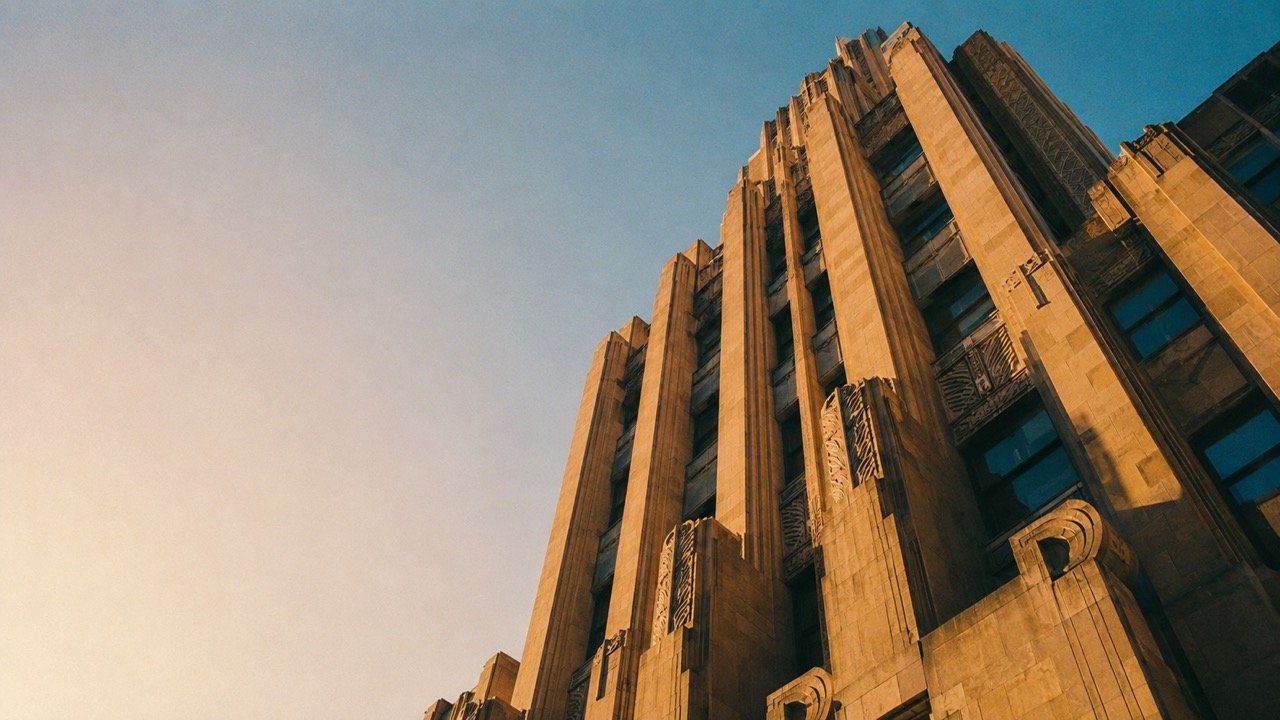
Brutalism arrived in Australia in the 1950s through architects who had studied or worked in Britain, Europe, and the United States and returned to a country in the middle of the most sustained period of public investment in its history. Post-war Melbourne was building — universities, government offices, civic facilities, cultural institutions — with a confidence that the period’s economic conditions made possible and that is almost impossible to imagine from the position of the contemporary city. The buildings that resulted from this confidence are concrete, massive, formally uncompromising, and absolutely sincere about the idea that a public building should look like what it is: something built by a society that believed in itself and wanted the buildings to say so.
The received judgment on Brutalism in the contemporary city is bifurcated between heritage campaigners who defend it and developers who want the sites for glass towers. Neither position quite gets at why these buildings are interesting. The interest is not sentimentality and it is not the abstract love of concrete as material. It is the question of what Melbourne was trying to be in the decades that produced these buildings — and the degree to which the ambition expressed in the forms is continuous with what the city still is, still imagines itself capable of, still measures itself against. Walking the city with Brutalist awareness does not make it feel dated. It makes it feel like a city with a longer memory than its skyline currently suggests.
The Arts Centre Spire, Roy Grounds
Roy Grounds conceived the Arts Centre master plan in 1960: a gallery and a theatre complex positioned on St Kilda Road at the bend of the Yarra, beneath a tall spire that would define the cultural precinct’s presence in the city skyline. The spire that was eventually constructed — erected in 1981 after two decades of political delay and funding arguments — is an open lattice steel structure 162 metres tall, lit from within at night, visible from the eastern suburbs in clear conditions and from aircraft on approach to Tullamarine. It is one of the first major structures in Australia designed with computer-aided analysis, predating CAD software by using calculation methods borrowed from the stadium structures at the 1972 Munich Olympics.
The spire is not precisely a Brutalist object — it is too light, too open, too much a piece of infrastructure raised to the register of civic symbol. But it belongs to the moment and the ambition. Grounds was the architect who designed the National Gallery of Victoria at 180 St Kilda Road, the bluestone and concrete cultural fortress with the extraordinary Leonard French stained glass ceiling covering 900 square metres — the largest stained glass ceiling in the world, installed in 1967 — and the moat that surrounds the building as both practical and symbolic boundary. These two buildings together constitute the most concentrated civic architectural statement in the city: the gallery (open to the public, free for the permanent collection) and the spire above the theatre complex next door. Both reward sustained attention rather than a passing glance.
Arts Centre Melbourne: 100 St Kilda Road. artscentremelbourne.com.au. National Gallery of Victoria: 180 St Kilda Road — free for permanent collection.
The Sidney Myer Music Bowl, Kings Domain
The Sidney Myer Music Bowl was completed in 1956 in the Kings Domain — the parkland between St Kilda Road and Alexandra Avenue that also contains Government House — and it remains one of the most significant works of tensile structural engineering in Australian architectural history. The canopy that covers the stage and front seating sections is a free-form shell of aluminium on a steel cable structure — not a concrete shell but a tensile equivalent — and the engineers who designed it with architects Yuncken Freeman were working at the edge of structural knowledge for the period, predating by nearly a decade the German engineer Frei Otto’s famous tensile structures.
The bowl is an outdoor venue and most of its audience experience it in summer, at night, from the grassed slopes above the covered seating. Few people attend it in daylight, which is when the structural logic of the canopy is most legible: the cables tensioned between the two concrete masts that anchor the roof, the aluminium skin rippling in a strong southerly, the organic curve of the shell form in contrast to the formal geometry of the surrounding parkland. Walk through Kings Domain on any morning and stand below the bowl’s canopy. The structure that produces those curves is considerably more serious than it looks from the slope above.
Sidney Myer Music Bowl: Kings Domain, Melbourne. Access through Alexandra Avenue gate or Linlithgow Avenue.
University of Melbourne and the Civic Campus
The University of Melbourne’s Parkville campus contains the highest concentration of significant Brutalist buildings in Victoria, several of them by architects who defined the movement in Australia: the Baillieu Library (1959, Grounds Romberg and Boyd), the Architecture Building on Masson Road, the Chemistry and Physics precincts. These buildings were constructed during the university’s most expansive period — the Menzies government’s investment in higher education infrastructure through the Murray Report, which funded university building across Australia in the late 1950s and 1960s — and they carry the ambition of that moment: exposed concrete, board-formed surfaces, strong horizontal shadow lines, buildings that make no concession to whether they are liked.
The walk through the campus from University Square to the Baillieu Library reveals the internal logic of a Brutalist precinct: the way buildings create shaded walkways and outdoor rooms between them, the use of level changes and stepped forms to negotiate the site’s modest topography, the integration of planting and concrete in ratios that have shifted as the trees have matured. The Architecture Building’s concrete is worth close inspection: the board-forming that produced its surface texture is visible in every horizontal line, and the shadows these lines create in the morning light give the facade a depth and movement that smooth render or glass cannot produce.
The Blue Crow Map and the Walking Practice
The Concrete Melbourne Map, published by Blue Crow Media and available at architecture bookshops in the city, identifies fifty significant concrete and Brutalist buildings across the CBD and inner suburbs and provides the basis for a proper walking exploration. The CBD circuit — Arts Centre spire, NGV, the Yarra Building at Melbourne University Extension (now RMIT Building 16), the former CRA building at 55 Collins Street, the NAB building at 500 Bourke Street — can be done in two to three hours at a pace that allows the buildings to be read rather than photographed.
The Flinders Lane precinct repays particular attention: the mix of Victorian bluestone warehouses and mid-century commercial buildings on the lane that runs parallel to Collins Street contains more architectural variety per block than any other street in Melbourne, including several early concrete buildings that predate Brutalism proper but anticipate its formal concerns. Walking Flinders Lane from Spencer Street to Swanston Street, at 6am on a weekday when the fashion industry’s deliveries are the only traffic and the light on the lane is still cool and grey, is one of the city’s underrated architectural experiences.
Concrete Melbourne Map: available at Perimeter Books, 379 Brunswick Street, Fitzroy, and other architecture booksellers.
A Note on the Walking Practice
The buildings described here are not uniformly open to the public — the Arts Centre complex and the NGV are publicly accessible, the university campus is open on weekdays, the Myer Music Bowl is accessible through the Kings Domain parklands. The walk that connects them is three to four kilometres from the Arts Centre at St Kilda Road north to the university at Parkville, and it traces the arc of Melbourne’s post-war civic ambition across the institutions that ambition built. Do it on a grey weekday morning when the concrete absorbs the flat light and the shadows are at their deepest, and the buildings are being used for what they were designed for rather than being visited as objects. That is when they make their full argument.