
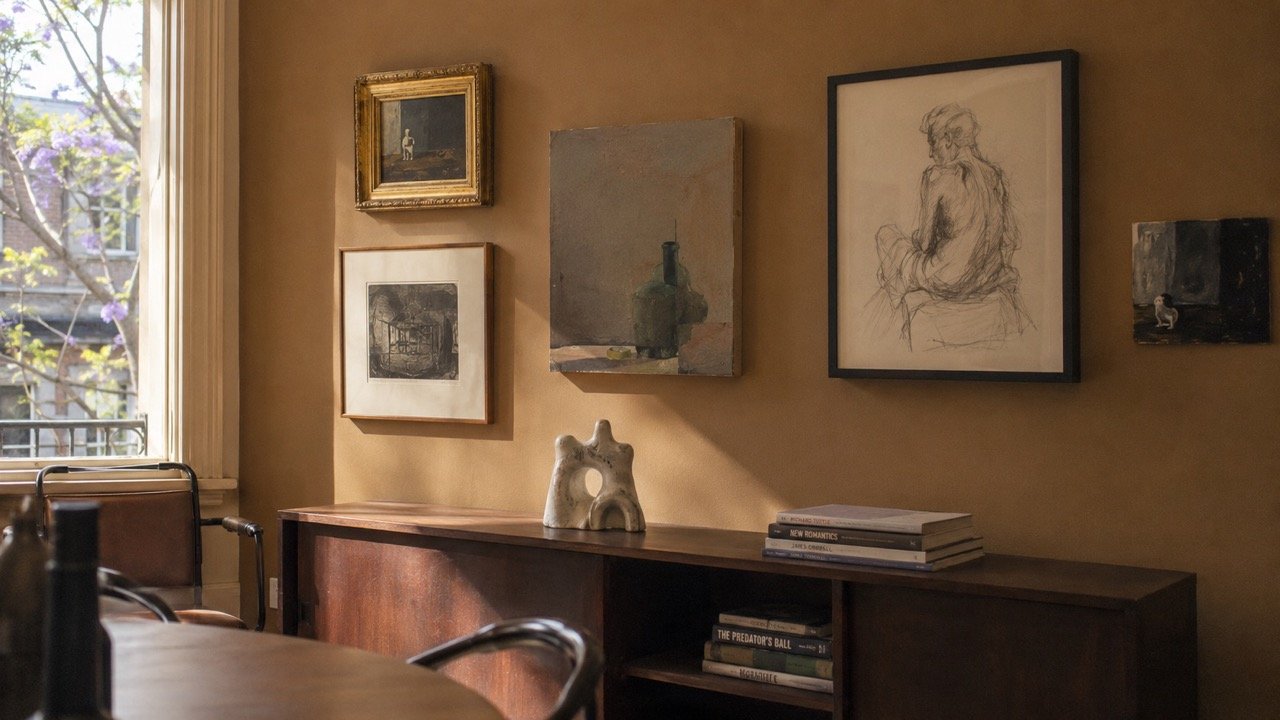
A collection is not a series of individual purchases. It is an argument about taste accumulated over time — a record of the decisions made, the risks taken, the artists trusted before the market confirmed they were worth trusting. The collector who has been buying seriously for a decade owns not only the works but the evidence of their own evolving eye, and the works they bought early — when the artist was unknown, the price was modest, and the conviction was personal rather than validated — are the ones that carry the most meaning. Collecting is a practice, and Sydney in the current moment is an unusually good city in which to practise it.
What follows assumes a reader who is already in the rooms — who attends openings, has gallery relationships, has made some acquisitions, and wants to think more systematically about what they are doing and why. It is not a map of the market. It is a set of principles, illustrated by the specific ecosystem Sydney provides.
The Gallery Ecosystem
Sydney’s commercial gallery scene is stratified in the way any serious market is: blue-chip galleries with long-established artist rosters, mid-tier galleries breaking new names, and project spaces that operate at the edges of the commercial model. Each serves a different function in the collector’s practice.
Roslyn Oxley9 Gallery in Paddington, established in 1982 and operating from Soudan Lane for more than three decades, is the reference point for blue-chip Australian contemporary. The roster — which has included Tracey Moffatt, Bill Henson, Patricia Piccinini, Fiona Hall, and Dale Frank across its history — represents the artists whose work has entered museum collections internationally and whose secondary market values are established by Langton’s classification and Christie’s auction results. Buying here is not discovery; it is the acquisition of confirmed cultural significance at a market price that reflects that confirmation.
Sullivan+Strumpf at 799 Elizabeth Street, Zetland, operates with a different logic: the gallery, co-founded by Ursula Sullivan and Joanna Strumpf in 2005, has built its reputation on representing artists whose work travels internationally — with spaces in Sydney and Singapore, the gallery is genuinely oriented toward the Asia-Pacific conversation rather than the provincial Australian one. The roster mixes established and emerging in a way that rewards the collector willing to buy an artist before the gallery’s international programme has confirmed their standing.
Olsen Gallery at 63 Jersey Road, Woollahra, run by Tim Olsen, maintains the estate and living work of John Olsen alongside a broader program of significant Australian contemporary painters and photographers. The gallery occupies a particular role in the Sydney market: it is the place to engage with the canonical generation of Australian painting — the painters who established the visual language that subsequent generations are working with, against, or in dialogue with — while also following the contemporary program that Tim Olsen curates with demonstrable conviction.
Sarah Cottier Gallery at 23 Roylston Street, Paddington, operates at a scale that allows it to take genuine risks. The gallery, established in 1993 and in its current Paddington location after stints in Newtown, Redfern, and Neild Avenue, shows Australian and international contemporary work with a program that often precedes rather than follows critical consensus. The collector who has developed a relationship with Sarah Cottier’s program over several years will have acquired works by artists now considered established at prices that reflected earlier stages of their careers.
NandaHobbs at 12–14 Meagher Street, Chippendale, serves the collectors whose interests run to the meeting point of Australian contemporary and international printmaking, and who understand the market for works on paper and limited editions at a level that most galleries assume away.
The Auction Landscape
Sydney’s auction houses provide a secondary market infrastructure that the serious collector needs to understand even if they are not primarily buying at auction. The results from Deutscher+Hackett — now operating from Gosbell Street, Paddington, having moved from its earlier premises — are the primary record of how Australian art is valued by the market, and the annual auctions of Important Australian Art constitute the most reliable price index available.
Menzies Art Brands conducts specialist auctions in both Sydney and Melbourne, three to four times annually, and its Langton’s Classification — published every few years and ranking Australian wines and artists by their secondary market performance — is the closest thing the domestic market has to a structured valuation reference. For the collector whose holdings include works by artists in the Classification, the auction results provide a real-time sense of how the collection is performing.
The collector’s relationship with auction should be primarily intelligence-gathering rather than acquisition. The works that come to auction have already been owned, sometimes multiple times; the provenance is part of the story, and not always a flattering one. Primary market acquisition — directly from a gallery — remains the collector’s most important activity.
First Nations Art and the Ethics of Engagement
No serious collector in Sydney can sidestep the conversation about First Nations art, and the collector who engages with this part of the market without thinking through the ethics of that engagement will eventually find themselves on the wrong side of it. The community-controlled art centres — the Utopia, Papunya Tula, and APY Lands centres — are the correct primary source for works produced within their communities, and the collector who buys directly from these centres, or from galleries that have transparent, verifiable relationships with them, is engaging in a model that returns money and cultural agency to the artists and communities involved.
The commercial gallery system for First Nations art is more complex, and due diligence matters. The collector should ask, explicitly, about the relationship between the gallery and the community, and about the proportion of sale price that returns to the artist. The ethical framework here is not merely moral; it is also practical, since the provenance questions around First Nations works acquired through opaque channels have created real problems for collectors and institutions.
On the Art Adviser and the Cultivated Eye
The question of whether to use an art adviser — a professional whose fee is paid for curatorial guidance, market intelligence, and access — is less a question of resources than of disposition. The collector whose primary interest is building a coherent collection with considered art-historical logic, rather than simply accumulating works they find beautiful, will benefit from the kind of sustained curatorial conversation that the best advisers provide. The collector whose interest is primarily personal — who wants to live with work that they respond to, and is prepared to trust their own eye — may find the adviser relationship constraining.
The alternative is the investment in one’s own education: spending time with the work in museum collections, attending openings consistently enough to understand what different galleries are doing over time, reading the criticism, and developing the kind of intimate familiarity with a field that allows the personal response to be calibrated by knowledge. The AGNSW’s collection of Australian contemporary work is the reference library. The commercial galleries are the real-time index. The auction results are the feedback loop.
The most interesting private collections in Sydney are not the biggest ones. They are the ones that reflect a specific intelligence, a particular period of serious looking, and the willingness to be wrong in interesting ways.