
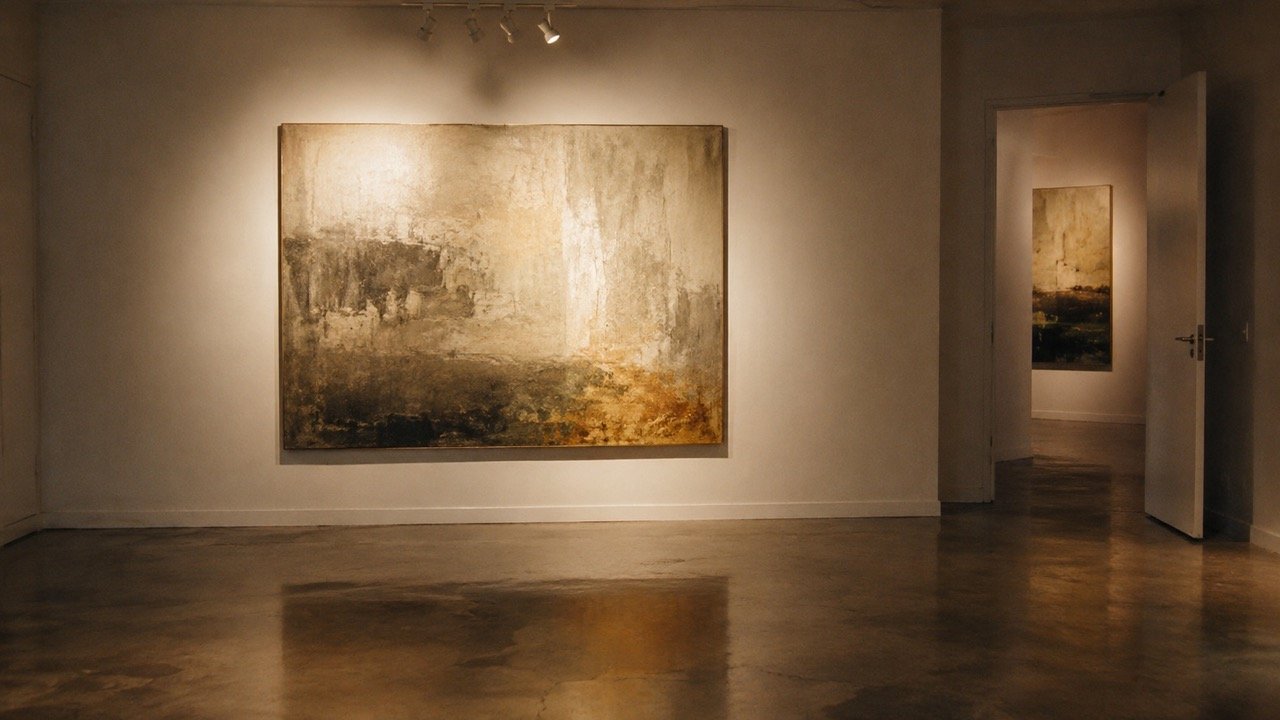
The relationship between a city and its commercial gallery ecosystem is one of the better diagnostic tools for understanding what kind of art culture that city actually has — not what it aspires to, or what its public institutions claim, but what its private collectors are prepared to commit to, year after year, gallery by gallery, work by work. Melbourne’s commercial gallery landscape is, by this measure, one of the most serious in the southern hemisphere: not the largest, not the flashiest, but possessed of a depth and longevity that suggests a genuine collecting culture rather than the fashion-responsive market that characterises some of the world’s more glamorous art cities.
What distinguishes the Melbourne galleries at the top of the ecosystem from their equivalents in Sydney or Brisbane is, in large part, a willingness to take positions — to commit to an artist’s practice across a career rather than cherry-picking commercially reliable moments, to represent work that is formally demanding or politically uncomfortable, to maintain programme integrity under market pressure. This is not universally true, and the Melbourne commercial scene contains its share of galleries that follow taste rather than form it. But the best of them are building something: a sustained argument about what Australian art can be, conducted through the specific medium of a programme and the specific commitment of a clientele.
Anna Schwartz Gallery: The Foundational Position
Anna Schwartz Gallery has operated from Flinders Lane since its establishment in 1986, and its position in the Melbourne gallery ecosystem is best understood through the word “conviction” — a willingness to make the same bet on the quality of an artist’s practice, decade after decade, that allows an institution rather than a shop to emerge from a commercial gallery’s operations. Schwartz was the gallerist who represented Louise Bourgeois’s work in Australia, introducing her practice to the local audience before it had achieved the canonical status it now holds. That kind of curatorial courage — betting on work that the market has not yet ratified — is the specific thing that distinguishes a forming institution from a retail operation.
The current programme runs across visual art, music, and publishing — the gallery’s SCHWARTZCITY imprint has produced some of the more substantial artists’ books published in Australia — and the roster includes Reko Rennie, whose Kamilaroi diamond designs, neon, and spray-work practice occupies a central position in contemporary First Nations art, and Marco Fusinato, whose noise music and conceptual practice has made him one of the most internationally exhibited Australian artists of his generation. The gallery at 185 Flinders Lane occupies a former clothing factory converted by Denton Corker Marshall — the architectural choice is itself a position, the commercial space refusing to announce itself through surface renovation.
Anna Schwartz Gallery, 185 Flinders Lane, Melbourne CBD. annaschwartzgallery.com
Sutton Gallery: The Brunswick Street Programme
Sutton Gallery operates from Brunswick Street in Fitzroy — the symbolic location of Melbourne’s inner-north art community for three decades — and runs a programme built around a specific group of artists whose practices the gallery has sustained across significant periods. The gallery’s strength is in photography and installation work with conceptual underpinning, a combination that places it in a tradition of rigorous Australian practice running from the 1980s through to the present. The space itself is characteristic Fitzroy: high-ceilinged, streetfront, a converted commercial room that still carries the texture of its prior use in the materiality of its walls and floor.
Sutton is the kind of gallery where a regular visitor develops a relationship with a programme rather than with individual works — where understanding why two apparently unrelated artists share a roster becomes a satisfying curatorial puzzle. It represents artists across career stages, which is unusual in a market that tends to either focus on established names or on emerging practices but rarely sustains the both/and approach that long-term collection development actually requires.
Sutton Gallery, 254 Brunswick Street, Fitzroy. suttongallery.com.au
STATION Gallery: The Conceptual Programme
STATION was established in 2011 in South Yarra and has built a programme with a distinctively conceptual orientation — artists whose practices are engaged with ideas as primary material, where the object is the residue of a proposition rather than an end in itself. The gallery has worked with Daniel Boyd, Paul Yore, and a roster that mixes established critical figures with emerging practitioners in a programme that is more interested in intellectual coherence than in market positioning. A South Yarra address suggests a certain kind of commercial gallery; STATION’s programme suggests a different kind entirely.
The Sydney branch, added in 2019, has allowed STATION to operate across both markets without compromising the programme for either — a difficult balance that the gallery has maintained with apparent conviction. For the collector interested in work that will repay sustained engagement rather than immediate spectacle, STATION’s programme is among the more reliably challenging available in Melbourne.
STATION, 322 Punt Road, South Yarra. station.com.au
MARS Gallery: Port Melbourne’s Unexpected Destination
Andy Dinan established MARS Gallery in Port Melbourne in 2004, converting a former dairy — the industrial heritage of inner Melbourne’s bayside suburbs — into a two-level contemporary gallery. The gallery has since relocated to Windsor, bringing its programme to a purpose-built space that retains the commitment to emerging and mid-career Australian artists that characterised the original Port Melbourne location. The space includes a custom black-box room for video work, a light and sound room, a drawing room, and a rooftop sculpture garden — each space calibrated for a different register of contemporary practice.
MARS is where Melbourne’s collector culture encounters work that is not yet stabilised by institutional validation, where the risk calculus of collecting is most visible and most engaging. The gallery’s focus on emerging and mid-career artists means that the programme requires more active engagement from the visitor — more willingness to sit with uncertainty, to form an opinion before the market has formed one on your behalf. For anyone serious about collecting Australian art rather than simply acquiring validated names, MARS is essential.
MARS Gallery, 7 James Street, Windsor. marsgallery.com.au
An Insider Note on Visiting
The serious Melbourne gallery visitor develops a rhythm: Flinders Lane and the CBD galleries on Thursday evenings, when openings tend to cluster; the inner-north galleries over a Saturday morning; the bayside and inner-south galleries by appointment or on quieter afternoons. The commercial gallery ecosystem is most usefully approached as a curriculum rather than a menu — attending openings and then returning for longer solo visits to exhibitions that warrant it, building relationships with gallery directors who are consistently informative rather than merely persuasive. In Melbourne, these relationships tend to last decades. That is the ecosystem’s best quality.