
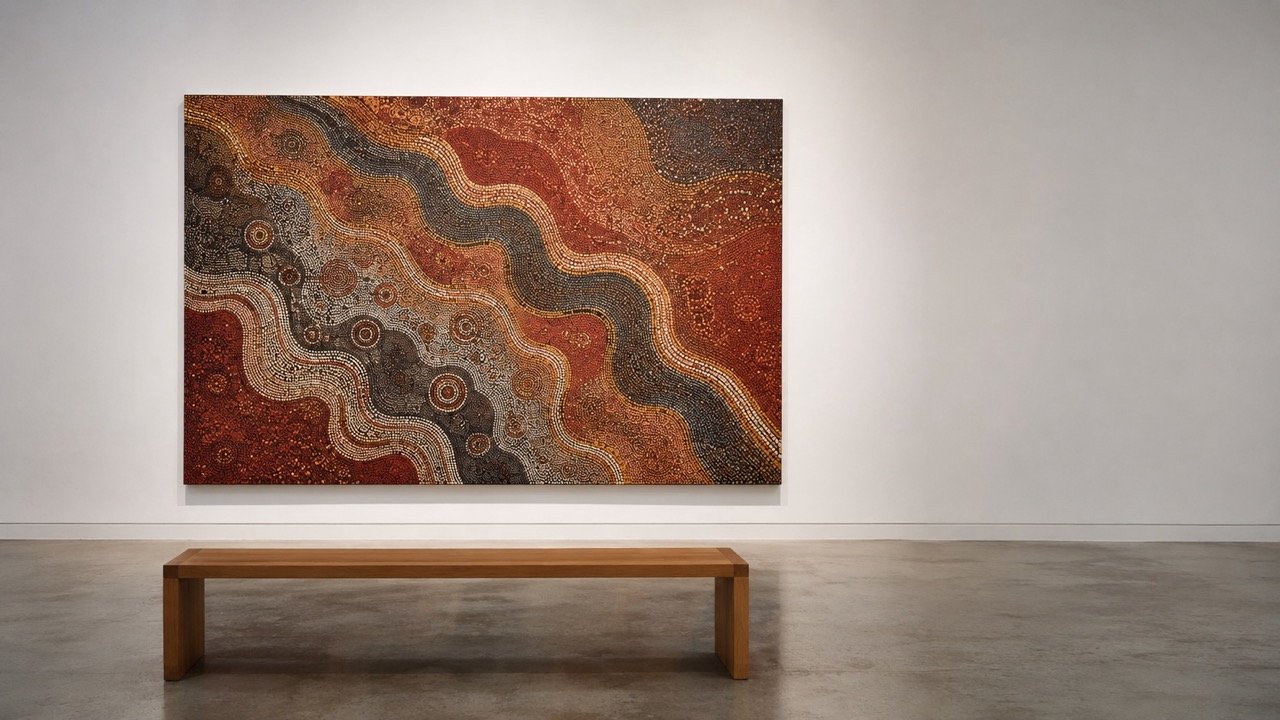
The land beneath Sydney has been known, sung, walked, and understood for at least sixty-five thousand years. The Gadigal people of the Eora Nation — whose Country this was and remains — developed a relationship with this particular harbour, this specific sandstone, these waters, long before the word Sydney existed. This is not historical context. It is a present-tense reality, and the cultural production that emerges from it — in painting, sculpture, weaving, language, story, and ceremony — is among the most significant and sophisticated in the world.
The question for the culturally engaged visitor or resident is not whether to engage with this. The question is how to do so well.
A Note Before Beginning
The engagement invited by this guide is serious, respectful, and relational — not transactional. Aboriginal art is not a decorative category or an investment class, though it can be both of those things. It is primarily a form of knowledge: visual records of Country, law, story, and spiritual understanding maintained across generations. To receive it properly requires a quality of attention that the best galleries and cultural centres in Sydney actively cultivate.
Where this guide includes commercial galleries, they have been selected because they operate with genuine care for the artists and communities they represent — with fair payment, transparent provenance, and ongoing relationships built over years rather than seasons.
The Art Gallery of New South Wales: The Yiribana Gallery
The Yiribana Gallery — yiribana means "this way" in the Dharug language — opened in 1994 and remains the most significant permanent collection of Aboriginal and Torres Strait Islander art accessible in Sydney. The collection spans bark paintings from Arnhem Land, Western Desert acrylic works, Tiwi Islands carved and painted sculpture, fibre art, ceramics, and an increasingly strong contemporary section that includes video and installation work.
The gallery does not present Aboriginal art as historical artefact. It presents it as continuous practice, with works from the 1960s and works from last year sitting in the same conceptual space. The effect is to make visible what is always true: that this is a living culture, producing serious contemporary art, not a frozen tradition on display.
Allow three hours minimum. The free docent tours, which run on weekend afternoons, provide access to knowledge that wall labels cannot approximate. Ask about the specific Country represented in each work — the guides engage with this with depth and precision.
Free entry to the permanent collection. Art Gallery Road, The Domain. artgallery.nsw.gov.au
Boomalli Aboriginal Artists Co-operative, Leichhardt
Founded in 1987 by ten urban Aboriginal artists — including Tracey Moffatt and Bronwyn Bancroft — Boomalli was and remains a landmark in the history of Aboriginal contemporary art in Australia. The co-operative was established explicitly to provide a platform for urban Aboriginal artists working outside the traditional community structures that had previously defined how Aboriginal art was exhibited and sold.
The gallery programme today mixes established mid-career artists with emerging voices, and the quality of curation reflects decades of accumulated institutional knowledge. The commercial gallery operates alongside a strong community and education programme, which means that a visit to Boomalli offers context that purely commercial spaces cannot.
For collectors, the gallery maintains relationships with a number of significant artists across multiple media. The staff engage with genuine knowledge about both the work and the artists — their Country, their community affiliations, the specific traditions and innovations their practice represents.
Marion Street, Leichhardt. Gallery hours vary; check the website before visiting. boomalli.org.au
Carriageworks, Eveleigh: The Contemporary Frame
Carriageworks — the vast former railway workshop in Eveleigh — is one of Sydney’s most significant contemporary arts venues, and its programming regularly includes major First Nations work in ways that reflect both the scale of the space and the ambition of the institution.
The annual Carriageworks programme typically includes several significant commissions from Aboriginal artists working in installation, performance, and large-scale visual art. The venue’s scale allows for work that cannot exist in conventional gallery spaces: immersive environments, architectural interventions, sound and light pieces that require room to breathe.
Checking the programme before visiting is essential — Carriageworks programs specifically, and a visit timed to a significant First Nations commission will be considerably more rewarding than a general walk-through.
245 Wilson Street, Eveleigh. carriageworks.com.au
The Museum of Contemporary Art: The Warrane Collection
The MCA’s permanent collection includes a strong representation of Aboriginal contemporary art that is frequently rotated through the main galleries. The Warrane Collection — named for the Gadigal word for the area now known as Sydney Cove — has been developed with the explicit intent of representing Indigenous Australian art within a global contemporary frame rather than isolating it in a separate ethnographic category.
The harbour-side setting is relevant: the museum sits at the point where the Gadigal people’s relationship with the water is most literally visible. The curatorial decisions around which works to show and how to position them benefit from an institutional awareness of the specific Country they occupy.
The MCA’s public programmes frequently include conversations with Aboriginal artists and curators — check the events calendar for talks timed to major exhibitions.
140 George Street, The Rocks. Free entry to the permanent collection. mca.com.au
Gadigal Country: Walking the Land
Cultural connection to Aboriginal Sydney does not require a gallery wall.
The Barangaroo Reserve — twelve hectares of reconstructed headland at the western edge of the CBD — was developed in consultation with the Metropolitan Local Aboriginal Land Council and is planted with hundreds of species native to the Sydney basin. The Cammeraygal Walking Track at North Head, Manly, passes Aboriginal rock engravings that are among the most significant on the Sydney coast. The Bondi to Coogee walk crosses land that has been a travel and fishing corridor for thousands of years, and the interpretive signage at several points along the route — installed in collaboration with the La Perouse community — provides genuine cultural context rather than scenic description.
For a guided experience of Country with the depth that formal walking can provide, the Sydney Living Museums offers occasional Aboriginal Heritage Tours of Hyde Park Barracks and The Rocks that go considerably further than the standard architectural narrative.
Guided Aboriginal Heritage Tours: sydneylivingmuseums.com.au
On Collecting Aboriginal Art Seriously
For those considering acquisition, several principles apply.
Provenance matters profoundly. Work should be traceable to the artist, the community, and — where relevant — the specific Country depicted. The gallery should be able to provide this documentation without hesitation.
Avoid markets and street stalls. Authentic Aboriginal art of significance is sold through established galleries with verifiable relationships with artists and communities. Inauthentic or appropriated work is a documented problem in the Australian art market.
The most significant commercial galleries in Sydney with strong Aboriginal art programmes include Utopia Art Sydney, NandaHobbs, and the Raft Artspace — all of which operate with the artist-first integrity that the work deserves.
Price is not a proxy for quality. Some of the most significant works available are priced modestly because the artist is not yet widely known. The galleries above will guide with knowledge rather than commercial pressure.
This guide engages with First Nations culture with the intent of deepening genuine understanding. It has been written to present, rather than represent, a culture that speaks for itself through its artists, institutions, and communities.