
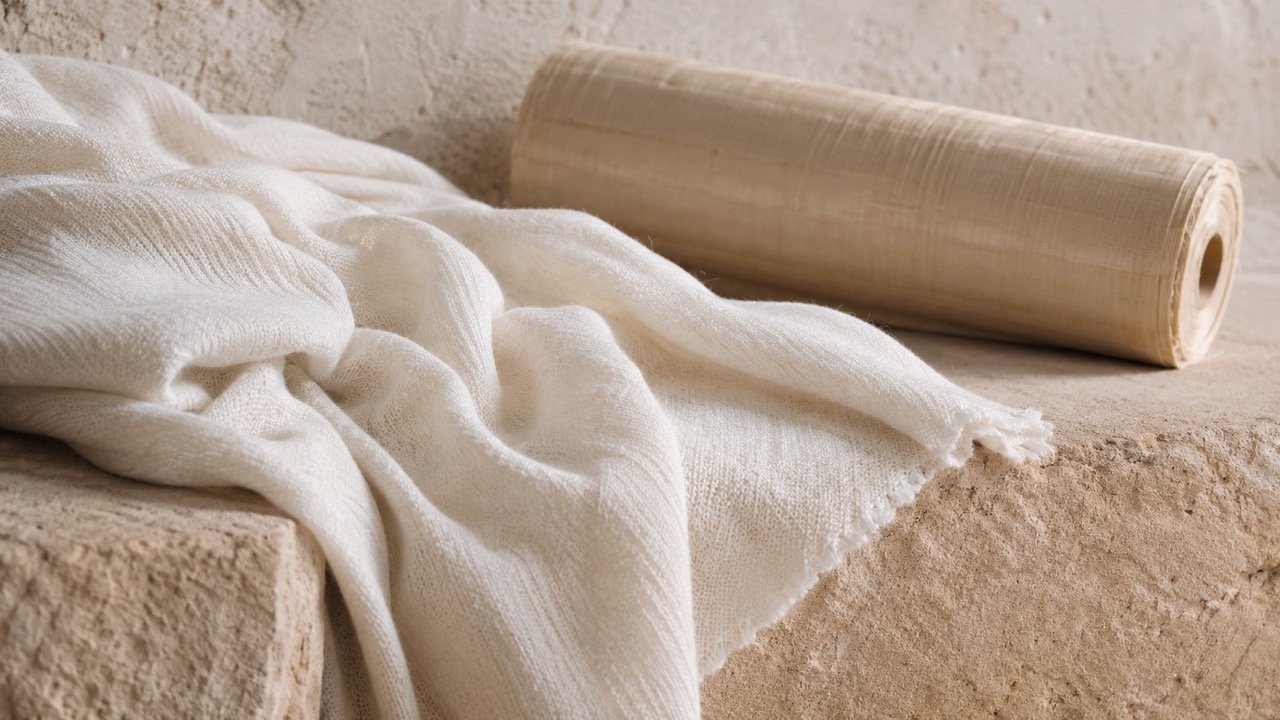
The merino sheep was introduced to Australia in the late eighteenth century, and the country has spent the two and a half centuries since quietly becoming the world’s dominant producer of the finest wool on earth. Australian Superfine merino — bred predominantly in the high country of New South Wales and Victoria, and classified by micron count rather than the older Super designation — accounts for the bulk of what arrives at the great European cloth houses: Dormeuil in Paris, Holland & Sherry in London, Scabal in Brussels. The irony is complete: the raw material of Savile Row, of the Neapolitan tailor’s bespoke cloth, of the finest dress fabric in the world, comes from the pastoral stations of Merriwa and Hay and Hay Plains, shorn, scoured, and shipped to be transformed into the cloth that returns to Australia as the most expensive item in the wardrobe.
For the cultivated Sydneysider, understanding this supply chain is not an exercise in national pride. It is the beginning of genuine textile literacy — the ability to assess a cloth by feel and visual structure before the label is consulted, to understand why a Super 150s Dormeuil weighs 220 grams per linear metre and why that matters for a summer suit, and to identify the difference between stonewashed Italian linen and Belgian linen in a rolled bolt without being told. These are not trivial distinctions. They are the difference between a wardrobe built on knowledge and one assembled on aspiration.
The Merino Question: Microns, Super Numbers, and the Sydney Cloth Market
The Super numbering system — Super 120s, 150s, 180s — indicates the fineness of the individual wool fibre, measured in microns. Superfine merino begins at around 18.5 microns; the finest commercially viable cloth, from Vitale Barberis Canonico or Loro Piana’s Pecora Nera range, reaches below 14 microns. Below a certain threshold, the cloth becomes too fine to survive daily wear and is produced primarily for ceremonial or exhibition purposes. The sweet spot for a garment intended to be worn rather than admired — particularly in Sydney’s climate — sits between Super 120s and Super 150s: fine enough to drape beautifully and wear without weight, durable enough to hold its structure through the day.
Zink & Sons, Sydney’s oldest surviving bespoke tailoring house, has been at 56 Oxford Street in Darlinghurst for over 130 years and maintains trunk show access to cloth from Dormeuil, Holland & Sherry, and Dugdale Bros. The house works to full-canvas bespoke construction, and the cloth library — several thousand samples drawn from the current seasonal books of the great mills — allows a client to feel the difference between a 250-gram Scabal flannel and a 180-gram Dormeuil Amadeus in their hands before committing to a yard. This is the proper way to choose cloth: not from a swatch catalogue, not from a screen, but from handling the actual woven article in natural light.
Zink & Sons, 56 Oxford Street, Darlinghurst. zinkandsons.com.au
The Linen Problem: Belgium, Ireland, and the Italian Solution
Linen is the most honest textile. It refuses to pretend. It wrinkles, it creases, it acquires the specific topography of the body wearing it, and it does all of this without apology. Belgian linen — woven from flax grown in the Kortrijk region, water-retted in the River Lys, and characterised by its long staple length and luminous surface — is the benchmark for suiting and shirting fabric. Irish linen from the Bann valley carries a slightly coarser hand at comparable weights, which some prefer for its character. Both are distinguished from lower-grade linens by their thread count, staple length, and surface regularity.
The Italian intervention, which has transformed how linen is worn in the past two decades, is the stonewashing and enzyme-washing process pioneered by mills such as Albini Group in Bergamo and Tessitura Monti in Verbania. By softening the surface of Belgian or Irish linen through mechanical and chemical processes, these mills produce a cloth that drapes with the weight of linen but breaks in immediately, skipping the first weeks of stiffness that characterise unwashed linen garments. For Sydney’s climate — where a shirt must survive both an air-conditioned office and a humid evening — a 120-gram stonewashed Albini linen shirt is not a seasonal option but a year-round necessity.
The distinction worth knowing: look for the "slub," the irregular thick-and-thin of the linen yarn that produces its characteristic uneven surface. A very regular linen surface, with no slub visible, usually indicates blending with cotton to reduce cost. The most characterful linens show their slub proudly, a record of the irregularity of the natural fibre. This is not a flaw but the textile’s signature.
The Silk Supplement: Understanding Structure Before Surface
Australian silk production is modest — the country’s climate does not favour the mulberry cultivation required for Bombyx mori sericulture at commercial scale. But Sydney’s relationship with silk is more interesting than its domestic production would suggest. The city’s proximity to Asia, and its significant Chinese community, means the finest Chinese and Japanese silks — Suzhou shantung, Nishijin brocades, Kyoto kiri-mon — arrive here with the same regularity as European luxury goods, and often with less markup.
The fundamental distinction the textile-literate person makes is between spun silk and reeled silk. Reeled silk, drawn continuously from a single cocoon, produces the long-filament, high-lustre cloth associated with Charmeuse, Habotai, and the great dress weights of Lyon and Como. Spun silk, produced from broken cocoons and waste fibre, has a shorter, duller appearance and rougher hand — it is not inferior per se, but it is a different material. Raw silk and dupioni, with their pronounced slub, belong to the spun category and reward a different application: they are for structure and surface interest rather than the fluid drape of reeled cloth.
For silk that can be handled in Sydney, the QVB still houses specialist fabric retailers carrying imported silks by the metre for those working with dressmakers. For tailored applications, the bespoke houses will source from their mill books: Dormeuil carries silk-wool blends of extreme refinement for spring-summer suiting, and a jacket cut from Dormeuil’s Amadeus in a silk-wool at 180 grams is among the finest warm-weather garments that can be commissioned anywhere.
The Connoisseur’s Protocol
Feel before you see. The hand of a cloth — how it moves against the palm, its weight in drape, whether it springs back or yields — tells you more than the specifications. A Super 150s from a lesser mill can disappoint where a well-woven Super 120s from Vitale Barberis Canonico performs. Mill reputation and weave construction matter as much as fibre fineness.
Microns in context. For Sydney’s climate, very fine merinos below Super 130s risk over-performing in the heat. The 200-gram range in a Super 120s or 130s weight is the most practical sweet spot for a wool suit that will be worn from April through October. For summer, consider a wool-linen or wool-silk-linen blend: the linen adds crispness and breathability, the silk adds drape.
The weight conversation. When commissioning cloth from a tailor, always ask for the gram-per-linear-metre weight. A 180-gram cloth and a 280-gram cloth of identical fibre quality will perform completely differently in Sydney’s September. A tailor who cannot tell you the weight of the cloth they are recommending is not the tailor for you.
The linen calendar. In Sydney, linen shirts are appropriate for eleven months of the year; the only month they over-perform is the brief, occasionally cold July. Belgian or Irish linen for formal occasions; stonewashed Italian linen for everything else. Never machine-wash linen that cost more than a restaurant meal.
Silk’s one rule. If you cannot identify whether a silk is reeled or spun, hold it up to natural light. Reeled silk will transmit light almost evenly, with a luminous quality; spun silk will show a cloudier, more opaque surface. Neither is wrong; they are for different purposes.