
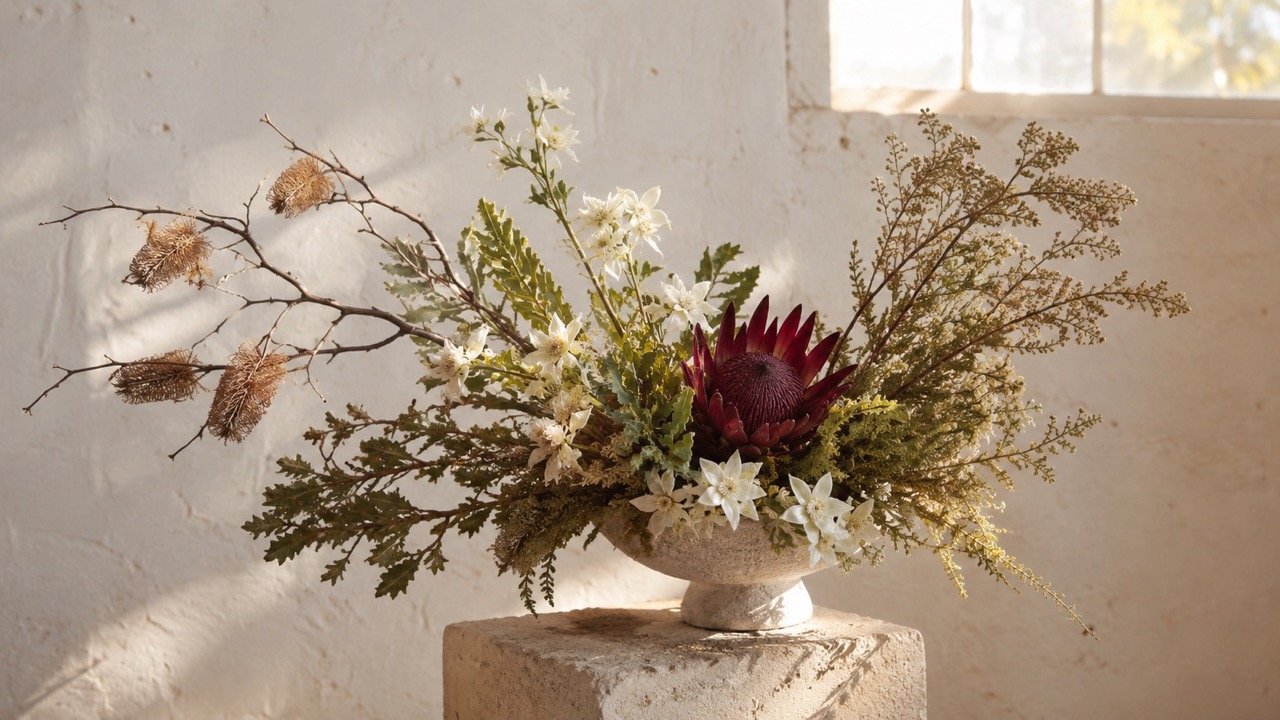
At the level at which it is practised by a small number of people, floristry is an art that operates in four dimensions. The first three are the usual ones — the form of the arrangement, its colour, its texture. The fourth is time: the specific, irreversible temporality of organic material that is already dying from the moment it is cut, and that will look different on the day it arrives than it will three days later, and different again at the week’s end. The florist who understands this fourth dimension is not making a decorative object. She is making a composition designed to move through time with intention, to peak at a specific moment, and to die gracefully.
This understanding separates the artist-florist from the commercial arranger in the same way that understanding the arc of a narrative separates the novelist from the copywriter. Sydney has produced several practitioners working at this level, and the most internationally significant among them — Saskia Havekes of Grandiflora — has been working from a small shop in Potts Point since 1995 in a way that has influenced a generation of Sydney florists and attracted attention from Chanel, Vogue, and Harper’s Bazaar without substantially changing the intimate, demanding character of the practice itself.
Grandiflora, Potts Point
Havekes opened Grandiflora at 12 Macleay Street in 1995, and the shop has since become one of the most distinctively identifiable floral presences in Australia — not because of scale or commercial ambition, but because of the intensity of its curatorial vision. The work is guided by what might be called a sculptural restraint: Havekes is as interested in what is not in an arrangement as what is, and her compositions use negative space with the confidence of a practitioner who has spent decades studying the relationship between form and emptiness.
The materials are seasonal and, wherever possible, locally sourced — the native flora of the Australian coast, the botanical vocabulary of a country whose wildflowers have evolved in isolation for millions of years and have a visual language that exists nowhere else. A Grandiflora arrangement might combine a single banksia cone with a length of eucalyptus and a stem of waratah in a way that makes those elements feel newly discovered rather than familiar. This is the hardest thing in botanical art: to make the material you grew up looking at seem extraordinary. Havekes does it consistently, and her four books — particularly the first, Grandiflora, published in 1999 — document the evolution of a practice that has always been more philosophy than decoration.
12 Macleay Street, Shop 1, Potts Point. grandiflora.net
Hermetica Flowers
Since Jai Winnell launched Hermetica in 2013, the studio has developed a distinctive position at the architecturally bold end of Sydney floristry — large-scale installations and sculptural bouquets that engage with the built environment rather than simply occupying it. Where Grandiflora works with a refined quietude, Hermetica often operates at the other end of the formal spectrum: dramatic scale, strong structural bones, the kind of installation work that changes the character of a space rather than enhancing it.
The studio’s event and installation work for corporate and private clients demonstrates a mature understanding of botanical art as spatial intervention — not flower arrangements placed in a room, but designed relationships between plant material, architecture, and light. The wrapping technique that has become something of a Hermetica signature — the specific way cut stems are grouped and bound before being placed in a vessel, visible rather than concealed — treats the mechanics of the arrangement as part of its aesthetic. In this, Hermetica shares something with the Japanese ikebana tradition’s willingness to show the structure that holds the composition together.
Bess Paddington
The lineage of Sydney floristry becomes visible at Bess Paddington on William Street, where Bess — who trained under Saskia Havekes before studying in London — has built a practice that is clearly in conversation with Grandiflora while developing its own distinct personality. Bess works with native wildflowers from her father’s farm in addition to seasonal blooms from the Sydney Flower Market, and this access to farm-direct material gives her arrangements a freshness and specificity that commercially sourced flowers cannot replicate.
The shop itself is as carefully considered as the work inside it: the small corner site on William Street, with its light-filled interior and unadorned surfaces, operates as the correct container for an aesthetic built around the integrity of the botanical material. Bess’s arrangements tend toward the bright and sculptural — generous in spirit, precise in structure — and the shop has accumulated a following among Paddington’s art and design community for the reliability of its visual intelligence. For those seeking to commission exceptional floral work for an event or private residence, the conversation begins here.
27 William Street, Paddington. besspaddington.com
On the Philosophy of the Botanical Form
The Japanese inheritance. The greatest single influence on contemporary Western floristry — barely acknowledged, frequently absorbed — is ikebana, the Japanese art of flower arrangement. The core ikebana insight is that an arrangement has three structural elements (heaven, earth, man in the classical Ikenobo school) and that the quality of the negative space between those elements is as important as the flowers themselves. Even florists who have never studied ikebana formally will tell you that the best arrangements have breathing room — that crowding is the enemy of composition. This is an ikebana principle.
Native versus imported. Australian native flora — banksia, waratah, kangaroo paw, protea, native grasses — grows slowly, blooms seasonally, and has a visual character shaped by millions of years of Australian ecology. It does not perform in the manner of roses or peonies, which are bred for a certain reliable showiness. It asks for a different kind of attention, and a florist who understands it can produce work that is irreducibly Australian in character, impossible to replicate elsewhere. This is not nationalism but specificity: the specific ecology of a place producing a specific visual language.
The brief, approached properly. When commissioning significant floral work — for a private dining table, a wedding, or a corporate installation — the most useful thing you can tell a florist is not what you want it to look like but how you want it to feel, and what the space is. The palette and form follow from that information far more productively than from a reference photograph, which tends to produce imitation rather than design.
The vase is not neutral. The most common error in domestic floristry is treating the vessel as a container rather than a compositional element. The height of the rim relative to the stem length, the colour of the material against the colour of the flowers, the weight of the vessel in relation to the lightness or mass of the arrangement — all of these are part of the work. Havekes’s published books spend considerable attention on vessels; the relationship between container and plant material is one of the things that separates arranged flowers from botanical art.