
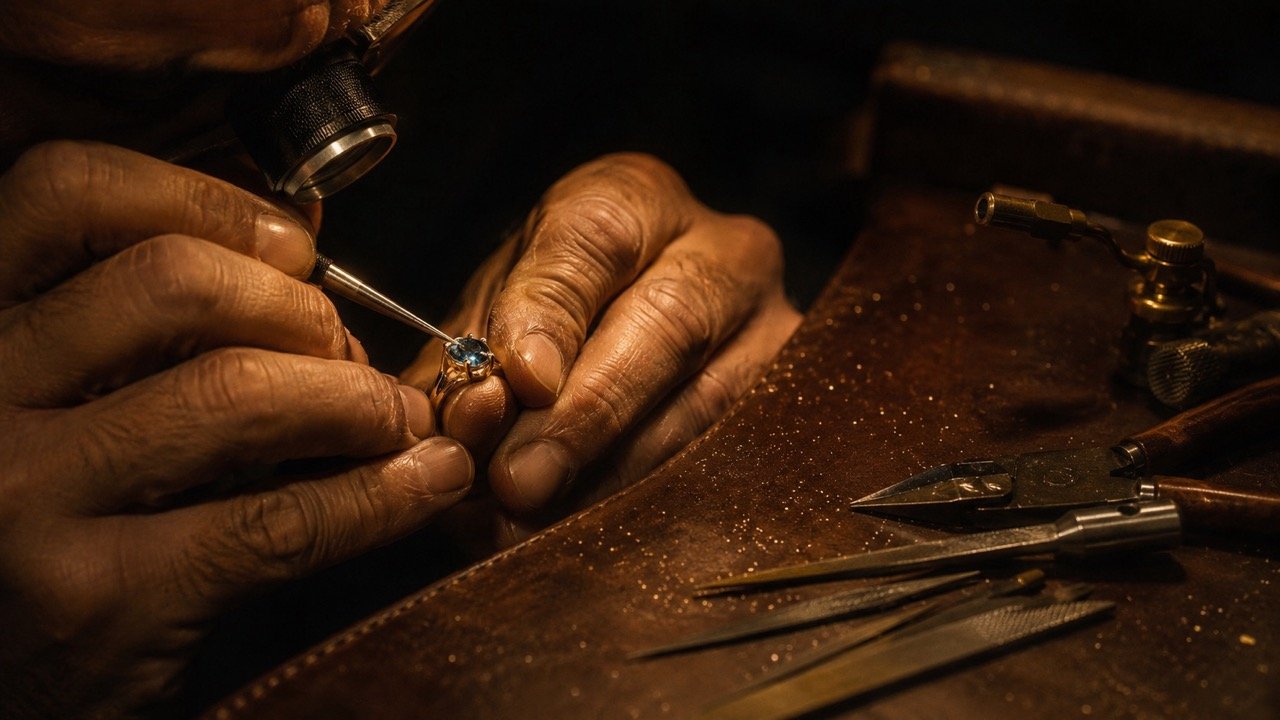
The heirloom is a piece that outlives the occasion for which it was made. It passes from the person who commissioned it through their children, their grandchildren, possibly their grandchildren’s children — carrying the original intention forward in a form that, if the maker was sufficiently skilled, retains its beauty across the entire journey.
This is a higher ambition than fashion jewellery. It requires not only technical excellence but a quality of imagination that can work across decades: a design that does not date because it was never fashionable in the first place, only beautiful. A stone set in a way that will hold correctly in thirty years. A hallmark that means something.
Sydney has a handful of jewellers working at this level. They are not in shopping centres. They are in studios, in converted terraces, in workshops above galleries. Their waiting lists are real and their work is worth them.
Australian Stones: What Makes Them Significant
Before the makers, a note on the materials available in this country, because the stones are the argument.
Australian sapphires from the New England region of New South Wales and the Anakie fields of Queensland are among the finest in the world. The New England stones in particular produce deep cornflower blues, parti-colour stones that move between blue and yellow in different lights, and greens of the particular saturation that makes collectors who know them prefer them to anything from Ceylon. They are undervalued internationally and correctly valued by the Australian makers who use them.
Argyle pink diamonds, from the now-closed Argyle mine in Western Australia, are the rarest coloured diamonds produced in the modern era. The mine closed in 2020, and the existing supply — distributed primarily through the Argyle pink diamond tender system — is finite and appreciating. Pieces containing Argyle diamonds are already understood by the market as investment objects.
Australian opal — black opal from Lightning Ridge, crystal opal from Coober Pedy, boulder opal from Queensland — produces stones of play-of-colour that no other gem material can approach. In the hands of a maker who understands how to set them without diminishing their movement, opal pieces are among the most singular objects in the jewellery world.
Jan Logan, Sydney CBD
Jan Logan has been making jewellery in Sydney for over thirty years, and her work occupies a position in Australian fine jewellery that very few practitioners have reached: genuinely original in design, technically beyond reproach, and consistently committed to Australian stones. The house is known particularly for its engagement with opal and sapphire — not as novelties or local colour but as the primary material from which exceptional pieces are built.
The design aesthetic is sculptural — forms that follow the logic of the stone rather than imposing geometry upon it, settings that exist to protect and display rather than to compete. The result is work that reads as modern without any reference to trend, which is exactly the condition required for an heirloom.
Bespoke commissions are central to the practice. The first consultation — typically ninety minutes — begins with the stone. Logan or her team will source a specific stone for the client’s brief, presenting options that they have selected from their established supplier network. The design is developed from the stone outward, not from a template inward.
Strand Arcade, 412 George Street, Sydney CBD. By appointment preferred for bespoke commissions. janlogan.com.au
Fairfax & Roberts, Sydney CBD
Fairfax & Roberts occupies the crown of the Australian fine jewellery market — the house that significant institutions commission, that significant collectors know by reputation, that the international visitor with serious intent is directed toward. The catalogue spans finished pieces of considerable technical complexity and bespoke commissions that draw on the full depth of the house’s workshop capability.
The sapphire work here is exceptional. The house maintains relationships with several of the most significant Australian sapphire mining operations and can source stones of specification — particular colour saturation, particular cut, particular carat weight — that are unavailable through the general market. For collectors interested in building a position in Australian sapphire over time, Fairfax & Roberts is the correct beginning.
The Argyle pink diamond programme — the house held an allocation relationship with the Argyle mine during its operating life — means that existing stock of Argyle-certified stones is available in a context of genuine provenance documentation.
Level 1, Strand Arcade, 412 George Street, Sydney CBD. fairfaxandroberts.com.au
Kader Jewellery, Surry Hills
Kader Jewellery operates from a Surry Hills studio with the particular independence of a maker who chose to remain independent precisely because it allows them to make work that commercial gallery relationships would not. The design vocabulary is more experimental than the established houses — forms that reference industrial and natural geometry simultaneously, settings that use titanium and oxidised silver alongside gold, stones selected for unusual character rather than conventional clarity grades.
For buyers whose relationship with jewellery is about the making and the object as much as the material value, Kader offers work of genuine intellectual interest alongside exceptional craft. The bespoke programme here begins with a conversation about how the piece will be worn and what the wearer wants to feel when they wear it — questions that the technically oriented houses rarely ask first.
Surry Hills. By appointment. @kaderjewellery on Instagram
Sarah & Sebastian, Paddington
Sarah & Sebastian occupy the tier between established fine jewellery and contemporary fashion, which places them in a position of unusual versatility — their work is technically accomplished enough to produce genuine heirlooms while remaining accessible to buyers for whom a lifetime piece is a new consideration rather than an established practice.
The house has developed a strong identity in delicate, modern forms — rings that stack, necklaces that layer, earrings that read differently in different lights. The sapphire and opal work, in particular, demonstrates a restraint in setting that allows the stones to carry the composition. Pieces can be made to order in specific stones and metals; the process is faster than the established bespoke houses but no less attentive.
**88 William Street, Paddington. Open Tuesday to Saturday. sarahandsebastian.com*
The Commission: How to Approach a Bespoke Piece
A note for those considering their first bespoke commission.
Begin with the stone. A piece built around a specific stone — one you have seen, held, and responded to before the design conversation starts — has a clarity of intention that a piece designed and then stoned rarely achieves. Ask the maker to show you stone options before drawing anything.
Set a realistic timeline. High-quality bespoke work from a serious Sydney maker takes three to six months from first conversation to final delivery. Rush commissions are possible but compromise the maker’s process; plan ahead for pieces tied to specific occasions.
Budget for the making as well as the stone. The labour component of bespoke fine jewellery in Sydney — bench time, setting, polishing, finishing — typically represents thirty to fifty percent of the total cost. This is not overhead; it is the craft you are commissioning.
Keep the documentation. The certificate, the provenance notes on the stone, the maker’s mark on the piece — these are the materials that make the heirloom traceable and the insurance meaningful.