
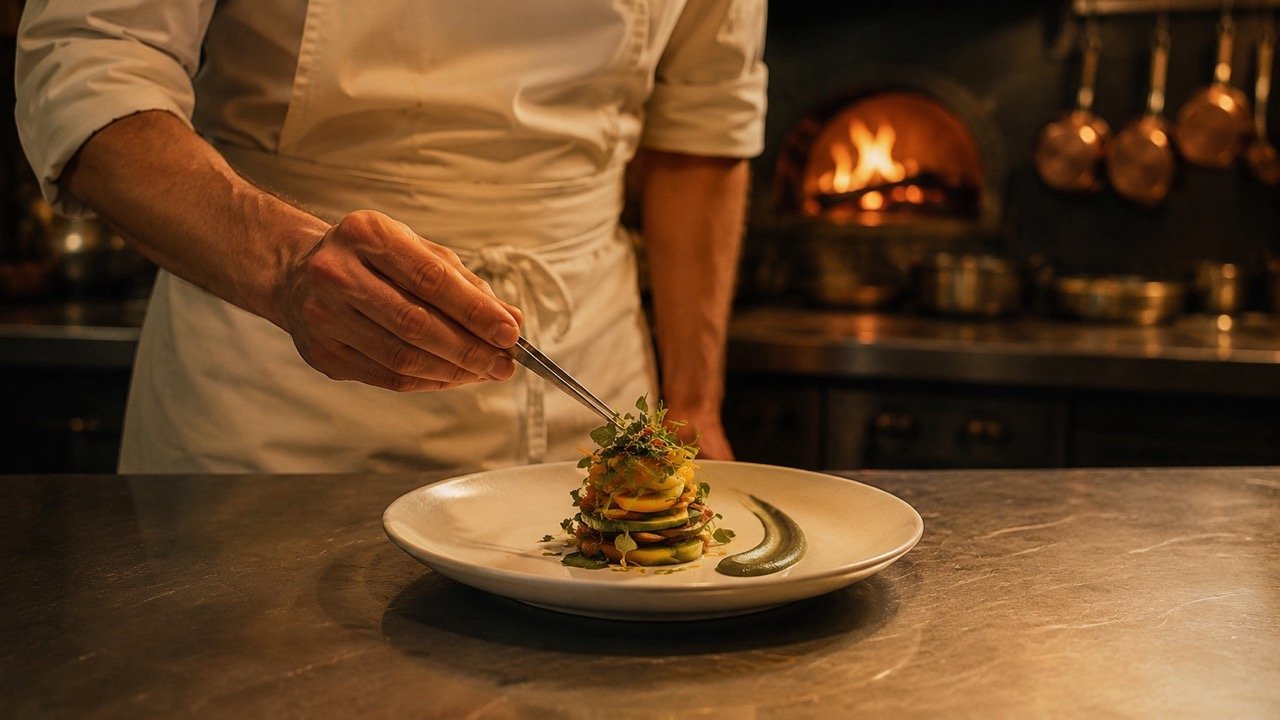
Ask a serious cook what Sydney food is doing right now and you will hear several things at once. Fire. Fermentation. The coast. Something Japanese at the structural level, not just at the level of garnish. A return to the table as the site of conviviality rather than performance. These are the currents running through the kitchens that matter, and the question any genuine culinary observer must answer is which rooms are most honestly, most ambitiously translating these currents into something coherent on the plate.
The era of Sydney fine dining as pure European transplant is long finished. What has replaced it is more interesting and considerably harder to define: a sensibility shaped by proximity to extraordinary marine produce, by a generation of cooks trained partly in Japan and partly in fermentation cellars in Scandinavia, by the arrival of native botanicals into the mainstream, and by a particular kind of casualness that is not laziness but rather a studied refusal to be precious. The best restaurants in this city right now serve extraordinary food in rooms that feel like they belong here, to this light, to this harbour-edged latitude.
These are the kitchens making the argument most forcefully.
Ester, Chippendale
Ester has been making its argument since 2013, and the argument has not aged. Mat Lindsay’s kitchen at 46-52 Meagher Street in Chippendale operates from a wood-fired hearth with the kind of unwavering focus that separates the genuinely committed from the merely fashionable. The fire here is not aesthetic choice — it is a governing philosophy. Everything passes through heat in a form that compels attention to timing, temperature, and the precise moment when a vegetable or a piece of meat makes the transition from raw material to something transformed.
The room is pared back to the point of severity: exposed brick, timber, a bar that anchors the space. The food is equally unadorned in its presentation but dense with consideration. A dish of vegetables from the wood oven arrives carrying a smokiness that reads as Mediterranean but tastes unmistakably Australian — the herbs different, the bitterness more present, the acidity from ferments that Lindsay has been building for years. The wine list is among the city’s most considered, drawn from natural and minimal-intervention producers across Australia and the old world, organised not by region but by what they taste like, which is the appropriate way to do it.
Ester is the ur-text of what Sydney cooking looks like when it stops apologising for not being somewhere else.
46-52 Meagher Street, Chippendale. Dinner Wednesday to Saturday, lunch Saturday and Sunday. ester-restaurant.com.au
Poly, Surry Hills
If Ester is the thesis, Poly — Lindsay’s second room, occupying the ground floor of the Paramount House building on Commonwealth Street — is the corresponding essay written in a more vernacular register. The fire is still present; the produce still demands attention. But Poly moves faster, thinks in smaller plates, and keeps space for the kind of spontaneous, unrepeatable evening that the best wine bars make possible.
Head chef Isabelle Caulfield, formerly sous chef at Ester, has made the kitchen her own. The menu shifts continuously with what the fire and the season allow: oysters prepared with something fermented and bright; a cut of lamb that has clearly been thought about before it arrived at the grill; bread that justifies its own arrival. Sommelier Julien Dromgool’s list reflects the same intelligence as Ester’s, but the context here is a glass at the bar rather than a considered dinner — which means you can encounter a remarkable grower Champagne or a skin-contact Sicilian white without committing to anything other than the next hour.
The building’s courtyard and the bar’s openness to walk-ins makes Poly one of the city’s rare genuinely democratic rooms at this level: you can plan it, or you can simply arrive.
74-76 Commonwealth Street, Surry Hills. Dinner Tuesday to Sunday. polysurryhills.com.au
Sixpenny, Stanmore
Daniel Puskas opened Sixpenny at 83 Percival Road in Stanmore in 2012, in a quiet residential strip a long way from the harbour, and the location was always intentional. The restaurant’s conversation is with the suburb, with the unhurried rhythm of a neighbourhood that has no interest in performance. Over thirteen years, Sixpenny has become the most serious fermentation-led fine dining room in the country, a kitchen that has been quietly doing what Noma made internationally legible but in its own accent and from its own soil.
The current tasting menu — seven courses, Wednesday to Saturday — is a document of time and patience. Fermentation here is not garnish; it is the primary flavour language. A lamb rack finished with beeswax, lavender, and fermented milk sauce arrives as a genuinely strange and coherent thing: you taste care expressed through months of preparation, not just the hour before service. Marron in coral trout butter carries the coastal specificity that marks Sydney’s best seafood cooking, the kind of dish that could only be made here because the ingredients only exist at this quality here.
Puskas works alongside head chef Tony Schifilliti, and the collaboration has matured into something that feels less like a restaurant with a philosophy and more like a philosophy that happens to need a room to be expressed.
83 Percival Road, Stanmore. Dinner Wednesday to Saturday. sixpenny.com.au
LuMi Dining, Pyrmont
Federico Zanellato arrived from Italy via Noma and Attica and opened LuMi at Wharf 10 on Pirrama Road in Pyrmont in 2014, and what he has built there has no direct precedent in Australian fine dining. The Italian warmth, the Japanese precision, the glass-walled room above the water with the city visible on three sides: these are the coordinates. But the food is its own entity, shaped by more than a decade in which Zanellato has slowly discarded reference and arrived at something genuinely personal.
The eight-course dinner is contemporary Italian in the most expansive sense — pasta technique from generations of Emilian nonne, seasoning intelligence from time in Japan, a willingness to let Australian produce define the flavour register. Gambero Rosso International named LuMi the best Italian restaurant in the world in 2019, which was a characteristically useful misclassification: it is not best understood as an Italian restaurant but as the expression of a chef who has Italian as his primary culinary language and fluency in several others.
The room’s relationship with the harbour — the light shifting through service, the city reflected in the water at night — makes LuMi one of the few Sydney restaurants where the setting and the food achieve a genuine parity of ambition.
56 Pirrama Road, Pyrmont. Lunch and dinner. lumidining.com
Nour, Surry Hills
Nour at Shop 3, 490 Crown Street occupies a different position in this map: where the other rooms on this list are examining Australian produce through various international lenses, Nour is bringing contemporary Sydney intelligence to the most ancient culinary tradition of the eastern Mediterranean. The Lebanese-Australian cooking here is not fusion in any synthetic sense — it is the expression of a community and a cuisine that have been present in this city for more than a century, finally given a room and a kitchen ambitious enough to do them justice.
The woodfired oven dominates the open kitchen, and the smoke from it carries into the dining room in a way that is part of the pleasure. The menu moves through mezze and wood-fired mains with a coherence that comes from genuinely knowing the tradition rather than sampling it. The tuna tabbouleh rethinks a canonical dish without diminishing it; the wood-fired eggplant achieves the charred, yielding, complex thing that is eggplant cooked properly; the scallops demonstrate that Lebanese spicing and Sydney seafood were always waiting to find each other.
That Nour holds a hat in the Good Food Guide is less interesting than what it represents: the arrival of the Lebanese culinary tradition into the permanent firmament of Sydney’s most serious dining, which took too long but feels inevitable now that it has happened.
Shop 3, 490 Crown Street, Surry Hills. Lunch Thursday to Sunday, dinner daily. noursydney.com
On What Sydney Cooking Has Become
The through-line connecting these five rooms is not fire, though fire is present in all of them. It is a coherent sense of place — a refusal to be a facsimile of somewhere else — that has become the defining quality of serious Sydney cooking in this decade.
For forty years, the ambition of the Australian fine dining kitchen was to equal Paris or Tokyo. The ambition now is different and arguably more demanding: to produce something that could only have been made here, with these ingredients, in this climate, by people who grew up eating this food and training in those kitchens. The comparison point shifts from whether it is as good as Europe to whether it is as honest as the place it came from.
This is harder work. It requires knowing not just how to cook but why this particular way of cooking belongs to this particular city. The rooms above are the ones making that argument most convincingly, in language that is specific, personal, and unrepeatable.
The Sydney table, at its best, is now a Sydney table.