
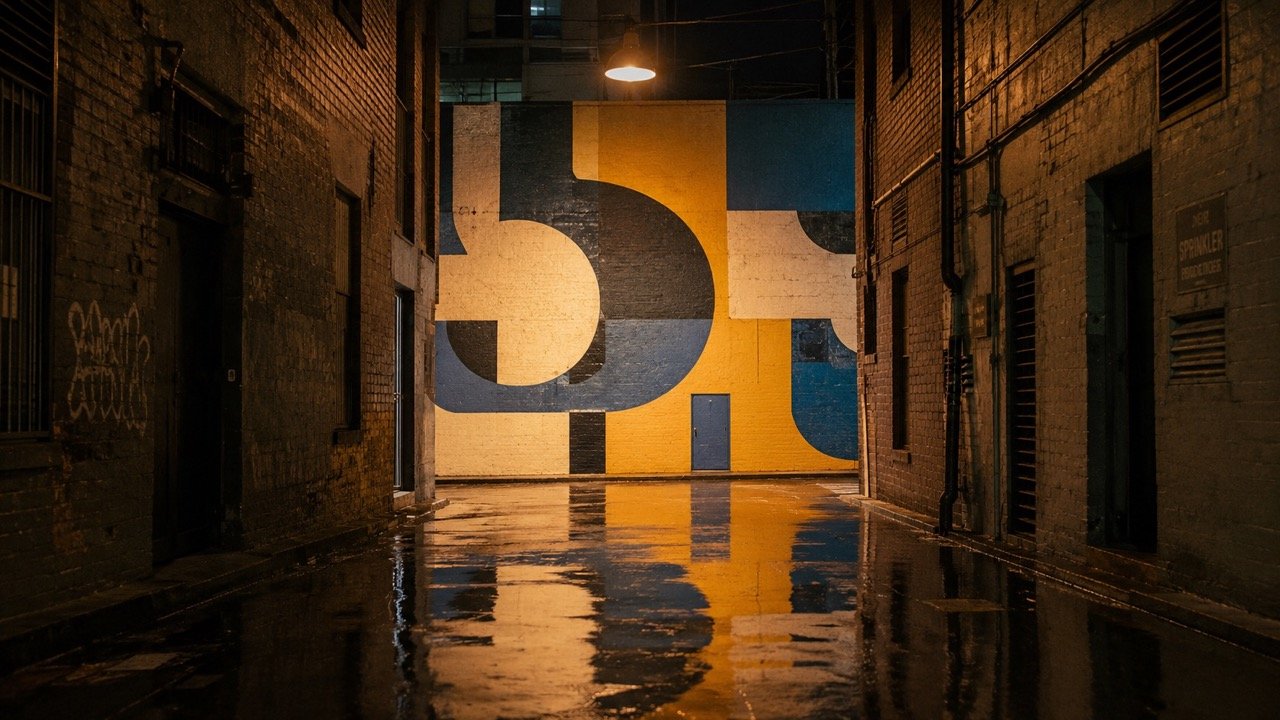
The distinction between street art and public art is not primarily legal or institutional — it is one of intentionality and permanence. A mural commissioned by a developer, approved by a council, and executed with scaffolding over three weeks occupies a different category from a piece painted in the three hours before dawn, regardless of which produces the more interesting image. Sydney contains serious examples of both, and the cultivated viewer does neither tradition any favours by conflating them, nor by treating one as inherently superior to the other. The most useful approach is to look at each work in its context — the wall, the street, the precinct, the community — and to ask what it is doing there and what it understands about the space it occupies.
Sydney’s public art landscape has been shaped by three overlapping forces over the past forty years: the grassroots tradition of the inner west, beginning in Newtown and Redfern in the 1980s; the institutional commissioning programmes of major urban development projects, most significantly Barangaroo; and the deliberate curation of precincts like Chippendale’s Kensington Street, where heritage industrial buildings have been treated as a canvas for contemporary art at scale. Each of these traditions has produced significant work, and each requires a different mode of attention.
Kensington Street, Chippendale
When the Chippendale precinct began its transformation in 2015, the developers behind the Old Clare Hotel and the surrounding buildings took a decision that was unusual in Australian urban development: they treated the walls of the heritage-listed industrial streetscape as an art programme rather than an advertising surface. The result is a concentrated collection of large-scale works — some commissioned specifically for the street, others installed in the adjoining gallery spaces and creative studios — that has made Kensington Street one of the most seriously considered street art environments in the country.
The physical structure of the precinct rewards attention. The working-class terrace facades and former brewery walls offer surfaces of genuine character: worn brick, patinated render, the specific texture of buildings that have absorbed a century of Sydney weather. When artists are given these walls rather than neutral painted surfaces, the work has something to respond to. Several pieces in the precinct demonstrate this understanding: the mural on the western end of Kensington Street uses the brick’s natural colour as a fourth tone in a limited palette, the work reading differently at different times of day as the light across the facade changes. Visit in the morning for one reading; return in the late afternoon for another.
Kensington Street, Chippendale. kensingtonstreet.com.au
The Redfern Tradition: Reko Rennie and The Block
In December 2012, Kamilaroi artist Reko Rennie led a series of workshops with young Aboriginal artists from the Redfern community, and the result — a transformation of the remaining Victorian terrace at the corner of Caroline and Hugo Streets — has become the most significant piece of Indigenous public art in Sydney. The work, known as "Welcome to Redfern," covers the building at 36 Caroline Street in vibrant geometric abstraction drawn from Rennie’s Kamilaroi visual language, alongside imagery of inspiring Aboriginal leaders. The scale and the precision of the execution — this is not folk muralism but gallery-level work at street scale — made it immediately clear that Rennie was operating in a register that transcended the category of "street art."
Rennie’s practice raises the fundamental question about First Nations public art in an urban context: what does it mean for a Kamilaroi artist to claim a building at The Block, which is to say, to claim a specific site of Aboriginal urban history in Australia’s largest city, through a visual language derived from his own country? The answer is not purely aesthetic but political and territorial, and the work becomes richer when understood in that full context. It is not decoration. It is occupation, in the most affirmative sense of that word.
The surrounding streets of Redfern contain additional layers of this history — the 40,000 Years mural along the Lawson Street bridge, painted in 1983 and now heritage-listed, operates as a kind of ancestor work in relation to Rennie’s more recent intervention, and the two are worth seeing in sequence.
36 Caroline Street, Redfern
Barangaroo: Commission at Civic Scale
The public art programme at Barangaroo represents the most formally ambitious institutional commissioning in recent Sydney history, and its results are instructive about what civic-scale public art can and cannot do. The German artist Sabine Hornig’s "Shadows" — 170 metres of photographs of indigenous Sydney flora layered in multi-coloured glass across the walkway connecting the International Towers — works as an act of ecological memory, pressing the built environment back toward the landscape that preceded it. The effect is subtle at first glance, more powerful on extended looking: the layering of plant photography and transparent colour produces moiré effects as you move through the space, the fixed image becoming dynamic through your own motion.
The Ghost Net Collective’s installation in Exchange Square — hand-stitched eagle rays from the Torres Strait appearing to rise from the harbour floor — is more overtly narrative and more easily legible, and that legibility is part of its function: this is art for the street, not the gallery, and the Collective understand that a work must earn its audience’s attention rather than presume it. The piece succeeds because it is technically extraordinary — the scale of the stitchwork, and the knowledge of the sea creature being rendered, are both evident to any close looking.
Barangaroo precinct, between Hickson Road and the western foreshore. barangaroo.com
Newtown and Erskineville: The Living Archive
The stretch of King Street and its tributaries in Newtown constitutes the longest continuously evolving street art archive in Australia. Works have appeared and been painted over and appeared again since the early 1980s, and several survive as heritage objects: Andrew Aiken and Juilee Pryor’s 1991 "I Have a Dream" mural, depicting Martin Luther King Jr. alongside the Aboriginal flag and the earth, is now heritage-listed — an act of institutional recognition that both validates the tradition and creates an interesting question about when street art ceases to be street art and becomes public monument.
The more interesting practice, for those who engage with it seriously, is tracking the ongoing work in the industrial laneways behind King Street — Wilford Lane, Phillip Lane, Thurnby Lane — where artists including Phibs, Fintan Magee, and Scottie Marsh have produced large-scale works that reward the kind of attention usually reserved for gallery visits. Magee in particular works with a painterly naturalism that makes his pieces immediately identifiable: his figures occupy their walls with the same weight and vulnerability that characterises the best social realist painting.
Inner West laneways. Begin at Wilford Lane off King Street, Newtown.
On Looking at Public Art Seriously
The time of day matters as much as the work itself. A mural in raking morning light and the same piece under flat afternoon cloud are two different objects. Several of the Barangaroo works are designed specifically for the quality of harbour light — they read very differently at dusk, when the refracted warmth from the water creates a chromatic environment that changes their colour relationships.
Resist the photograph. The first impulse in front of a significant mural is to photograph it. The photograph will always be worse than the experience of standing before it, and it will always be better than the memory of the photograph. The most useful discipline is to look before you photograph, and to look again after.
The wall is part of the work. The best street artists understand the specific character of the surface they are working on — its texture, its existing colours, its orientation to the sun. Work that ignores its substrate is decoration. Work that responds to it is art.
Read the commission. For Barangaroo and Kensington Street, the curatorial framework behind the commissions is available online. Reading it before the visit changes what you see — not by telling you what to think, but by revealing what the artist and curator were thinking, which is different information and often more useful.