
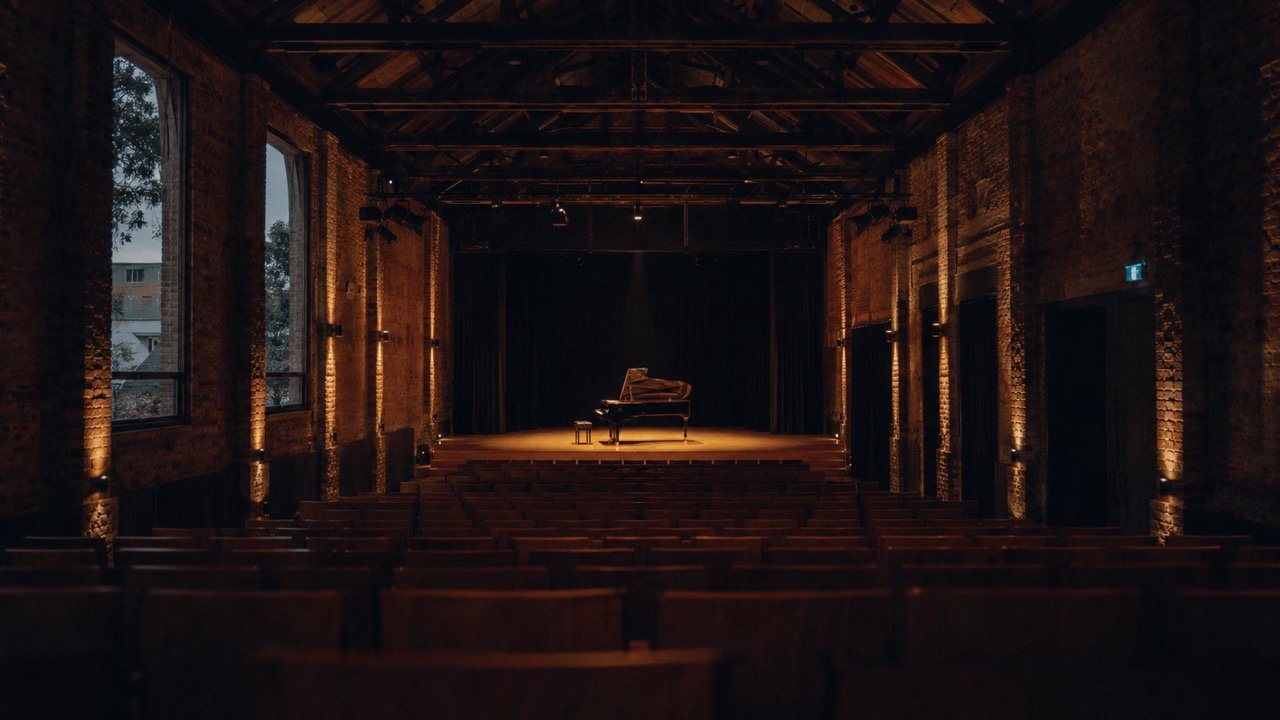
A great concert hall is a musical instrument — not a metaphor, but an acoustic fact. The dimensions of the room, the angle of its walls, the material of its surfaces, the height of its ceiling: all of these determine what the performers on stage can hear of themselves and each other, what the audience in the middle stalls hears versus what the audience in the rear balcony hears, and whether the reverberation that follows each note serves the music or drowns it. The best halls in the world — the Großer Musikvereinssaal in Vienna, the Concertgebouw in Amsterdam, the Symphony Hall in Boston — share a characteristic shoebox geometry and a reverberation time of approximately 2 seconds for a full audience, a number refined through centuries of European hall-building before the science of architectural acoustics existed to explain why it worked.
Sydney’s acoustic infrastructure is more recent but more thoughtful than the city’s youth might suggest. The Opera House Concert Hall, after its 2022 renewal, now delivers what it always promised visually — an extraordinary relationship between architecture and sound. The City Recital Hall at Angel Place, purpose-built in 1999, was the first serious concert hall in the country designed from first principles with acoustic performance as the primary brief rather than an afterthought. Together, they constitute a serious claim on the repertoire of the world’s finest listening rooms, and they are supported by a culture of programming — particularly the chamber music tradition — that has been building in Sydney for longer than most of the city’s inhabitants know.
City Recital Hall, Angel Place
The hall was designed with one purpose, which is unusual. Not a multipurpose arts centre, not an auditorium adapted for music — a hall for solo recitals, chamber music, and the spoken word, designed with Arup Acoustics in close consultation with Musica Viva Australia, the Australian Chamber Orchestra, and the Sydney Symphony. The shoebox form, directly inspired by the great nineteenth-century European halls, creates the specific acoustic characteristic that chamber music demands: the 1.8-second reverberation time measured in an empty hall (shorter with a full audience, as bodies absorb sound) that gives a string quartet the time to breathe around each note without the wash drowning the detail.
The engineering beneath this is precise and invisible. The entire auditorium sits on rubber bearings to eliminate the transmission of street vibration — Angel Place is busy, and without this isolation, the low-frequency rumble of the CBD would infiltrate every pianissimo passage. The air conditioning and lighting systems have been treated to minimise their own acoustic signatures. The banners that hang in the upper volume of the hall are deployed or retracted depending on whether the programming is acoustic or amplified, adjusting the reverberation time between regimes. In 2024, a 360-degree spatial sound system from d&b Soundscape was installed, extending the hall’s capacity for contemporary and electroacoustic programming without compromising its classical acoustic.
The seat to seek is in the middle stalls, between rows G and N, slightly off-centre toward the left if the concert is string-focused: the first violin section will project most directly toward the right stalls. For piano recitals, dead centre at row K is among the finest listening positions in Australia.
2 Angel Place, Sydney CBD. cityrecitalhall.com
Concert Hall, Sydney Opera House
The 2022 renewal was the most significant intervention in the Concert Hall since Jørn Utzon’s original structure was completed in 1973, and it addressed the acoustic problems that had plagued the hall since its opening — the acrylic "donuts" suspended above the stage that reflected sound irregularly, the sightline issues, the lack of intimacy between stage and audience. The replacement of those reflectors with eighteen purpose-designed acoustic "petals" — finished in the same magenta as Peter Hall’s original seat upholstery, in a direct conversation with the existing interior — transformed the hall’s acoustic behaviour. Where the old reflectors bounced sound, the petals distribute it, the diffusion producing the even coverage across the auditorium that the venue’s architectural grandeur had always demanded but never quite achieved.
The stage itself was lowered by 400 millimetres, reducing the physical and psychological distance between the Sydney Symphony and its audience. The result, for the first time, is a Concert Hall that feels like a room for listening rather than a room for observing. Simone Young, who took over as the Symphony’s chief conductor in 2023 — the first woman to hold the position — has programmed the renewed hall with a combination of canonical orchestral work and more adventurous contemporary commissions, the programming reflecting a conviction that a great orchestra must simultaneously maintain the repertoire and expand it.
Bennelong Point. sydneyoperahouse.com
The Utzon Room, Sydney Opera House
The same building contains a listening room of an entirely different scale and purpose. The Utzon Room — designed by Jørn Utzon himself as part of his return engagement with the building he had been forced to abandon in 1966 — is a 200-person space designed for the intimate encounter between audience and performer that the Concert Hall, by its scale, cannot achieve. The room faces the harbour through a glass wall of Utzon’s distinctive tapestry design, and performances in the Utzon Music series, curated by musician and programmer Genevieve Lacey, take place on Sunday afternoons from February through November, placing the audience in a direct relationship with music from France, Iran, Japan, Sweden, and elsewhere, performed with the specificity that the intimate room demands.
The Utzon Music series, now in its eighteenth edition, has developed into one of the most curatorially coherent chamber music programmes in the country. The combination of transcendent acoustic intimacy, harbour views, and programming that routinely features Australian debuts and first-time collaborations makes it the most reliably rewarding concert experience in Sydney — and among the least known to those outside the classical music community.
Bennelong Point. Programming at sydneyoperahouse.com/utzon-music
On the Art of Serious Listening
Arrive early enough to sit still. The most common failure of concert-going is arriving too close to the start to settle. The transition from the street — its noise, its demands — into a state of genuine receptivity takes ten minutes at minimum. Arriving with time to sit in the silence before the musicians appear is not pedantry; it is preparation.
The specific quality of silence. Great concert halls, particularly the City Recital Hall, have a specific quality of silence — the cessation of background noise that reveals what was masked. Spending a few moments in this silence before a concert begins is an act of acoustic calibration: the ear adjusts, the attention sharpens, and the first sound the musicians produce lands in a context of real quiet rather than relative quiet.
Programme notes as score. The programme note is not supplementary reading — it is the score for the non-musician. The best programme notes (the Sydney Symphony and Musica Viva both commission serious writing) offer structural maps of the works being performed: what to listen for, where the surprises lie, what the composer was doing in the third movement that departs from convention. Reading them changes what you hear.
The chamber music society tradition. Musica Viva Australia, which presents touring chamber ensembles at the City Recital Hall and around the country, has been operating since 1945 and represents the deepest roots of Sydney’s serious listening culture. A subscription to a Musica Viva series is among the most concentrated musical educations available in the city — not because the programming is conservative, but because it is consistent and curatorially principled.
After the concert. The conversation that follows a serious concert is part of the experience. The specific combination of wine and argument about what was just heard — the disagreements about tempo, the discoveries about programme juxtaposition — is one of the pleasures of the serious concert-going community that cannot be replicated in solitary listening at home, however good the recording. Sydney’s concert-going culture, particularly around the Angel Place precinct, has its post-performance rituals; finding them is part of joining it.