
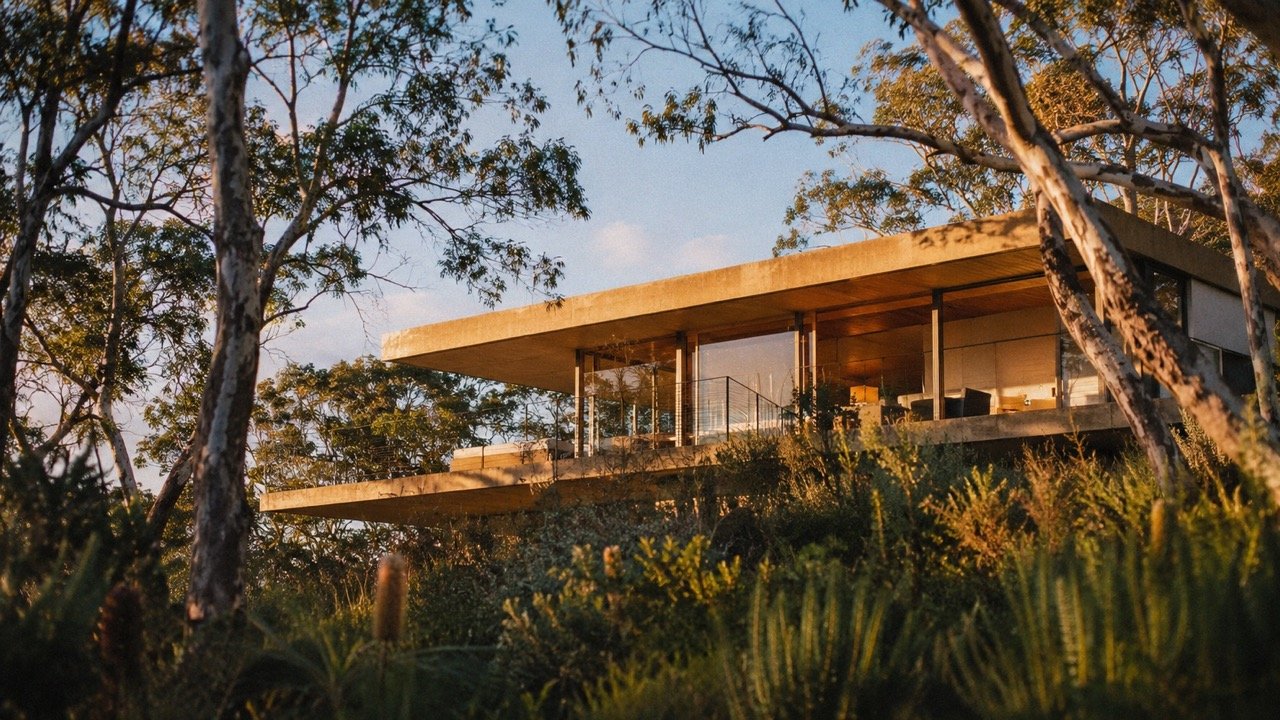
There is a specific quality of light in Sydney that modernist architecture meets better than any other tradition. It is a hard, lateral light that arrives from the north and east, strips away shadow when it hits a flat plane, and creates deep recesses where concrete overhangs. The European post-war modernism that Harry Seidler brought to Australia in 1948 — filtered through his training with Walter Gropius at Harvard and Marcel Breuer in New York — was in some fundamental way better suited to this latitude than to the grey Northern European climate it was developed in. The white concrete glows. The cantilevers cast dramatic shadows. The geometry is clarified by a sun that never apologises for its angle.
Understanding Sydney’s built environment requires understanding at minimum four figures: Jørn Utzon, who was commissioned to make a symbol and instead made a civilisation; Harry Seidler, who brought international high modernism to a city that barely knew what it was; Walter Burley Griffin and Marion Mahony Griffin, who designed a suburb as a manifesto; and Glenn Murcutt, who won the Pritzker Prize for houses almost nobody would ever visit. Together, they describe a relationship between architectural ambition and Australian landscape that remains the defining conversation in this city’s built fabric.
Harry Seidler: The Modernist in Full
Seidler’s Sydney is concentrated downtown and in the immediate environs, but its radius is wide. Australia Square in the CBD — completed in 1967 with the Italian structural engineer Pier Luigi Nervi — was the city’s first genuinely modern high-rise, a circular tower whose public plaza represented a radical proposition for a city accustomed to buildings that met the footpath and nothing more. The tower occupies only a fraction of its site; the rest becomes public space, which was an act of civic generosity unusual in Australian commercial development. The building still commands attention, and standing beneath it at the plaza level, looking up through the circular shaft of the tower to the sky above, you understand immediately that Seidler was working with space, not just structure.
The MLC Centre on Martin Place, completed in 1978, is the more formally complex achievement. The octagonal tower and its associated public spaces demonstrate Seidler’s debt to the Brutalist tradition while exceeding it in civic intelligence: the ground level opens to the street with galleries, a theatre, and public passageways that remain among the most sophisticated retail and civic spaces in the city. Blues Point Tower in McMahons Point — visible from almost any point on the harbour, and controversial since its 1962 completion — is Seidler in a more combative mode, a slab of residential modernism inserted into a leafy north shore promontory with all the deference of an argument. Its defenders, among whom connoisseurs of modernism are now increasingly numerous, point to the visual tension Seidler deliberately built into the window pattern: a rhythm that makes the building appear to vibrate slightly from a distance.
The Horizon in Darlinghurst, completed 1998 — his last major Sydney project — demonstrates that Seidler’s formal intelligence never diminished. The 43-storey residential tower’s scalloped facade is shaped not for aesthetics but to give as many apartments as possible an oblique view of the harbour. This is modernism in its most proper sense: form derived from function at the service of human experience.
Australia Square, 264 George Street CBD. MLC Centre, 19-29 Martin Place, CBD. Blues Point Tower, Blues Point Road, McMahons Point. The Horizon, 184 Forbes Street, Darlinghurst. All accessible exteriors.
Jørn Utzon and the Opera House: Beyond the Postcard
The Sydney Opera House has been photographed so many thousands of times from so many identical positions on Circular Quay that the building has become a logo before it is experienced as architecture. The serious visitor must find ways to see it that strip away familiarity and restore the original shock.
Utzon entered the 1957 competition as a relatively unknown Danish architect and won with drawings so technically unresolved that the engineering establishment initially dismissed them as unbuildable. What he submitted was not a technical proposal but an idea: a building that would arrive from the water as though growing from it, whose forms would be legible from any distance and at any scale, whose podium would lift performance above the harbour like the Mayan platforms he had studied in Mexico. This is the crucial source: in the late 1940s Utzon had visited the temples at Chichen Itza and understood that the platform — the deliberately elevated base that separates the sacred space from the surrounding ground — was the primary architectural gesture. The Opera House’s massive podium, the monumental steps, the way the shells rise from this plinth as though placed rather than built: all of this derives from a civilisation that Utzon understood as solving the same problem of how a building announces itself in an open landscape.
The shell vaults, whose geometry was only resolved years after the competition win, are derived from sections of a single sphere of constant radius — Utzon’s great insight that turned the unbuildable into the constructable. They are not shells in the marine sense, though the coastal association is irresistible; they are interlocking vaults of precast concrete tile whose self-cleaning Swedish ceramic tiles change colour through the day from cream to grey to luminous white. Walk the broadwalk at dusk and watch the transition; it is one of the finest effects in world architecture.
Bennelong Point, Sydney Harbour. Tours available daily. sydneyoperahouse.com
Walter Burley Griffin at Castlecrag
An hour from the CBD on the Lower North Shore, the suburb of Castlecrag remains the most intact demonstration of Walter Burley Griffin’s vision of architecture in genuine relationship with the Australian bush. Griffin — who with his wife Marion Mahony Griffin won the 1912 competition to design Canberra — purchased the Castlecrag peninsula in 1921 and spent fifteen years attempting to build a community in which houses would not merely coexist with the sandstone and native vegetation but emerge from it.
The fifteen Griffin houses that survive in Castlecrag are small by contemporary standards, built from local sandstone or prefabricated Knitlock concrete blocks, with flat roofs and internal courtyards that demonstrate a profound spatial intelligence about how light moves through a building in this climate. They sit in the landscape without announcing themselves; you could walk past several without registering them as architecturally significant, which is precisely the point. Marion Mahony Griffin’s drawing style — the extraordinary coloured renderings she made for the Canberra competition, which many historians now consider the primary visual intelligence behind her husband’s work — deserves more attention than it receives in the story of what happened at Castlecrag.
The Castlecrag walking tour organised by the Australian Institute of Architects is the proper introduction to the precinct; the houses themselves remain private residences, and the respectful response to the suburb is to walk its streets with attention rather than to treat it as an open-air museum.
Castlecrag, Lower North Shore. The Castlecrag walking tour is periodically available through the Australian Institute of Architects.
Glenn Murcutt and the Architecture of Touch
Glenn Murcutt has never built a tower or a cultural institution. He works alone, as a sole practitioner, primarily on private houses, mostly in rural New South Wales. He won the Pritzker Prize in 2002, becoming the first Australian to do so, for work that the prize committee characterised with the phrase ‘touch the earth lightly’ — Murcutt’s own formulation for an architecture that responds to landscape and climate with a kind of listening intelligence rather than imposing upon them.
His houses are difficult to visit in the conventional sense; they are private homes, not public buildings. But his influence in Sydney is felt indirectly in the generation of architects who trained under him or in his philosophical orbit. The Marie Short House in Kempsey, the Ball-Eastaway House at Glenorie on Sydney’s outskirts, the Arthur and Yvonne Boyd Education Centre at Riversdale: these are the texts from which a Sydney architectural education reads his contribution. The principle — that a building should be inseparable from its site, that the direction of prevailing winds and the angle of winter sun should determine the cross-section of a wall — represents an architecture as discipline and as environmental argument that has never been more relevant.
Collins and Turner, the Sydney studio founded in 2002, represents the most interesting current work in the city that draws on this lineage: their Barangaroo House and residential projects demonstrate a similar intelligence about how buildings meet the ground and respond to the specific quality of Sydney light, applied now to contexts Murcutt himself rarely occupied.
How to Walk This Inheritance
The essential architectural tour of Sydney requires no guide and no entrance fee for most of its subjects. Begin at Circular Quay and approach the Opera House from the west broadwalk, with the Harbour Bridge framing the right side of your view. Walk the podium fully before entering; the exterior is a complete argument. Cross to the CBD via Cahill Expressway and find the Australia Square plaza — stand at its centre and look up. Walk through the MLC Centre on Martin Place and understand what a properly designed urban interior feels like. Cross the Harbour to McMahons Point by ferry and look back at Blues Point Tower from the water, where its scale and presence read correctly.
Then take a train to Castlecrag, or a day to read about Murcutt in the Pritzker documentation, available at pritzkerprize.com. Architecture is an art most people never look at. Sydney, for those paying attention, is among its finest galleries.