
The conversation about First Nations art in Australia has never been more consequential, and Sydney sits at its centre for reasons that are simultaneously historical and contemporary. The city stands on Gadigal Country, the easternmost reach of the Eora Nation, and the relationship between that foundational fact and what has happened on this land over the past two hundred and thirty-five years shapes every engagement with First Nations culture here. The art that emerges from this context — from this specific intersection of ancient knowledge and contemporary form — is among the most significant being made anywhere in the world, and the institutions and galleries that represent it range from the publicly important to the genuinely visionary.
This is not a subject that tolerates vagueness or goodwill without knowledge. The question of how to engage seriously with First Nations art — what to know before you enter a gallery, what questions to ask, how to understand the provenance and community context of what you are looking at — demands the same kind of preparation that engagement with any complex cultural tradition demands. The reward is access to an artistic inheritance of extraordinary depth and, in its contemporary expressions, an urgency that challenges comfortable assumptions about what art is for.
The Art Gallery of New South Wales: The Yiribana Gallery
The AGNSW’s Yiribana Gallery — the name means "this way" in the Sydney language of the Gadigal people — is located at street level in the new building that opened as part of the Sydney Modern expansion in 2022. Its ground-floor position is architecturally and philosophically significant: the gallery that had occupied a basement level in the old building has been moved to the most visible and accessible location in the expanded institution. This shift of physical emphasis reflects a deeper reorientation of the gallery’s sense of what its First Nations collection represents.
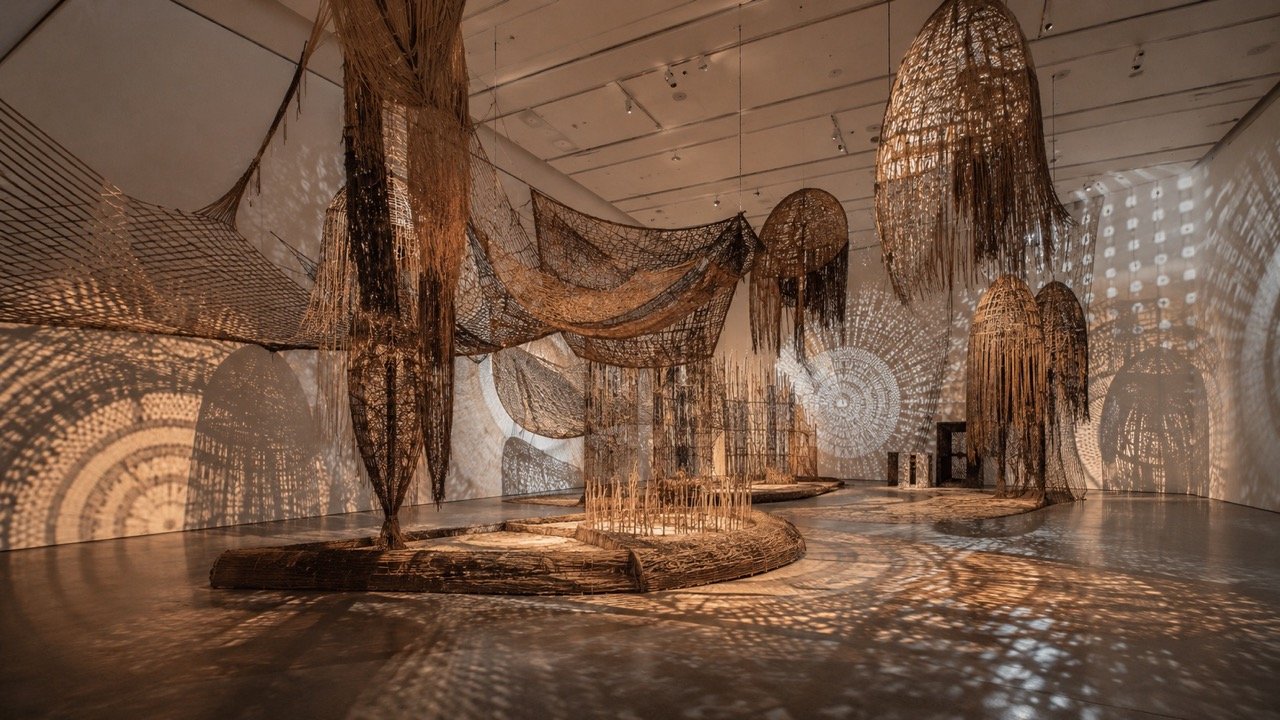
The gallery now contains over 160 works, including significant commissions created for the new building. Lorraine Connelly-Northey’s Narrbong-galang (many bags) — fabricated from reclaimed and rusted wire and metal salvage, referencing the possum-skin bags of Wiradjuri Country — occupies the full twenty-metre length of the Yiribana window in a work of formidable presence. The salvaged metal is the point: Connelly-Northey transforms industrial waste into objects that reference a pre-colonial material culture, making both histories visible at once.
The permanent collection includes Clifford Possum Tjapaltjarri and Tim Leura Tjapaltjarri’s monumental Warlugulong (1977) — a work of almost hallucinatory complexity that maps the Dreaming stories of the Anmatyerre people in a visual language that requires sustained attention to begin to read. Lin Onus’s Fruit Bats (1991), with its suspended colony of bats hanging from a Hills Hoist — that most Australian of suburban objects — demonstrates the deadpan wit and formal intelligence with which this generation of artists worked the collision between traditional imagery and contemporary Australian life.
Art Gallery Road, The Domain. Open daily. Admission free for the permanent collection. artgallery.nsw.gov.au
Boomalli Aboriginal Artists Co-operative, Leichhardt
Boomalli is the oldest Aboriginal-owned and operated arts organisation in Sydney, and its position in Leichhardt since 1987 has made it an anchor institution for urban Aboriginal art across nearly four decades. Its founding in 1987 by ten artists — among them Tracey Moffatt, Michael Riley, and Bronwyn Bancroft, each of whom has achieved significant national and international recognition — was a deliberate act of cultural self-determination: a space in which Aboriginal artists could exhibit and work on their own terms, governed by their own community, without the mediation of non-Indigenous institutions.
The name — which translates in Bundjalung, Gamilaroi, and Wiradjuri as "to strike; to make a mark" — is a precise statement of purpose. The gallery at 55-59 Flood Street operates a Co-operative structure in which senior artists support and mentor emerging artists, creating a generational transmission of both technical knowledge and cultural context that institutional galleries cannot replicate. The current membership of approximately fifty artists spans generations, geographies, and styles, from works deeply rooted in Country-based traditional forms to rigorously contemporary practice engaging with politics, technology, and urban experience.
Engaging with Boomalli properly means understanding that the gallery is not a commercial entity in the conventional sense — it is a community resource, and purchasing from it supports an ecosystem of artistic practice rather than simply acquiring an object. This distinction matters, and the gallery’s staff are equipped to explain it.
55-59 Flood Street, Leichhardt. boomalli.com.au
The MCA and Contemporary First Nations Practice
The Museum of Contemporary Art Australia at Circular Quay has, over the past two decades, developed one of the most ambitious First Nations programming strategies of any contemporary art museum in the country. The MCA’s approach — integrating First Nations works throughout the collection and programming rather than quarantining them in a dedicated space — reflects a curatorial philosophy that insists on the contemporaneity and formal ambition of First Nations art rather than treating it as a cultural heritage category distinct from contemporary practice.
The institution’s work with artists including Richard Bell, Vernon Ah Kee, and the Karrabing Film Collective has brought political urgency and formal radicalism into the museum’s permanent dialogue in ways that continue to challenge both the institution and its audience. Bell’s conceptual practice — his paintings that interrogate the framing of Aboriginal art within the international art market, his interventions into the question of whose knowledge owns what — represents a form of institutional critique that operates from within the tradition it critiques. This is sophisticated work that requires a sophisticated audience.
140 George Street, The Rocks. Open daily. mca.com.au
On the Ethics of Collecting First Nations Art
The question of collecting First Nations art is one that responsible collectors engage with seriously, and the ethical framework around it is more developed than in most other collecting areas.
Provenance and community benefit. The most important question a collector can ask is whether the work comes through a community-controlled art centre or a gallery with a verifiable and transparent relationship with the artist’s community. The network of community art centres in remote Australia — from Papunya Tula Artists (Western Desert) to Buku-Larrŋgay Mulka (Yirrkala, Arnhem Land) — operates with the dual purpose of sustaining artists economically and maintaining the integrity of cultural knowledge within the work. Purchasing from these centres or from galleries with direct relationships to them means that money flows back to communities and that cultural context is preserved.
AIATSIS and the research obligation. The Australian Institute of Aboriginal and Torres Strait Islander Studies in Canberra is the national authority on First Nations culture, heritage, and cultural practice. Its collections, its guidelines on cultural authority and copyright, and its research resources represent the most serious starting point for any collector who wants to understand what they are engaging with beyond the visual surface of the work.
The copyright question. Australian copyright law protects individual artistic authorship but has historically struggled with the question of communal cultural knowledge expressed through individual work. This is an ongoing legal and ethical conversation; collectors should understand that the value of a First Nations work is often inseparable from the cultural knowledge it carries, and that this knowledge belongs to a community rather than to the individual artist alone.
On style tourism. The danger of engaging with First Nations art at the level of visual pattern — collecting dot paintings because they look good above a sofa — is that it extracts the object from the knowledge system that gives it meaning. The more you know about what a specific work means in its cultural context, the more completely you can appreciate it as an aesthetic object. These are not competing forms of appreciation; they reinforce each other in any serious engagement.
The best galleries in Sydney working with First Nations art — Boomalli, the major institutions, and the handful of commercial galleries with genuine community relationships — are equipped and willing to have these conversations. The invitation to ask is always open.