
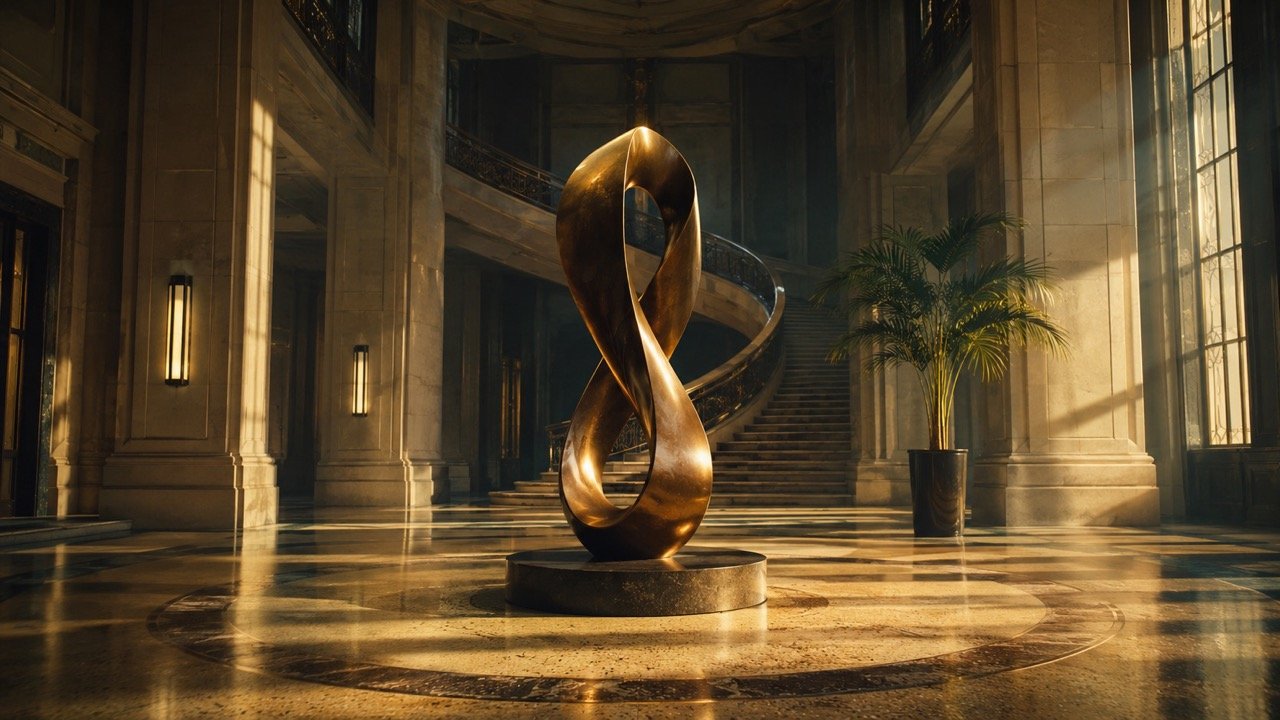
The lobby is the first argument a hotel makes about itself. It announces, in spatial terms, what the house values, what it thinks its guests deserve to encounter on arrival, what kind of experience it intends to provide before a key is handed over. The hotels listed below have made that argument through art and architecture of genuine quality — through commissions, collections, and spatial decisions that would warrant attention even without the rooms above.
Several of these spaces can be visited without a reservation. The art is not reserved for guests. The public lobby of a serious hotel is one of the most accessible galleries in any city, and Sydney’s finest are exceptional examples of the form.
Park Hyatt Sydney: Art on the Harbour
The Park Hyatt’s harbour-edge position — with the Opera House occupying the view from every water-facing room — provides a curatorial challenge that its design team has met with intelligence: the exterior context is so significant that the interior must either compete or redirect. The Park Hyatt redirects.
The lobby programme features a rotating selection of works from established and mid-career Australian artists, managed with the care of a private collection rather than a hotel decorator’s brief. Sculptures occupy specific positions in the main lobby that have been calibrated for sight lines and light. Works on paper, which deteriorate under sustained lighting, are rotated more frequently than the main collection pieces. The team can speak to specific works on request — ask at the concierge.
The best time to encounter the lobby as an art space is mid-morning on weekdays, when the space is between check-out and check-in and the light from the harbour fills the room without the competing activity of a busy arrival period.
7 Hickson Road, Walsh Bay. Open to public in lobby areas. sydney.park.hyatt.com
The Fullerton Hotel, Sydney CBD
The Fullerton occupies the former General Post Office — Edmund Blacket’s sandstone building on Martin Place, completed in 1874, one of the finest Victorian civic buildings in Australia. The adaptive reuse — converting postal sorting rooms, public halls, and exchange spaces into hotel rooms, restaurants, and event spaces — has been executed with a genuine care for the original building that hotel conversions of historic structures rarely achieve.
The art programme works with rather than against the architecture. Significant works are positioned in the original public halls where the scale is appropriate — large-format paintings in rooms with four-metre ceilings, sculpture in the main postal hall that commands the floor space the building always implied it should occupy.
The clock tower access — intermittently available for guests and visitors through the hotel’s cultural programming — provides a perspective across the Martin Place precinct that reveals the extraordinary quality of the original urban sequence: Blacket’s GPO, Seidler’s MLC Centre, the Victorian commercial buildings that survived the twentieth century’s enthusiasm for clearing them.
1 Martin Place, Sydney CBD. Lobby open to visitors. fullertonhotels.com
Capella Sydney, CBD
Capella opened in the former Department of Education building on Bridge Street, a landmark sandstone building completed in 1876 and expanded significantly in the early twentieth century. The conversion has produced Sydney’s most architecturally significant new hotel of the current decade, and the art programme reflects the ambition of the property.
The hotel worked with a dedicated art consultant to develop a collection that is specifically Australian in its focus — First Nations works, contemporary Australian painting, and photography placed in dialogue with the building’s heritage fabric. The approach throughout is that the art should feel inevitable in its placement rather than installed: a First Nations bark painting in a room whose sandstone walls carry the same geological logic; a contemporary abstract canvas that echoes the ceiling heights.
The main staircase of the heritage building — retained in full and lit through a new skylight above — is one of the finest interior spaces in the city. The collection of small sculptures and objects placed along the stair run rewards slow climbing.
Bridge Street, Sydney CBD. Lobby open to visitors. capellahotels.com/sydney
The Langham, Sydney
The Langham’s Sydney property occupies a 1900s building in the CBD that has been transformed through significant investment into a hotel whose public spaces function as a coherent interior design argument. The art collection — focused on works that respond to the building’s Edwardian-heritage architectural character — includes pieces from the nineteenth and twentieth centuries alongside contemporary commissions.
The Palm Court — a light-filled interior courtyard that serves afternoon tea — is the lobby-adjacent space that rewards the longest visit. The architectural restoration here is unusually faithful, and the way afternoon light enters through the glass canopy produces a quality of illumination that the original architects would have recognised.
Afternoon tea at the Palm Court provides legitimate extended access to the space. The pastry programme is sufficiently good to warrant the visit independently of the architectural tourism.
89–113 Kent Street, Sydney CBD. langhamhotels.com/sydney
Amora Hotel Jamison, CBD
The Amora Jamison is the least prestigious hotel in this guide and the one that rewards the most specific kind of attention: the architectural detail of the building itself, rather than any art programme overlay. The heritage conversion — of a 1930s commercial building with extraordinary Art Deco lift lobbies and terrazzo floors maintained in near-original condition — produces public spaces that any serious architectural enthusiast will find worth visiting.
The lifts, in particular, deserve sustained attention. The original bronze-and-enamel lift car interiors, preserved from the building’s commercial-office period, are of a quality of decorative craftsmanship that has no equivalent in contemporary Australian production.
11 Jamison Street, Sydney CBD.
On the Art of the Hotel Visit
A brief note for those who have not formed the habit of visiting hotel public spaces as a cultural practice.
The lobby is public space. There is no admission charge, no dress code (within reason), and no obligation to consume. Walking into a significant hotel lobby with the expressed intent of looking at the art is entirely acceptable behaviour and is, in most cases, welcomed by hotel teams who have invested in their collection precisely to be seen.
The most productive approach: identify two or three pieces that warrant extended looking, then ask a member of the lobby or concierge team about them. The response will indicate quickly whether the collection is curated or merely decorated, and at the hotels listed above, it will produce a conversation of genuine quality.