
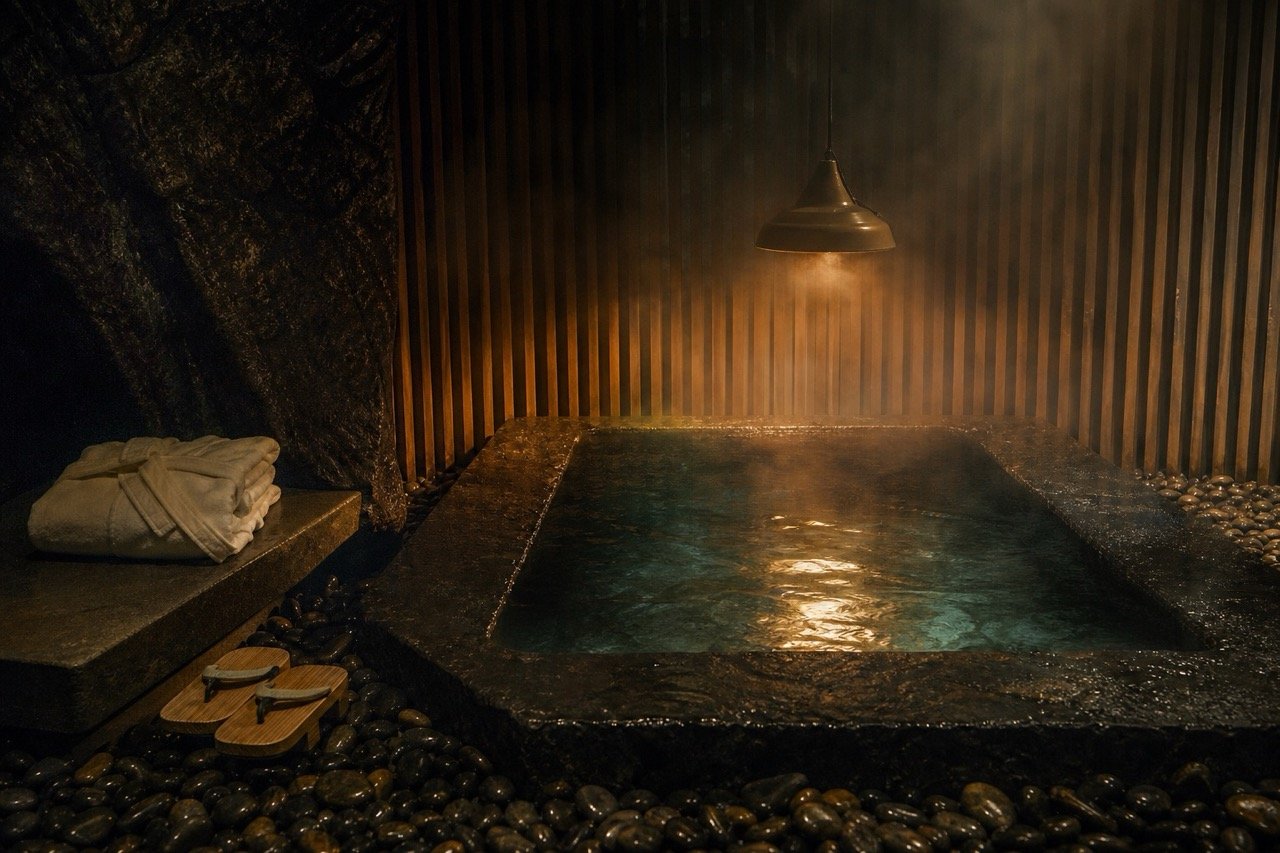
The Japanese have a word, 湯治 (toji), for the practice of travelling specifically to immerse in healing waters — a medical and contemplative tradition that predates formal medicine and persists alongside it. The distinction between onsen and sento is not merely geographical: an onsen draws its water from a geothermal source and is categorised by its mineral content under Japanese law; a sento is a public bath heated artificially, historically the neighbourhood facility of an urban community before household plumbing. Both traditions share the same fundamental understanding: the body is not cleaned in a Japanese bath. It is first cleaned, separately and thoroughly, then immersed. The bath itself is for immersion, for heat, for the specific stillness that water at 40 degrees produces in the nervous system. You do not wash in it. You dissolve into it.
This distinction — the pre-soak wash, the clean entry into communal or private water, the understanding that the heat is treatment rather than comfort — is what separates the Japanese bathing tradition from everything else the wellness industry has subsequently attempted to appropriate from it. The philosophy is egalitarian and unsentimental: in the traditional mixed onsen, nakedness is mandatory and social hierarchy is suspended. What you enter the water as is what you are in the water. Sydney cannot fully replicate this tradition — the city lacks the geothermal geology and, for the most part, the cultural intimacy required for true communal nudity — but several serious practitioners have built experiences worth understanding within that context.
Capybara Bathing, Surry Hills
Capybara, at 235 Commonwealth Street, draws on the broadest possible understanding of communal bathing — Japanese sento, Russian banya, Korean jjimjilbang, Moroccan hammam, Mayan temazcal — and assembles them into a form that makes sense in a Sydney context without impersonating any single tradition. The space is built around a mineral-infused communal bath set to 38 degrees, a hot stone sauna reaching 90 degrees, a lounge with a warm bench and ice station, and a cold plunge pool. The sequence is not arbitrary: the progression from warm to hot to cold and back, done correctly, produces a profound vasodilatory response that the Japanese call 温冷浴 (on-rei-yoku) — alternating heat and cold bathing — and which has measurable effects on circulation, inflammation, and sleep quality.
The atmosphere at Capybara is deliberately contemplative. The materials — cedar, mineral tile, natural light filtered through deep apertures — create an environment that discourages the phone and encourages the long look at the water. Additional programming includes Watsu aquatic therapy, guided breathwork, and sound bath experiences for those who want to extend the practice beyond the physical. A 90-minute session at $65 is not the cheapest wellness expenditure in Sydney, but it is among the most physiologically serious.
235 Commonwealth Street, Surry Hills. Mon–Fri 8am–9pm, Sat–Sun 8am–7pm. capybarabathing.com.au
Arisoo Spa, Paddington and Chatswood
Arisoo practices the Korean bathhouse tradition — technically distinct from the Japanese but sharing the same fundamental philosophy about the separation of washing and bathing, and the medicinal value of heat. The Korean tradition emphasises the때밀이 (ddaemiri) body scrub — a vigorous exfoliation performed by a trained therapist using a coarse Korean washcloth — and the sequence of herbal baths at different temperatures. Arisoo is women-only at both its Paddington and Chatswood locations, which allows for the full undress that genuine bathhouse culture requires and that mixed facilities rarely achieve.
The 39-degree herbal bath at Arisoo is the anchor experience. The specific herb blends used in Korean bathing — mugwort, pine needle, ginger, persimmon leaf — are not decorative additions but a pharmacological tradition refined over centuries, the herbs selected for their specific effects on circulation, skin tone, and the lymphatic system. The dry barrel sauna at Chatswood operates at temperatures that most Western spas would consider extreme; the Korean understanding is that the intensity of the heat is not the enemy of relaxation but its precondition.
Paddington: 495A Oxford Street. Chatswood: contact for address. arisoospa.com.au
Soak Bathhouse, Alexandria
Opened at 25 Bourke Road, Alexandria in 2025, Soak brings a more architecturally considered version of the bathhouse experience to the inner west. The design — a contemporary interpretation of the Nordic and Japanese bathing traditions — focuses on the quality of the water experience rather than the ancillary wellness programming. The mineral pools are calibrated to specific temperatures, the cold plunge is maintained at a temperature that produces the physiological response rather than merely discomfort, and the transition spaces between hot and cold are treated as part of the experience rather than corridors between facilities.
The Alexandria location operates from 6.30am, which permits the pre-work immersion that is, in fact, the most effective way to use a serious bathhouse: the heat and the cold stimulate the sympathetic nervous system in a way that produces clarity and focus, rather than the post-work soporific effect of evening bathing. The early morning at Soak has a specific quality — the light not yet harsh, the pool still and steaming, the city not yet fully assembled — that rewards the early riser in ways that are difficult to replicate in any other Sydney context.
25 Bourke Road, Alexandria. Mon–Thu 6.30am–10pm, Fri–Sun 6.30am–midnight. soakbathhouse.com.au
The At-Home Japanese Bath: A Protocol
The Japanese domestic bath ritual is not a luxury. It is a daily practice, and its simplicity is part of its design. To practice it at home in Sydney:
The temperature. Japanese bathing water is hot: 40–43 degrees Celsius. Most household hot water systems require adjustment to achieve this. A bath thermometer is the first purchase. Below 38 degrees is warm water, not bathing water.
The pre-soak wash. The body is washed thoroughly before entering the bath, in the shower. The bath is entered clean. This is non-negotiable in the Japanese understanding.
The additives. The Japanese practice of 入浴剤 (nyūyokuzai) — medicinal bath additives — has a specific pharmacological basis. Hinoki cypress essential oil or shavings produce the forest fragrance associated with high-end ryokan bathing and contain phytoncides with demonstrated antimicrobial properties. Epsom salt (magnesium sulphate) at 250 grams per bath is supported by evidence on transdermal magnesium absorption. Yuzu — the Japanese citrus — is used at winter solstice (the 冬至 toji, a homophone of the therapeutic travel term) in a tradition as old as the Edo period: the oils in the rind release into the water and perfume both the bath and the body.
The duration. Ten to fifteen minutes at 42 degrees is the Japanese standard. Longer soaks at lower temperatures produce lethargy. Shorter periods at higher temperatures, followed by a cool shower, produce the specific, clean tiredness that precedes good sleep.
The hinoki tub. For those with the means and the inclination, a hinoki cypress soaking tub — available from Japanese import specialists — is the single material object most likely to transform the experience. Hinoki releases its forest oils into warm water, and the wood ages beautifully with use. It is a craftwork, not a convenience: maintenance requires care, and the object rewards it in kind.