
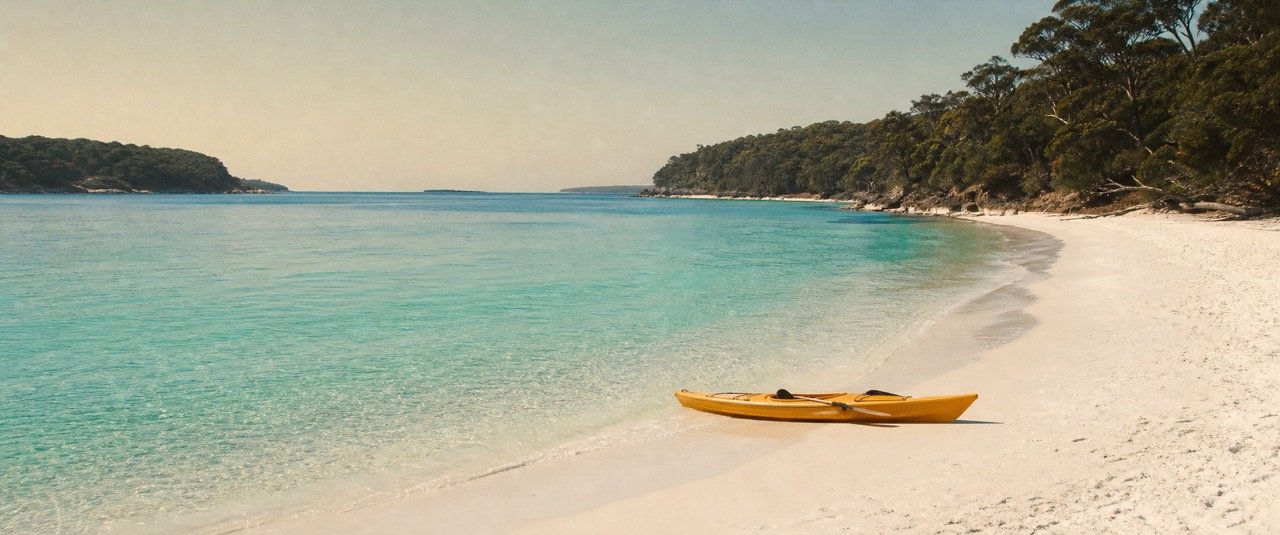
The sand at Hyams Beach has been tested and classified as the finest white quartz on earth — the silica particles so pure, so precisely formed, and so thoroughly separated from any impurity by the geological processes of the Shoalhaven that they reflect light rather than absorbing it, making the beach luminous even on overcast days and almost unbearably brilliant under direct sun. This is not marketing language but measurable fact. The same sand that makes the beach visually extraordinary also makes the bay exceptional: the silica does not muddy the water, creates no turbidity, and the result — in combination with the bay’s relative shelter from ocean swell — is water of a blue-green clarity that has no equivalent on Australia’s east coast and few precedents anywhere in the temperate world.
These physical facts about Jervis Bay are worth stating plainly, because the destination’s reputation as a family holiday spot has obscured what is actually there. The bay — 180 kilometres south of Sydney, two and a half hours by car — contains one of Australia’s finest marine parks, the most significant stand of coastal rainforest in New South Wales, world-class temperate diving, and a quality of silence, particularly on the Booderee National Park side, that is increasingly rare anywhere within a day’s drive of a capital city. The question is not whether Jervis Bay competes as a destination. It is whether the visitor has the orientation to receive what it offers, and whether they have found accommodation and dining commensurate with that orientation.
The Geography: Two Sides of One Bay
Jervis Bay is a drowned valley — a river system that was inundated by rising seas at the end of the last ice age, leaving a deep, sheltered embayment surrounded by the specific ecology of the NSW South Coast: spotted gum and Sydney blue gum forest, coastal heath in brilliant seasonal flower, the paperbark swamps and reed beds of the bay’s shallower inner shore. The bay divides administratively into two parts: the Booderee National Park side, which constitutes the southern headland and is managed jointly by Parks Australia and the Wreck Bay Aboriginal Community, and the Vincentia-Huskisson side, which carries the commercial infrastructure of the region.
The distinction matters. On the Booderee side — the Bherwerre Peninsula — the development pressure has been held at bay by the national park status, and the result is a coastal environment of extraordinary integrity: beaches accessible only on foot, forested headlands with no structures visible, the specific quality of a place that has not been curated for convenience. Cave Beach, reached from the national park campground by a forty-minute walk through coastal heath, is one of these: a beach with sandstone sea caves at its southern end, accessible at low tide, surrounded by nothing but the park, the sky, and the water. The walk itself, through heath studded with flannel flowers and banksia in season, rewards the attention of anyone who knows what Australian botanical diversity looks like.
On the Huskisson-Vincentia side, the town has matured in recent years into something genuinely useful — accommodation, dining, and marine services at a standard that would have been hard to find here a decade ago.
Where to Stay: SALT Beach House, Vincentia
SALT Beach House at Vincentia represents the most considered accommodation proposition in the region — a luxury beach house positioned seven minutes from Hyams Beach and a three-minute walk from Collingwood Beach, operating in the register of the finest private rental properties in Australia. The house functions as a withdrawal in the fullest sense: designed for a small group who want the bay’s extraordinary environmental endowments without the motel character that still defines much of the region’s accommodation stock.
The logic of staying in Vincentia rather than Huskisson is the access it provides to both the Booderee side of the bay and the town facilities. From Vincentia, the drive to the Cave Beach trailhead takes twenty minutes through the park; the walk to Collingwood Beach takes three. The specific quality of the south-facing Vincentia beaches — calmer, less visited than Hyams, the water achieving the same extraordinary blue-green at lower tide — rewards those who take the time to explore beyond the most photographed destinations.
Where to Dine: The Gunyah at Paperbark Camp
The Gunyah Restaurant sits on a raised timber platform in the paperbark forest at 571 Woollamia Road, Huskisson — a candlelit room in the canopy, open to the forest on three sides, the specific smell of paperbark and damp earth rising from below. It is the most atmospheric dining room within a long drive of Sydney, and it has earned that atmosphere through serious cooking. The kitchen uses native ingredients with genuine knowledge rather than tokenism: lemon myrtle, wattleseed, and bush tomato appear in preparations that understand their flavour profiles, and the protein is drawn from the finest local and regional producers — seafood from Jervis Bay Marine Park’s sustainable fishery, lamb from the Southern Tablelands, dairy from the South Coast’s exceptional pastures.
The Gunyah is open to non-resident guests for dinner, and a reservation here is as important as securing accommodation — the forest room fills quickly. The journey to the table, through the dark paperbark forest on a lit path, is itself a preparation: by the time you sit, the city has been thoroughly evacuated from the body.
571 Woollamia Road, Huskisson. Reservations essential. paperbarkcamp.com.au
The Diving: Temperate Water at Its Finest
Jervis Bay Marine Park contains more than thirty dive sites in waters that, despite their temperate temperature (between 16 and 22 degrees depending on season), host a marine diversity that bridges tropical and subantarctic species in a manner found at very few locations on earth. The confluence of the East Australian Current — bringing warm, tropical water southward along the coast — with the cooler inshore water of the bay creates an ecotone: a meeting zone between ecological regimes where species from both systems coexist, producing a density of life that is visually spectacular.
The specific claims of Jervis Bay diving: the endangered grey nurse shark population that gathers at several sites within the park, particularly accessible at Cathedral Cave; the eastern blue devilfish, found nowhere else in such numbers; the giant sponge gardens at deeper sites, where barrel sponges two metres in diameter have been growing for centuries; and the extraordinary visibility — routinely exceeding 20 metres, achieved through the same silica sand filtration mechanism that produces the white beaches above the waterline. Dive Jervis Bay in Huskisson provides guided diving and equipment hire for those without their own.
A Protocol for the Contemplative Visit
Arrive on a weekday, leave on a weekend. Jervis Bay’s quality is inversely proportional to its occupancy. Midweek, particularly outside school holiday periods, the bay returns to what it fundamentally is: a wilderness coast of extraordinary beauty, largely empty. On peak summer weekends, the compression of visitor numbers at Hyams Beach transforms the experience entirely.
Walk before you swim. The Cave Beach and Bherwerre Beach circuit through Booderee National Park is the most complete introduction to the bay’s ecology available to the ambulatory visitor. Allow three hours, carry water, and begin at dawn if you want the light on the beach at its most extraordinary.
The light at Jervis Bay is specific. The combination of white sand, clear water, and the bay’s southern orientation means the mid-morning light — roughly 8am to 11am — produces conditions of visual intensity that the afternoon cannot replicate. The water colour shifts from blue-green to deep cobalt after midday as the sun moves west. Both are beautiful. They are not the same.
The bay in winter. July and August bring humpback whale migrations into the bay’s sheltered water — Jervis Bay is one of the very few places in New South Wales where whales rest in calm conditions close to shore, the bay functioning as a nursery for mothers and calves mid-migration. The water is cold enough to require a wetsuit for diving, but the above-water experience — whale watching from the headlands at Point Perpendicular or from the Huskisson jetty — is among the most moving encounters with wild animals available in Australia.