
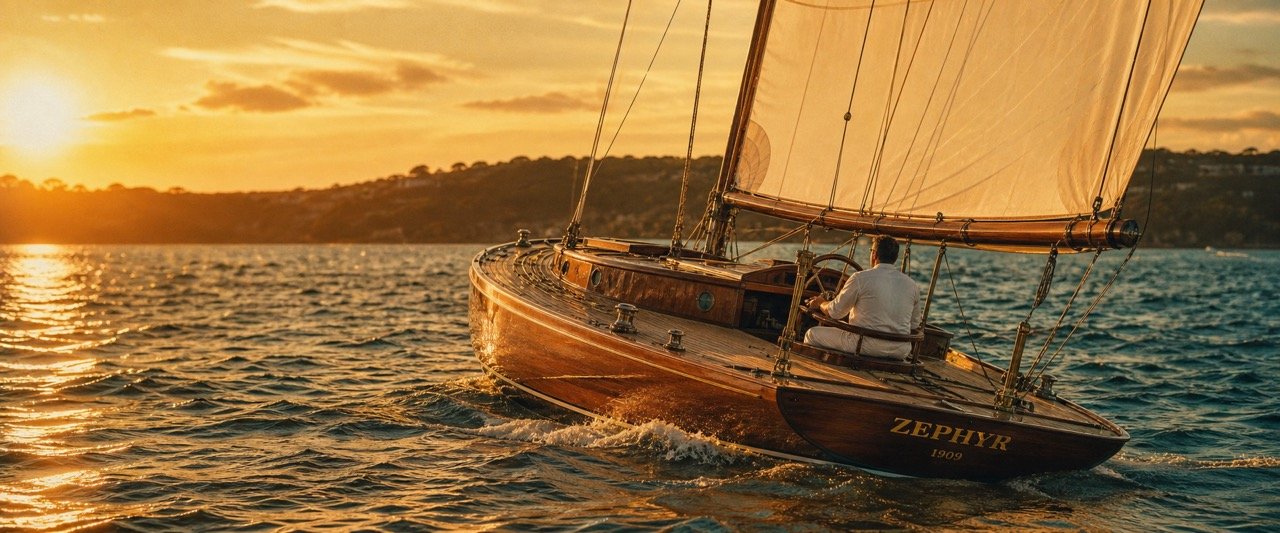
There is a theory, held by most people who have sailed Sydney Harbour, that the city is only fully intelligible from the water. From land, Sydney presents itself in fragments — the bridge as a destination, the Opera House as a postcard, the suburbs visible only as they face the water. From a boat under sail, it resolves into a single composition: the harbour as the central fact, the city as its eastern shore, the national parks as its northern and southern edge, and the open ocean beyond the Heads as the thing toward which all this geography has been pointing. This perspective changes people. Those who have sailed it rarely forget it; those who haven’t often live in the same city for decades without knowing what they’re missing.
Sydney Harbour — Port Jackson, to use its technical name — covers twenty-one square kilometres and extends thirteen kilometres from the Heads to the nearest tidal reaches at Parramatta. Its thirty-five subsidiary inlets, coves, and bays create a coastline of around 240 kilometres, which is why sailors who have been on it for years still discover reaches they haven’t entered before. The water is tidal and wind-affected; on a Tuesday morning in spring with a nor’easter building, the harbour can be a pleasure garden. On a Boxing Day afternoon with the southerly change coming through, it is one of the most demanding pieces of water in the world. Both conditions exist within the same harbour, sometimes within the same afternoon.
The Clubs: The Royal Sydney Yacht Squadron and the CYCA
Two clubs define the institutional culture of Sydney Harbour sailing, and understanding both is important for anyone who wants to engage seriously with the water rather than simply observe it.
The Royal Sydney Yacht Squadron at Kirribilli has occupied its waterfront site since 1862, making it among the oldest yacht clubs in Australia. The Squadron sits on the harbour’s north shore, roughly beneath the northern pylon of the Harbour Bridge, and its clubhouse looks directly across to the Opera House in a composition of some magnificence. The Squadron’s sailing programme includes a full calendar of keelboat and offshore racing, and while it operates as a private members club, the path to engagement — through introductions, a sailing programme, or provisional membership — is open to those who approach it seriously. The club’s heritage is formidable; its current membership includes some of the most accomplished offshore sailors in the country.
The Cruising Yacht Club of Australia at Rushcutters Bay occupies a different register. The CYCA is the organising body of the Rolex Sydney Hobart Yacht Race, which starts from the harbour on Boxing Day and represents one of the three most prestigious offshore races in the world. The CYCA at Rushcutters Bay faces north across the harbour with a marina that holds some of the finest blue-water yachts in the southern hemisphere. The club is more accessible than the Squadron in terms of new membership, and its programmatic calendar — including weekly twilight racing during summer, the Sydney Harbour Regatta, and extensive offshore training — makes it a genuine resource for the serious sailor who is new to the city.
Royal Sydney Yacht Squadron, 28 Kirribilli Avenue, Kirribilli. rsys.com.au Cruising Yacht Club of Australia, 1 New Beach Road, Rushcutters Bay. cyca.com.au
Chartering: The Water Without the Mooring
For those who want to sail the harbour without the logistics of ownership, the charter market in Sydney is extensive and ranges from crewed day boats to bare-boat keelboats available by the hour or the day. Fraser Yachts operates globally and offers a Sydney programme for those seeking crewed charter at the higher end — a day on the harbour in a properly staffed sailing vessel, with provisioning and guiding, for private events or simply for the experience. YATCO’s platform provides access to the full range of Sydney charter options from day-sailing to extended coastal cruising.
For those with sailing experience, bare-boat charter from marinas at Rushcutters Bay, Balmain, and the Spit bridge provides access to the harbour with a degree of independence that crewed charter cannot offer. An afternoon on a chartered keelboat, handling the boat yourself through the passages and coves that the ferries and cruise ships never enter, is among the finest forms of private engagement with the city that is available.
The sailing instruction market in Sydney is well-developed, and for those without existing qualifications, a Royal Yachting Association Day Skipper course — available through several harbour-based sailing schools — provides both the competence and the certification to bare-boat charter. The time investment of a long weekend is repaid across years of independent access to the water.
The Passages: Reading the Harbour Under Sail
The experience of entering Sydney Harbour from the ocean — rounding South Head at dawn on a passage from Melbourne or the Coral Sea, with the city gradually appearing through the Heads and then opening up like a held breath suddenly released — is one of the most celebrated arrivals in world sailing. The Heads themselves are significant water: the tidal race runs hard at springs, the swell refraction from the Pacific creates confused seas on incoming tides, and the passage between North Head and South Head, barely four hundred metres wide, compresses all of this into a few minutes of concentrated navigation.
Once through, the harbour opens. Sailing south from North Head, the first mark is Bradley’s Head — a sandstone promontory on the north shore with its lighthouse and the mast of HMAS Sydney visible as a war memorial on the hillside. Rounding Bradley’s Head on a port tack, with the city suddenly ahead and the Opera House shells appearing over the bow, is the moment most sailors describe as the single finest in Sydney sailing: the geometry of the building from the water is more beautiful than from any land-based position, and the scale is only legible when you are moving toward it at several knots from a mile off.
The passage between Garden Island and the ferry wharves of Circular Quay is narrow and fast with traffic; the experienced harbour sailor learns its rhythms — the Manly ferry on the hour, the hydrofoils from Circular Quay, the water taxis cutting across the lanes — and navigates with awareness rather than anxiety. Beyond this passage, the upper harbour opens toward Parramatta, and the quality of the water changes: quieter, less exposed, the suburbs pressing closer, the light more diffuse.
The most private sailing on the harbour is found in its coves and inlets: the Middle Harbour, accessible through the Spit Bridge, with its deep wooded shores and near-absence of traffic; Hunters Bay, off Middle Harbour, where the water is still enough to hear conversation on other boats; and Manly Cove itself, where the oceanside ferry terminal gives way to a calm anchorage at the harbour entrance that has one of the finest positions in world sailing.
The Calendar: When the Harbour Performs
Sydney’s sailing year follows a rhythm that the serious observer learns to read.
Summer twilight racing runs Wednesday evenings from October through April from both the Squadron and the CYCA. These races — typically on a short windward/leeward course in the eastern harbour — are among the best spectator sailing available anywhere: fast, well-attended, social, and occurring in the long evenings of an Australian summer when the light at six o’clock still falls at an impossible gold.
The Sydney Harbour Regatta, typically held in late February or early March, is the harbour’s biggest regular keelboat event, with over 150 boats racing across multiple divisions. The racing is visible from various foreshore vantage points, but the only way to properly understand its scale and speed is from a spectator boat in the thick of it.
The Rolex Sydney Hobart Yacht Race starts at 1pm on Boxing Day from Sydney Harbour — the fleet assembling at the start line between Clark Island and South Head, then making the parade down the harbour before crossing the start line, with hundreds of thousands of people watching from every available vantage point on both shores. The race itself takes the fastest boats approximately forty hours; what is not mentioned in most accounts is that watching the start from a spectator boat is one of the defining Sydney experiences, the city demonstrating what it looks like when its relationship with the water is given its most complete and competitive expression.
On What the Harbour Teaches
Those who sail Sydney Harbour develop a spatial intelligence about the city that land-based inhabitants never acquire. They understand where the wind accelerates around headlands and where it dies in the lee of tall buildings. They know that the harbour is always moving — tidal, wind-driven, temperature-stratified — and that reading it correctly is a skill acquired through years rather than weekends.
This knowledge is not practically useful to most people. But it produces a kind of ownership of the place that is among the deepest forms of belonging a city can offer. Sydney is a harbour city in the way that Venice is a canal city — remove the water and you have removed the thing that explains everything else. Those who sail it are, in some sense, reading the city in its original language.