
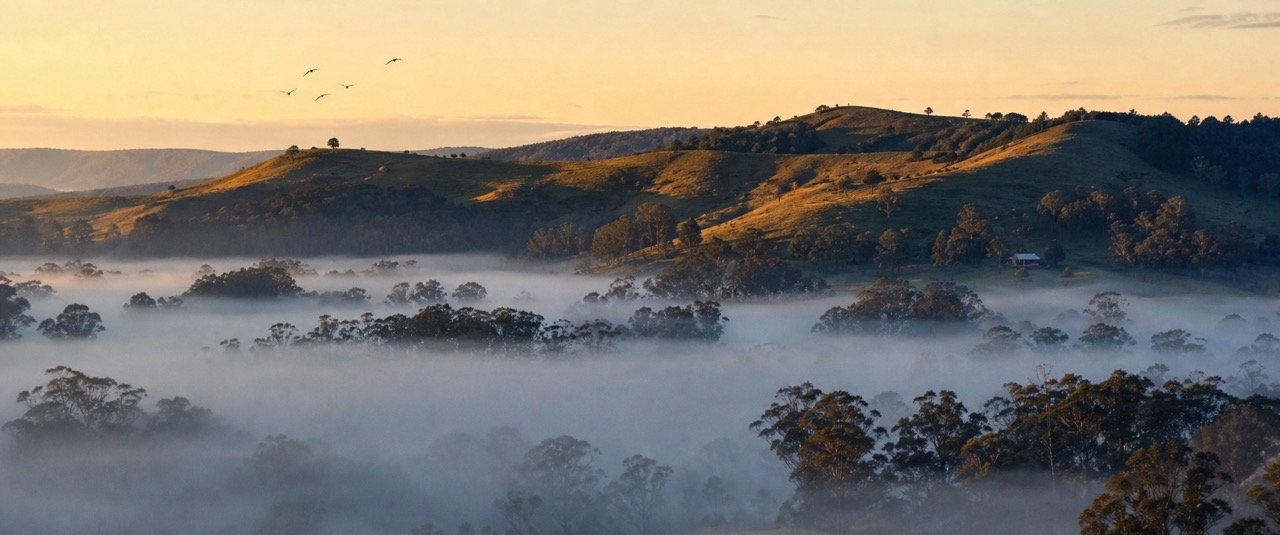
There are two ways to leave Sydney for a weekend. You can take the freeway south and arrive in the Southern Highlands two hours later — at Bowral or Mittagong, in a landscape of rolling paddocks and English garden villages that has been serving as Sydney’s weekend countryside for a century, and which shows the strain of that long service in its crowded accommodation, its booked restaurants, and its gradually diminishing sense of discovery. Or you can turn off before the plateau, descend the escarpment at Fitzroy Falls, and drop into Kangaroo Valley.
The descent is the point. The road falls through a series of steep switchbacks, the subtropical moisture rising to meet you as the altitude drops, the vegetation thickening from dry schlerophyll into something denser and more dramatic. By the time you reach the valley floor — the narrow strip of cleared dairy country that follows the Kangaroo River through its basalt and sandstone gorge — you are in a different microclimate, a different landscape register, and a different quality of silence. The Shoalhaven River system here runs through country that has been farmed since the 1830s but retains a wildness — the escarpment walls on both sides, the river flooding the road twice a year without apology — that the more accessible Southern Highlands lost long ago.
Kangaroo Valley is not undiscovered. Sydney’s creative class has been retreating here for decades, and the township knows what it has. But it remains genuinely quiet, genuinely small, genuinely resistant to the development that has softened the Highland villages into something resembling a themed retail precinct. The Friendly Inn has been serving travellers since the 1890s. The Hampden Bridge is still the only way in. Nothing here has been arranged for your convenience, which is, precisely, why it is worth the two hours.
The Arrival: Hampden Bridge and the Township
The Hampden Bridge at the entrance to the valley is the detail that distinguishes the arrival from any other country drive in New South Wales. Built in 1898 and named for Lord Hampden, the Governor of New South Wales at the time, it is the last surviving suspension road bridge from the nineteenth century in the state — a single-lane structure of timber deck and steel cable that crosses the Kangaroo River with a slight bounce under load, which concentrates the attention. It was the second suspension bridge built in New South Wales and is now on the state heritage register, an object of engineering history that most visitors cross twice and do not look at.
The township is a single main street of perhaps three hundred metres: the pub, two or three cafes, the general store, a bakehouse, and a collection of heritage buildings that have changed occupancy but not character over a century of commercial life. Maddison’s, housed in the former bank building with its striped awning and outdoor tables, does breakfast and lunch with the kind of relaxed competence that valley cafes at their best manage — eggs properly cooked, coffee that doesn’t require qualification. The Kangaroo Valley Bakehouse produces pies and bread on the premises daily, and the Hampden Deli, created by the fine-dining couple Nick Gardner and Stevie-Lee Bounader, offers the local produce — the cheeses, the cured meats, the preserves — in the form that Sydney visitors have been trained to find satisfying.
None of this is destination dining. But it is honest food in a beautiful place, and the lack of destination-level restaurant ambition is part of what makes the valley what it is.
Wildes Boutique Hotel: The Proper Base
The most considered accommodation in the valley is Wildes Boutique Hotel, which occupies a purpose-built property with the spatial generosity and attention to fit-out that distinguishes it from the holiday cottage market that dominates the valley’s accommodation landscape. The rooms are properly done — the kind of hotel room that neither over-decorates nor under-maintains, where the bed is at the right height and the bath is the right depth. The hotel’s restaurant, Wildes Dining, opens to non-residents and represents the valley’s most ambitious attempt at modern Australian cooking: local produce, Mediterranean influence, a kitchen that understands the difference between using local ingredients as a point of pride and actually building dishes around them.
The hotel’s position — in the valley proper, within walking distance of the township — means that the escarpment views are from one side of the property while the river paddocks are visible from another. This dual aspect is part of what Kangaroo Valley offers that few comparable landscapes provide: you are simultaneously in the gorge and on the valley floor, surrounded by a geography that is simultaneously intimate and vast.
Wildes Boutique Hotel, Kangaroo Valley. wildes.com.au
Fitzroy Falls: The Escarpment View
Fitzroy Falls — technically within Morton National Park, approximately fifteen kilometres from Kangaroo Valley township on the road back to the plateau — is the specific geography that explains the valley. The falls drop eighty-one metres from the edge of the Shoalhaven sandstone plateau into the gorge below, and from the main lookout you are standing on the escarpment rim looking down over a hundred-metre vertical face into dense temperate rainforest. The scale is genuinely vertiginous; the vegetation below is a different world from the open paddocks you have left.
The West Rim walking track from the visitor centre runs for approximately 3.5 kilometres along the escarpment edge with views into the gorge throughout. The walk is of easy to moderate difficulty, along a well-maintained path, with several lookout platforms that offer different framings of the same extraordinary view. The morning light, coming from the east and filling the gorge, is the time to be here; by midday the shadows have moved and the contrast is less dramatic. The visitor centre itself is well-resourced and provides botanical and geological context that rewards reading before the walk rather than after.
Fitzroy Falls Visitor Centre, Nowra Road, Fitzroy Falls. NSW National Parks. nationalparks.nsw.gov.au
Yarrawa Estate and the Valley’s Wine Character
That Kangaroo Valley has a winery is not obvious from the outside, but Yarrawa Estate — established by Susan and Mark Foster in 1998 at their property on the Upper Kangaroo River — produces wines that genuinely reflect the valley’s distinctive terroir: volcanic basalt soils, a temperate microclimate moderated by the escarpment, and a growing season that retains more moisture than the nearby coast or the drier Southern Highlands. The cellar door — which is literally the Fosters’ dining room — is open for tastings on weekends with the essential advance booking.
The chambourcin, a red variety unusual in Australian viticulture, performs particularly well in the valley’s conditions: a wine of medium weight with bright fruit and a slightly tannic edge that reflects the volcanic soil character. The verdelho is the white variety that has historically done best in the local conditions, with the broad, slightly tropical fruit profile that the variety produces in warm-maritime climates. The walnut liqueur wine — a local eccentricity pressed from the property’s walnut trees — represents either the estate’s most interesting departure from convention or its most appealing irrelevance, depending on your relationship with walnut.
Yarrawa Estate, Upper Kangaroo River Road. Weekends by appointment. yarrawaestate.com
On What Kangaroo Valley Is and Is Not
The case for Kangaroo Valley as a serious alternative to the Southern Highlands is not merely geographic — it is temperamental. The Highlands offer the pleasures of a well-serviced destination: good restaurants, established accommodation, a variety of activities calibrated for the visitor. The Valley offers something less polished and therefore more authentic: a genuine agricultural landscape that has not been transformed into a tourism product, a geology of considerable drama, and an absence of the weekend-in-the-country infrastructure that turns rest into a programme.
The visitors who return year after year to Kangaroo Valley are those who understand the specific pleasure of arriving somewhere that does not require a reservation for anything, of walking the escarpment rim without a guide, of driving the valley road in the morning when the mist is still on the paddocks and the dairy cattle are moving toward their feed. This is a landscape for people who know how to be still in it — which is, increasingly, a skill as rare and as worth cultivating as any other.
The drive back to Sydney is two hours through the Illawarra Escarpment, with the Pacific visible from the top of the descent and the city reappearing on the coastal plain as though you have been away for considerably longer than a weekend. This is the appropriate effect of a proper withdrawal.