
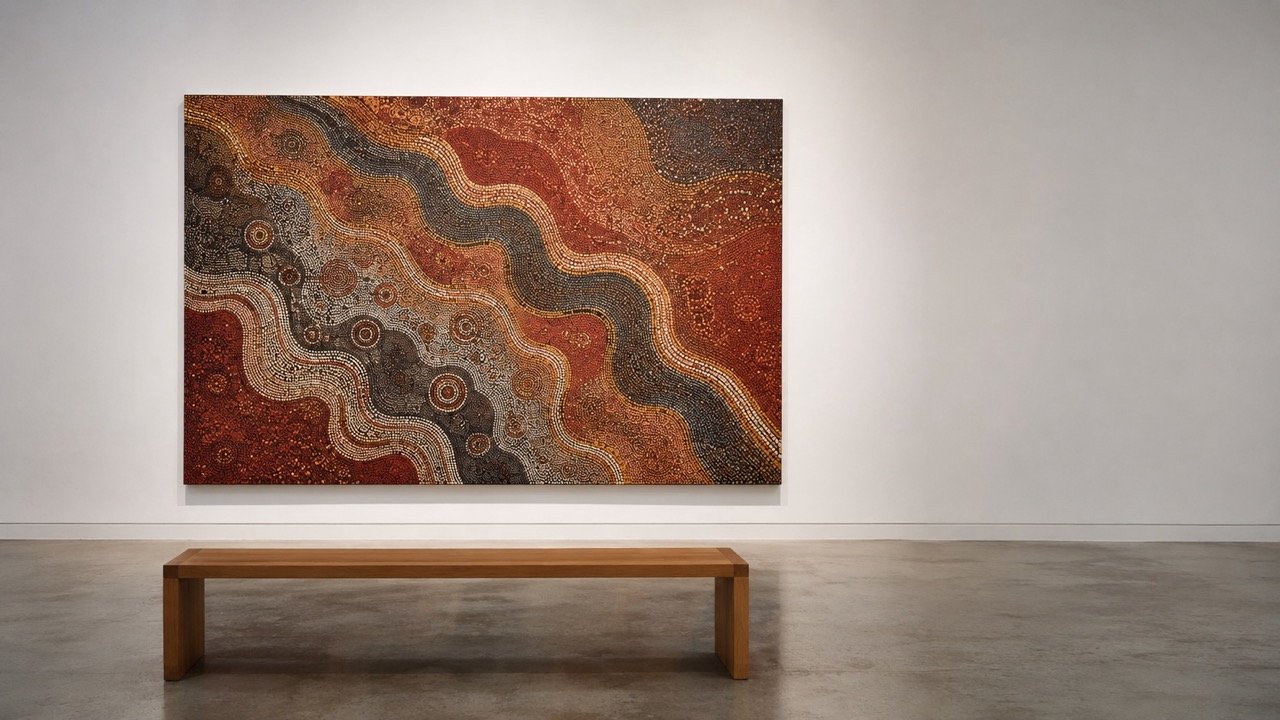
The story of First Nations art in Melbourne’s gallery ecosystem is not a story about representation as accommodation — about a mainstream system making room for a marginalised culture as a corrective gesture. It is a more interesting and more demanding story: about the ways in which contemporary First Nations artists are working in and alongside the mainstream system on their own terms, with practices that are formally sophisticated, politically articulate, and aesthetically uncompromising. To encounter the work of Reko Rennie, Destiny Deacon, or Kim Wandin through the lens of cultural tourism — of respectful but essentially external engagement with a distant tradition — is to misread what the work is doing. These are artists in conversation with the contemporary art world’s most demanding questions, making work that happens also to be an assertion of cultural sovereignty.
Melbourne’s position in this landscape is specific. Naarm — Melbourne — is built on the Country of the Wurundjeri Woi Wurrung and Bunurong Boon Wurrung peoples of the Kulin Nation, and the density of Kulin Nations cultural life in the city is not merely a historical fact but an ongoing reality. The Koorie Heritage Trust at Federation Square is the most concentrated expression of this — a sovereign cultural institution, discussed elsewhere in this guide, that is indispensable to any serious engagement with First Nations culture in Victoria. But the commercial and public gallery ecosystem also contains spaces and programmes that are taking First Nations contemporary practice seriously in the specific way that “seriously” requires: not as cultural content to be incorporated into an existing framework, but as work that challenges and changes the framework itself.
Reko Rennie: The Kamilaroi Diamond
Reko Rennie was born in 1974, is of Kamilaroi and Bigambul heritage, and lives and works in Melbourne. He was introduced to graffiti culture as a young man, and the influence of that initiation — the use of public space as a site of cultural assertion, the economy and legibility of mark-making designed to be read at speed, the conviction that walls are arguments — remains visible in work that has moved far beyond any single medium. Rennie works across painting, neon, spray-work, print, video, sculpture, and installation, but the Kamilaroi diamond — a design inherited from his paternal grandmother, a homage to the Kamilaroi shield — functions as the formal centre of gravity through which these diverse media are held in relation.
The diamond is not a logo or a brand. It is a cultural marker with specific ancestral meaning, deployed in contemporary contexts in a way that is neither nostalgic nor assimilationist. When Rennie prints it in hot pink on a Rolls Royce, or renders it in neon across a gallery wall, or layers it with spray-paint in a work that is equally at home on a building’s exterior and a museum’s white cube, he is insisting on the survival and vitality of a cultural practice that has been consistently underestimated by the Australian mainstream. His retrospective at the NGV in 2024 — REKOSPECTIVE, spanning more than a hundred works including a fifteen-metre light sculpture — made the argument at an institutional scale that his career had been building toward for two decades.
Reko Rennie’s work is held in the NGV collection and represented by Anna Schwartz Gallery, 185 Flinders Lane, Melbourne CBD. annaschwartzgallery.com
Destiny Deacon: Photography and the Blak Interior
Destiny Deacon — who died in May 2024, after a career of more than thirty years — was a photographer, broadcaster, and artist of Kuku and Erub/Mer heritage who lived and worked in Melbourne. Her practice was built on a series of formal decisions that are precise in their formal and political implications: the use of cheap domestic spaces as sets, kitschy Aboriginal-kitsch objects as props, her own community as subjects, and a deliberately unadorned photographic style that refuses the aesthetic refinement that would have aestheticised away the work’s critical content.
The result is a body of work that is funny, disturbing, politically exact, and formally impossible to dismiss. Deacon was among the artists who introduced the term “Blak” — reclaiming and recasting an imposed racial designation as a term of cultural pride and artistic positioning. Her photographs in the NGV collection are among the most important First Nations works in any Australian public institution. The 2020 retrospective, DESTINY, curated by Myles Russell-Cook at the Ian Potter Centre: NGV Australia, was the most comprehensive account of her practice mounted in her lifetime, and the catalogue remains essential.
Destiny Deacon’s work is held in the NGV Australia collection, Ian Potter Centre, Federation Square. ngv.vic.gov.au
Kim Wandin: Yorta Yorta Country and the Contemporary
Kim Wandin is a Yorta Yorta artist working in Melbourne whose practice engages with the specific landscape, species, and seasonal knowledge systems of Yorta Yorta Country — the Murray River region where Victoria and New South Wales meet — through a combination of painting, works on paper, and material practice. Wandin’s work is less internationally visible than Rennie’s or Deacon’s, but it represents a different register of the same commitment: the use of contemporary art practice to assert the continued vitality of a specific Country’s knowledge systems rather than to produce a generic “Indigenous art” for consumption by external audiences.
The distinction matters. Melbourne’s First Nations gallery culture is at its best when it makes this distinction legible — when it presents work that is specific to its Country, its language group, its particular custodial relationship to land and species and story, rather than treating all First Nations practice as interchangeable expressions of a unified tradition. The diversity of Country and culture within Victoria’s First Nations communities is enormous, and the best programmes in Melbourne’s gallery ecosystem reflect this rather than smoothing it into a single, accessible cultural category.
Kim Wandin’s work is held in the Koorie Heritage Trust collection and appears in rotating First Nations programming at the NGV Australia.
The Galleries and the Institutional Framework
The NGV Australia, at the Ian Potter Centre in Federation Square, holds the country’s most significant public collection of Australian art and has in recent years substantially expanded its First Nations holdings and programming. The permanent collection galleries dedicated to First Nations art — and the rotating temporary exhibitions that have included the Rennie retrospective and significant Deacon, Gordon Bennett, and Richard Bell surveys — are no longer supplementary to the institution’s core identity; they are central to it. This is a shift that has been years in the making and represents a genuine change in how the institution understands the country’s art history rather than a programme adjustment.
Anna Schwartz Gallery and the Koorie Heritage Trust remain the two most important spaces for First Nations contemporary practice at the commercial and not-for-profit levels respectively. The Trust’s exhibition programme — drawn from its collection and from commissioned contemporary works — is the place where First Nations art in Melbourne is most consistently encountered on terms that the community controls. For the serious collector: works by Rennie and a growing number of Kulin Nations artists are available through commercial galleries, and the field is moving fast enough that collection decisions made in the next several years will look, with hindsight, like the same kind of early conviction that established the canonical twentieth-century Australian collections.
An Insider Note on Engagement
The most important thing the non-Indigenous Melbourne gallery-goer can do in relation to First Nations art is learn the Country. Understanding that Reko Rennie’s Kamilaroi heritage is distinct from Yorta Yorta practice, and that both are distinct from Wurundjeri cultural material, is not a bureaucratic exercise in cultural literacy. It is the precondition for understanding what the work is actually doing — the specific cultural stakes it is raising, the specific assertions it is making about identity and survival and the relationship between contemporary practice and ancestral knowledge. Melbourne is built on Kulin Nations Country, and engaging seriously with the art that comes from that Country is not optional for anyone who wants to understand the city.
Koorie Heritage Trust, Yarra Building, Federation Square, Naarm/Melbourne. kht.org.au. NGV Australia, Ian Potter Centre, Federation Square. ngv.vic.gov.au