
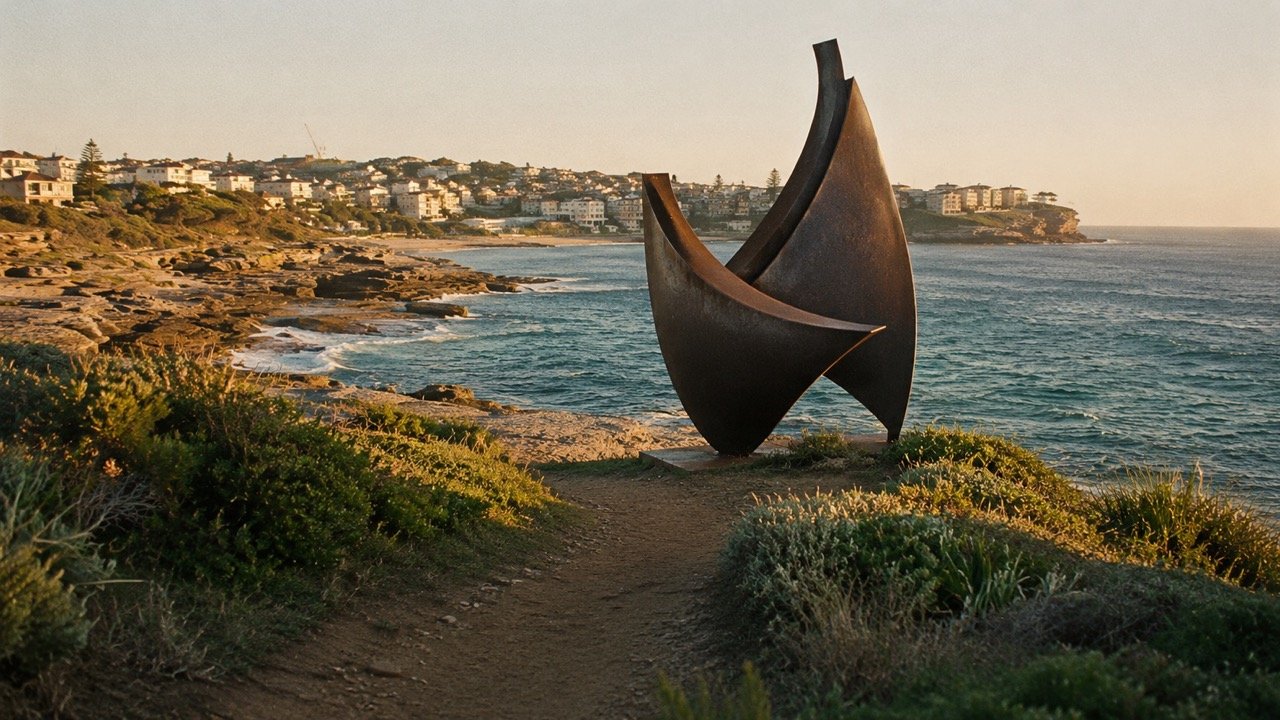
Sydney’s great advantage for outdoor sculpture is the landscape itself. A work placed on a harbour headland is framed by sky and water of extraordinary scale; a work in the Royal Botanic Garden operates in a setting that changes with every hour of light. The outdoor sculpture collection across this city is — in aggregate, and if you know where to look — among the most significant in Australia, and much of it is permanently accessible without admission charge.
This guide moves from the foreshore west to the gardens east, then south to the private sculpture parks that the most serious collectors drive a weekend to visit.
Barangaroo Reserve Foreshore
The Barangaroo Reserve headland — twelve hectares of reconstructed foreshore at the western edge of the CBD — was developed in close consultation with the Metropolitan Local Aboriginal Land Council and planted with species native to the Sydney basin. Within this setting, several permanent and semi-permanent sculptural installations have been commissioned that engage with both the landscape and the cultural history of the site.
The most significant permanent work is the Marrinawi Cove interpretive installation, which uses carved sandstone and water feature elements to mark the original foreshore line before colonial modification. The landscape architecture and the cultural programming that surrounds it represent one of the most serious attempts in Sydney to integrate Indigenous cultural knowledge into public urban design.
Walk the headland at low tide: the lower rock shelf platform provides access to views of the CBD from a position at water level that no other point on the foreshore offers, and the sandstone geology — the same formation that underlies the entire harbour — is legible here in a way that urbanisation elsewhere has covered.
Barangaroo Reserve, Hickson Road. Open daily. Free entry.
Sculpture by the Sea, Bondi (Annual, Permanent Legacy)
Sculpture by the Sea is technically an annual event rather than a permanent collection — the works are placed along the Bondi to Tamarama coastal walk each October and removed after three weeks. But its cultural impact on the city’s relationship with outdoor sculpture has been sufficiently transformative that it warrants permanent inclusion in any guide to Sydney’s sculptural landscape.
Several works commissioned through the festival have found permanent public homes across the city, and the annual event — which attracts over half a million visitors and is widely credited with developing the largest outdoor sculpture audience of any programme in the world — has created a fluency in public sculpture engagement that did not exist in Sydney thirty years ago.
If you are in Sydney in October, the Bondi to Tamarama walk during the festival is the most concentrated encounter with serious outdoor sculpture available in the country. Arrive before nine in the morning; the cliff-top walk before the crowd arrives, with the Pacific light coming in low and the sculptures occupying the rock shelves and headland grass as if they had always been there, is among the finest cultural experiences Sydney produces.
Bondi to Tamarama coastal walk. October annually. Free entry.
The Royal Botanic Garden: The Permanent Collection
The Royal Botanic Garden’s sculpture collection — permanently installed across the thirty-hectare site — is the most varied outdoor collection in the city. Works range from nineteenth-century figurative bronzes through mid-twentieth-century Australian modernist pieces to contemporary commissions that have been placed in specific garden contexts with curatorial attention.
The most significant work in the collection is Dual Nature by Hossein and Angela Valamanesh — a large, site-specific installation that responds to the garden’s dual function as cultivated landscape and living collection. Positioned near the harbour foreshore, the work uses both the garden view and the harbour view as compositional elements, shifting meaning as the viewer moves around it.
The garden is most rewarding for sculpture in the two hours before closing, when the light is long and low and the works cast significant shadows. The path from the Palm House through to the harbour foreshore concentrates the most significant works in the shortest walking distance.
Royal Botanic Garden, Mrs Macquaries Road. Open daily. Free entry. rbgsyd.nsw.gov.au
Brett Whiteley Studio, Surry Hills (and the Lavender Bay Legacy)
Brett Whiteley occupies a singular position in Australian art history — a painter of genuine international stature who spent the most productive period of his career in Sydney, using the harbour, the light, and the particular quality of Lavender Bay as the persistent subject of his most significant work.
The Brett Whiteley Studio in Surry Hills — the artist’s former studio, now managed by the Art Gallery of NSW — functions as a small museum dedicated to his practice, with the studio environment largely preserved. The connection between the studio and the outdoor is explicit: the large harbour canvases that constitute Whiteley’s most celebrated work were produced here, and the walk from the studio to the foreshore at Lavender Bay — where the view that animated those canvases is still visible — is among the most direct connections between an artist’s working environment and their subject available in any city.
2 Raper Street, Surry Hills. Open Friday to Sunday 10am–4pm. Free entry. artgallery.nsw.gov.au
Heide Museum of Modern Art, Melbourne (Worth the Trip)
An honest admission: the finest sculpture park within driving distance of Sydney is in Melbourne. Heide — the former country property of John and Sunday Reed, now a public art museum — maintains an outdoor sculpture collection that uses the garden landscape of the original property as a curatorial medium rather than a display surface.
Works by Arthur Boyd, Sidney Nolan, Charles Blackman, and significant contemporary Australian sculptors are positioned throughout the grounds with a sensitivity to sight lines, season, and the particular Australian relationship between domesticity and landscape that the property itself embodies. The house, the garden, and the collection are inseparable; visiting one without the others is not the experience.
The two-hour drive from Sydney warrants two nights in Melbourne to do the collection proper attention.
7 Templestowe Road, Bulleen, Victoria. Open Tuesday to Sunday. heide.com.au