
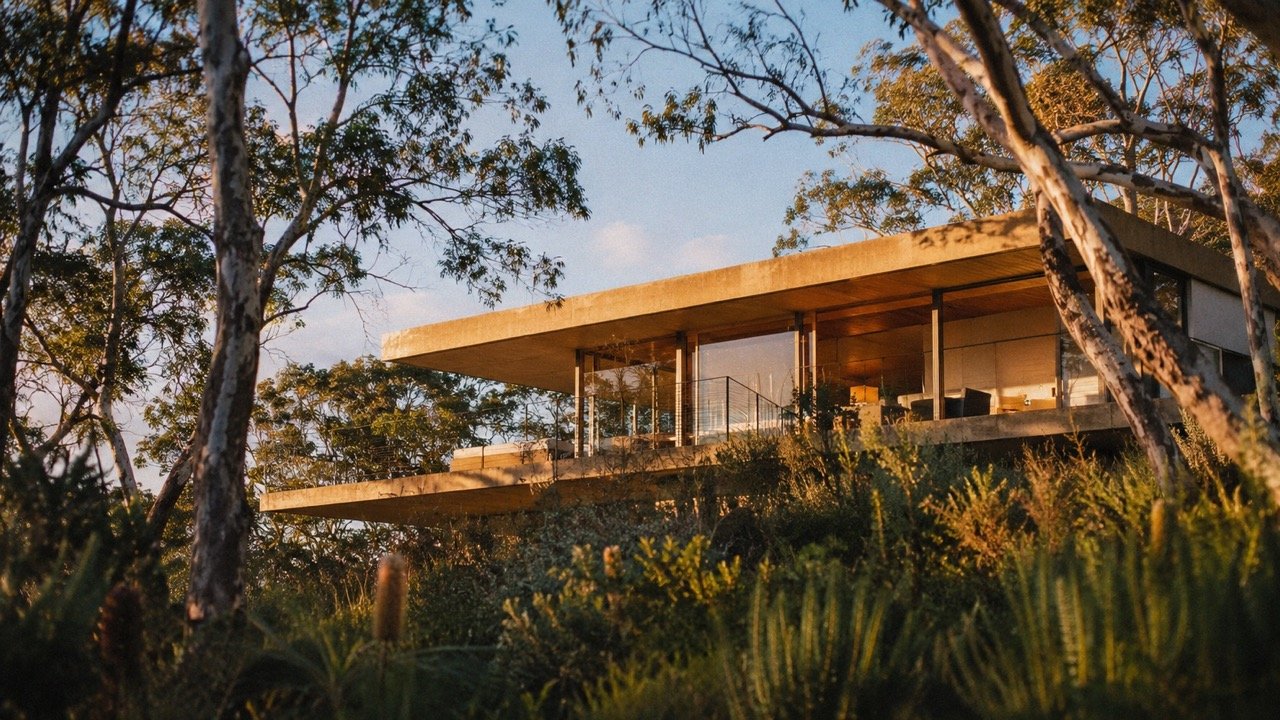
There is a particular quality of light that visits the paddocks along Templestowe Road in Bulleen — diffuse, grey-gold, softened by the Yarra’s proximity — that makes Heide feel less like a museum than like a place where something was genuinely at stake. And it was. Between 1934 and 1981, the property that Sunday and John Reed purchased as a rundown dairy farm became the most consequential address in the history of Australian modern art: the site where Sidney Nolan painted the first Ned Kelly series, where Joy Hester worked through some of the most psychologically urgent drawings made by any Australian artist, where Albert Tucker, Arthur Boyd, Danila Vassilieff, and John Perceval found a patron, a kitchen table, and an argument. To come to Heide without understanding the Reed project is to see a museum; to come understanding it is to stand inside a cultural rupture.
What the Reeds built was not simply a salon. It was a proposition — that Australian art could not remain provincial, that it needed to engage with modernist practice from Europe and America without imitating it, that it required the specific texture of this landscape, this light, these conflicts. Sunday Reed, who managed the money, ran the correspondence, and maintained the intellectual atmosphere, was as decisive a force as John, whose written criticism and editorial work gave the project its public face. The fact that art history has taken decades to fully recognise her role is part of what makes revisiting Heide now a different experience than it was even twenty years ago.
Heide I: The Farmhouse Where the Kellys Were Painted
The original farmhouse — Heide I — is where Nolan worked, in the dining room, from March 1946 to July 1947. He was, at the time, living in a complicated domestic triangle with Sunday and John Reed, painting on hardboard with Ripolin enamel, producing the twenty-seven panels that would eventually become one of the foundational series of Australian art. The house itself is modest, French provincial in its renovation, a place that rewards slow attention: the kitchen’s aspect, the way light enters the living rooms, the correspondence archives that speak to a working intellectual life rather than a heritage tableau.
The Reeds bequeathed the property to the Victorian government in 1980, and the museum opened in 1981. Since then, Heide I has been restored twice — most recently in 2010 — with an eye to maintaining its domestic legibility. It is not a period room so much as a continued argument: this is where serious Australian art happened in conditions of genuine austerity and genuine conviction.
7 Templestowe Road, Bulleen. heide.com.au
Heide II: McGlashan and Everist’s Modernist House
In 1963, the Reeds commissioned David McGlashan and Neil Everist — among the most important architects working in Melbourne at that moment — to design a new residence. Completed in 1967 and awarded the Bronze Medal of the Victorian Chapter for outstanding architecture in 1968, Heide II is built with limestone-block walls and horizontal planes that hold the landscape in disciplined relationship. It is not brick modernism in the International Style manner; it is something more particular, something that belongs to this specific southern latitude, this specific relationship between indoors and garden.
McGlashan Everist designed a house of controlled light: rooms that open onto the Reeds’ garden in a sequence that feels both planned and inevitable. As a museum space, Heide II now presents the collection with an intimacy that conventional gallery white-cube environments cannot replicate. Standing in a room where Sunday Reed’s correspondence was written, looking at a Hester drawing pinned to the wall, the work and the place remain in conversation. That relationship — between what was made here and where it was made — is what distinguishes Heide from almost every other Australian museum.
Joy Hester’s work, in particular, earns a stop that most visitors rush past. Her charcoal and ink drawings — faces dissolving into gesture, maternal love rendered with an almost unbearable directness — were made at Heide under conditions of serious illness and personal extremity. They are among the most emotionally true works produced by any Australian artist of the twentieth century. The NGV holds significant examples, but seeing them in the context of Heide II, where Hester worked and struggled, is a different experience entirely.
7 Templestowe Road, Bulleen. heide.com.au
Heide III: The Contemporary Gallery and the Sculpture Park
The third building — Heide III, the purpose-built contemporary gallery designed by Andrew Andersons and opened in 1993 — closes the architectural sequence with a structure that defers to the site rather than competing with the earlier buildings. It provides the large-volume, climate-controlled environment needed for major loans and new commissions, and in recent years it has hosted exhibitions of genuine ambition: surveys of First Nations contemporary practice, significant retrospectives of Australian modernist figures, and international touring programmes that might otherwise bypass Melbourne.
But what Heide III really does is allow the sixteen acres of heritage-listed garden and sculpture park to exist as a connective tissue between the three buildings. The garden was Sunday Reed’s sustained creative project — she worked it for decades, and the result is a landscape that reads as art-adjacent without being formally curated into something precious. Walking between Heide I and Heide III along the gravel paths, through plantings that mix native species with the kitchen garden remnants of the Reed years, is to understand something about Australian modernism that no catalogue essay can fully convey: that it was rooted, literally, in a specific patch of ground along a specific river, under a specific quality of light.
The serious visitor allows most of a day. The sculpture park changes seasonally; the permanent collection rotates intelligently; and the café — housed in a structure adjacent to Heide I — makes the transition from close looking to reflection easier than in most art institutions. Come on a weekday, when the school groups are absent, and the Reed project recovers its original texture: private, urgent, important.
7 Templestowe Road, Bulleen. heide.com.au. Closed Mondays.