
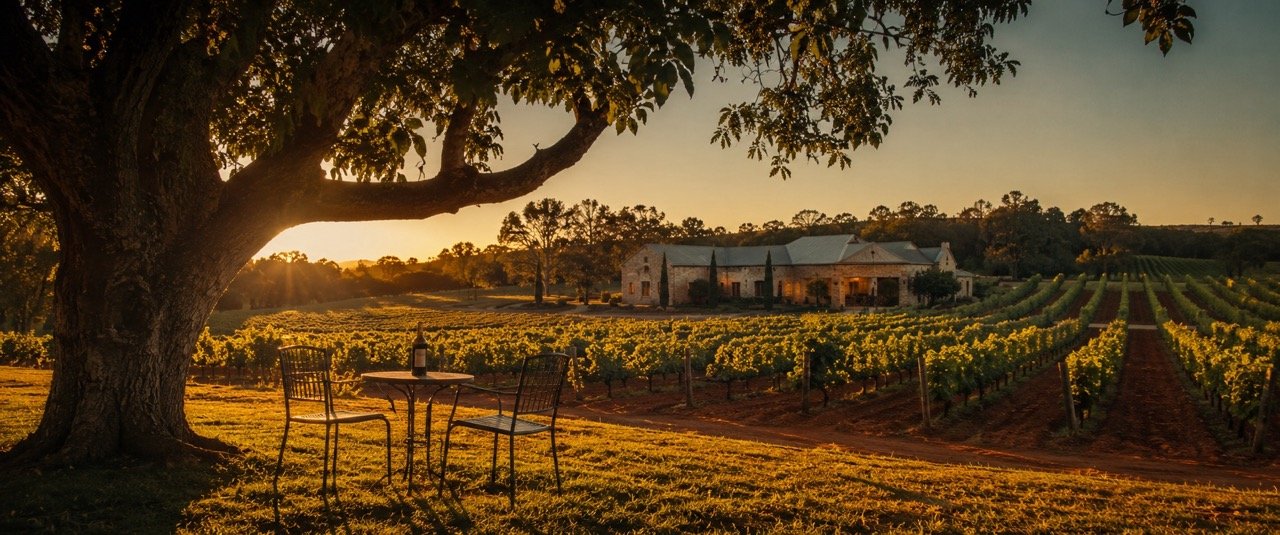
The Hunter Valley has a problem with its own reputation. Two hundred kilometres north of Sydney through the Central Coast and up through Cessnock, Australia’s oldest wine region has spent several decades accommodating a kind of visitor that the wine itself does not require — the weekend bus crowd, the hen’s party circuit, the cellar door that optimises for throughput rather than conversation. It has, in some rooms, confused hospitality with entertainment.
The Hunter of this guide exists in parallel to all of that, and in many instances on the same road. It is the Hunter of small-batch Semillon that tastes like nothing else on earth after ten years in the bottle, of independent producers who farm a single hectare and are barely known outside the region, of estate lodges where the view across the vine rows at dusk is the entire programme for the evening. This version of the Hunter rewards advance planning and the willingness to choose quality of experience over quantity of cellar doors.
On Hunter Semillon
To visit the Hunter without understanding Semillon is to arrive at the wrong conversation. This single variety — the region’s most significant and most misunderstood — produces wines in the Hunter Valley that have no meaningful equivalent anywhere else in the world. The reason is specific: Hunter Semillon is typically harvested at very low sugar levels, producing wines of ten to eleven percent alcohol that taste thin and austere in youth and, over eight to fifteen years in the bottle, develop a complexity of honeyed, toasted, lanolin-and-lemon depth that is one of the most extraordinary transformations in wine.
The best aged Hunter Semillon — a 2012 Tyrrell’s Stevens Vineyard, a 2010 Brokenwood ILR Reserve — will silence a table of people who thought they already knew what wine could do. It is among the most intellectually serious arguments any Australian region makes for its own necessity.
Request the cellar door reserves and back vintages at every estate you visit. They are worth the additional cost.
Where to Stay
### Spicers Vineyard Estate, Pokolbin
The Spicers Group has built a portfolio of Australian retreat properties that consistently exceed the standard that the boutique lodge sector has set for itself, and the Pokolbin estate — twenty-one rooms across heritage-listed buildings in the heart of the Pokolbin wine district — is among the strongest. The architecture is low and horizontal, the rooms larger than their category suggests, the views across the vines precisely oriented for the late-afternoon light.
The Botanica restaurant operates with a regional-produce brief that the Hunter can supply with unusual depth: venison and wallaby from local farms, stone fruit from the Barrington Tops foothills, olive oil from estates within twenty minutes of the kitchen. The wine list is a serious document — weighted toward Hunter, with genuine depth in aged Semillon and Shiraz from the top estates, alongside a careful selection of Burgundy and Loire for those whose evening requires both hemispheres.
Broke Road, Pokolbin. Rates from $450 per night. spicersretreats.com
### Brokenwood Wines Guest Cottage
Brokenwood — one of the Hunter’s most respected estates, producing wine since 1970 — maintains a small number of guest cottages on the property available to visitors who are serious enough about the wine to want to spend the night beside it. The cottages are modest by luxury lodge standards: good beds, a well-equipped kitchen, a private garden. The trade-off is everything else: waking to the vineyard before anyone else is there, the option to visit the winery before cellar door opening hours, and the particular pleasure of knowing that the bottle on the kitchen counter was picked from the row visible from the window.
The ILR Reserve Semillon and the Graveyard Vineyard Shiraz are the two benchmark wines; both age magnificently and should be ordered in the back vintage where available.
McDonalds Road, Pokolbin. Guest cottages by enquiry through the winery. brokenwood.com.au
The Cellar Doors That Reward Serious Attention
### Tyrrell’s Wines, Pokolbin
Tyrrell’s has been farming in the Hunter since 1858, and the weight of that history is not ceremonial — it is expressed in wines that carry a geological patience unavailable to younger operations. The Vat 1 Semillon, the Vat 47 Chardonnay, and the Stevens Vineyard Semillon are benchmarks against which serious Hunter producers continue to measure their own work.
The cellar door operates with the confidence of a house that does not need to perform. The team will talk through the vineyard’s history without prompting, will open back vintages for comparative tasting without excessive formality, and will guide visitors whose existing knowledge of Hunter Semillon is limited into the conversation through the wine rather than the lecture.
Ask for the tasting menu that includes the aged releases. The comparison between a current-vintage Semillon and a ten-year-old version is the most direct way to understand what the Hunter is actually doing.
Broke Road, Pokolbin. Open daily. tyrrells.com.au
### De Iuliis, Lovedale
De Iuliis is family-operated, smaller than the major estates, and makes wine with a precision and restraint that the more commercially oriented Hunter producers rarely achieve. The single-vineyard Semillon and the estate Shiraz are both produced in volumes small enough that allocation is a meaningful concept — if a particular wine is listed, there is a finite quantity. The family’s approach to oak is minimal to the point of being principled: the fruit and the soil are asked to speak, and they do.
The cellar door is understated — the Lovedale address is quieter than the main Pokolbin strip, which suits the wines. The conversation here tends to go long. Bring the afternoon.
Broke Road, Lovedale. By appointment preferred for groups; walk-in generally welcomed for pairs. deiuliis.com.au
### Scarborough Wine Co., Pokolbin
Scarborough has spent thirty years developing the case that Hunter Chardonnay is as significant as Hunter Semillon, and the argument is now largely won. The Yellow Label Chardonnay — restrained, precise, mid-weight, with the natural acidity that the Hunter’s warm days and cool nights produce — is one of the most carefully managed expressions of the variety in the country.
The cellar door sits on a rise above the vine rows with a view that is, at golden hour, among the most compositionally satisfying in the region. The tasting is conducted with the seriousness the wines deserve. The library wines — back vintages available for tasting and purchase — tell the story of a house that has been refining rather than changing.
Gillards Road, Pokolbin. Open daily. scarboroughwine.com.au
Where to Eat
### Muse Restaurant, Hungerford Hill
Muse has occupied the position of the Hunter Valley’s most serious restaurant for long enough that the question is no longer whether it deserves the status but how it maintains it. The kitchen produces food that takes the region’s produce seriously without reducing itself to a regional produce showcase — the technique is international, the materials are local, and the interaction between the two is the point.
The wine list is, predictably, exceptional. The Hunter Semillon selection spans multiple decades and multiple estates; the Shiraz selection does the same. For visitors who have spent the afternoon at cellar doors and understand roughly where the region’s quality peaks, the Muse list provides the opportunity to drink those peaks at table.
2843 Broke Road, Pokolbin. Dinner Wednesday to Sunday, lunch Friday to Sunday. musedining.com.au
The Hunter Valley is approximately two hours from Sydney by car via the M1 Pacific Motorway. Direct coaches from Central Station are available but compromise flexibility for cellar door visits. The optimal logistics involve a Friday evening departure and a Sunday afternoon return. Cellar door hours typically run 10am–5pm daily; appointment-only estates should be confirmed by telephone the week before visiting.