The address is not incidental. The Koorie Heritage Trust occupies Levels 1 and 3 of the Yarra Building — now increasingly known as the Birrarung Building — at Federation Square, the corner of Swanston and Flinders Streets, directly above the river that the Wurundjeri call Birrarung. To enter the Trust from the plaza of Federation Square, with the Yarra visible through the building’s eastern glass, is to encounter an institutional argument made in spatial terms: that the most important cultural organisation concerned with this city’s oldest and deepest culture sits at its geographic and civic centre, not in a suburb, not in a heritage-designated precinct on the margins of the Hoddle Grid, but here. The Trust’s location in Federation Square is not a tenancy arrangement. It is a position.
The Trust was established in 1985, born from a legal action brought by Uncle Jim Berg, Ron Castan, and Ron Merkel demanding the return of First Nations cultural material from the University of Melbourne and the Museum of Victoria. What began as a reclamation became an institution: a custodian of over one hundred thousand items including paintings, artefacts, photographs, oral history recordings, and a reference library that constitutes the only public collection in Victoria dedicated solely to Koorie art and culture. Every object in the collection was gathered and is curated by Koorie people, which is not a bureaucratic formality but a foundational condition of what the collection can be trusted to contain. This is sovereign cultural stewardship, not consultation.
The Collection and What It Holds
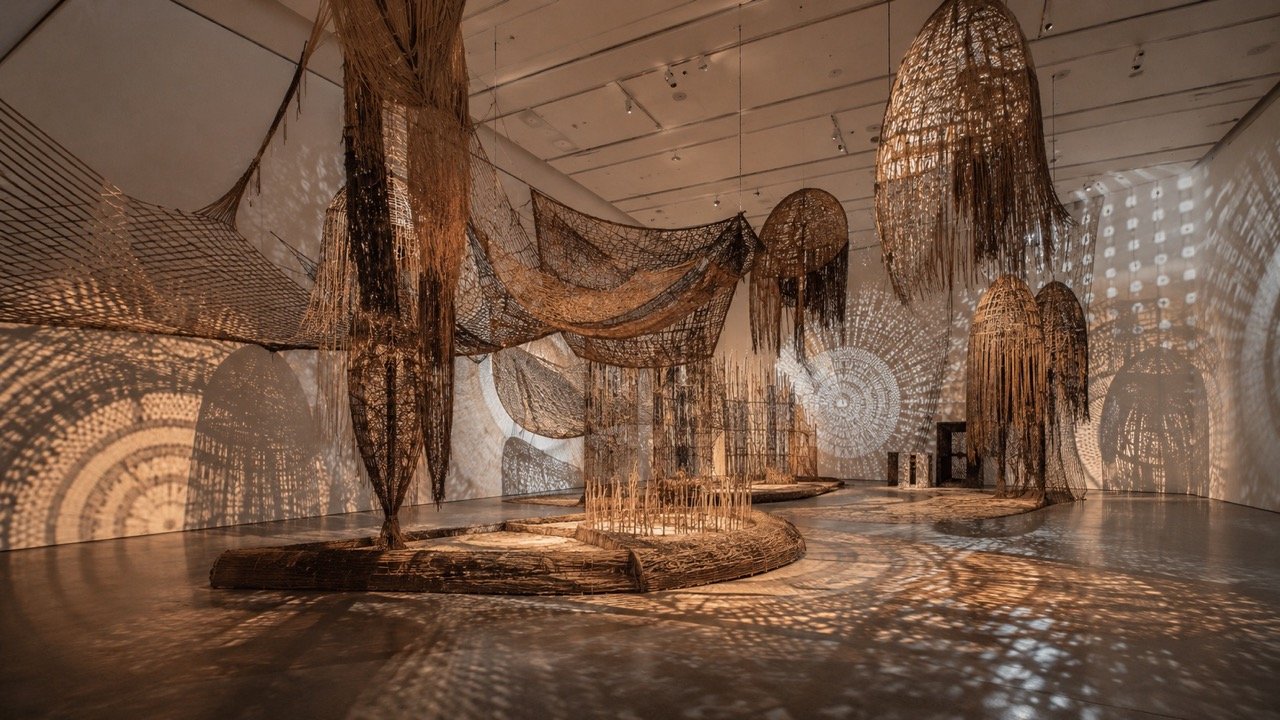
Walking through the Trust’s gallery spaces, the density of what is held becomes gradually apparent. The collection spans several hundred years of material culture from across Victoria’s First Nations communities — the Wurundjeri Woi Wurrung and Bunurong Boon Wurrung of the Kulin Nation, the Wergaia and Wotjobaluk of the Wimmera, the Yorta Yorta of the Murray, and many others. Bark paintings, stone tools, possum-skin cloaks, photographs from the mission-era that require sustained attention to read without the flattening effect of historical distance. The Trust resists any single curatorial narrative that would reduce this diversity to a unified “Koorie culture” — the specificity of Country, language group, and practice is maintained throughout.
The oral history archive is among the Trust’s most significant holdings and the least visible to the casual visitor. Begun in the 1980s and expanded continuously since, it contains recorded testimonies from Elders across Victoria — accounts of life on country before and after colonisation, of the mission system, of language maintenance, of cultural practice sustained under conditions of deliberate suppression. This is not supplementary material. It is primary historical evidence of a kind that written colonial sources cannot provide, and its existence in the Trust’s archive rather than in a university repository is itself a statement about whose knowledge counts as knowledge.
Koorie Heritage Trust, Yarra Building, Federation Square, corner of Swanston and Flinders Streets, Naarm/Melbourne. kht.org.au. Open daily 10am–5pm. Free entry.
The Koorie Voices Gallery and the Walk Beyond It
The Trust’s Koorie Voices gallery presents a rotating programme drawn from the collection, alongside commissioned contemporary works, in a space that manages to be both museum and living community room. There are days when the gallery holds school groups engaged in cultural education programmes; days when Elders are in residence; days when the space feels like a threshold between the trust’s holdings and the city outside. All of these are correct experiences of what the Trust is.
What the serious visitor takes from the Trust, ideally, is not a checklist of objects seen but a recalibration of the city itself. Melbourne was built on Kulin Nations Country — the five language groups who occupied and managed this landscape for tens of thousands of years before settlement, whose seasonal movements shaped the routes that became roads, whose knowledge of the Birrarung’s flooding patterns was ignored at the colonists’ repeated cost. The Hoddle Grid, which seems so imposed and rational, was laid over a landscape whose logic was entirely different: organised around water sources, seasonal abundance, ceremonial geography. To walk from the Trust back out into Federation Square with this in mind is to walk through a different city — not a more depressing one, but a more accurate one.
The Trust operates cultural programs, walks, and educational events across the year. The Bunjilaka Aboriginal Cultural Centre at Melbourne Museum, while separately managed, presents complementary programming from a different institutional base and is worth experiencing in sequence with the Trust rather than as an alternative. The two institutions together describe the breadth of what First Nations cultural engagement in Melbourne can be, when it is done with seriousness and on its own terms.
Koorie Heritage Trust, Yarra Building, Federation Square, Naarm/Melbourne. kht.org.au
An Insider Note on Engagement
The Trust is not a museum in the conventional sense — a container of static objects for passing inspection. It functions as a community institution that happens to be publicly accessible, and the distinction matters in how you engage with it. Come with questions rather than conclusions. Come prepared to sit with material that does not resolve quickly into familiar cultural categories. Come more than once — the experience differs significantly depending on what is installed, who is present, and where you are in your own understanding of Victorian First Nations history and culture.
For those who want to go further: the Trust’s publications programme produces catalogues, cultural histories, and educational materials that cannot be found elsewhere. The Trust’s reference library, accessible by appointment, holds a depth of Victorian First Nations scholarship that makes it indispensable for anyone engaged seriously with this country’s history. Begin at the gallery. Return to the library. Let the city’s oldest story revise your understanding of its newest preoccupations.
Koorie Heritage Trust, Yarra Building, Federation Square, Naarm/Melbourne. kht.org.au. Free entry.