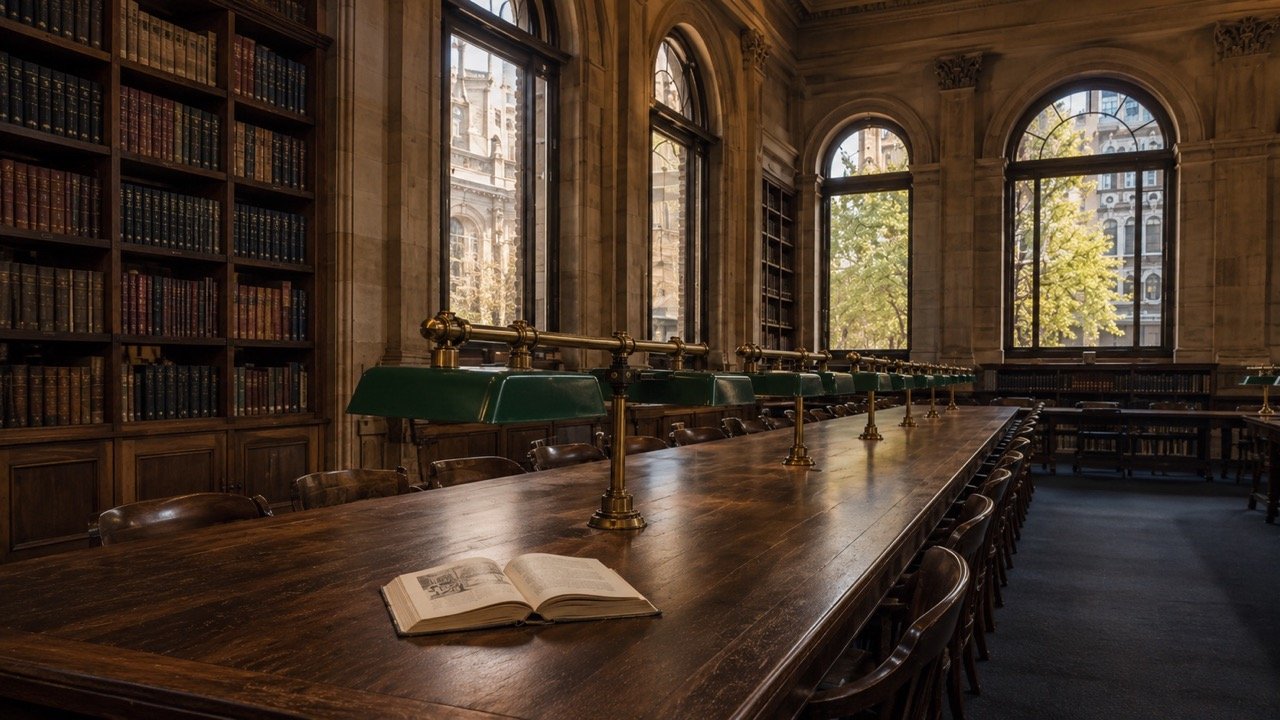
There is a moment, ascending the staircase from the State Library Victoria’s main entrance on Swanston Street, when the dome becomes visible above: an octagonal lantern of reinforced concrete, its twelve skylights admitting the particular grey-gold Melbourne light in a way that seems calibrated to make the room beneath feel like the most serious possible container for the act of reading. This impression is not accidental. When the La Trobe Reading Room was completed in 1913, the dome was the largest reinforced-concrete dome in the world — a claim that has since been displaced by other structures, but that tells you something about the ambition of the civic investment in knowledge that the room embodies. The men and women who built it believed — with the earnest, sometimes overreaching confidence of colonial Melbourne — that the life of the mind deserved a serious home. The room is that belief made permanent.
The La Trobe Reading Room closed in 1959, when leaking skylights were covered in copper sheeting and the space was repurposed for stacks and administration. For four decades, the dome sat in darkness. It reopened in 2003, the copper removed, the skylights restored, the eight tiers of gallery stacked around the octagonal interior once again visible from the reading floor below. The restoration returned to Melbourne a room that is, without qualification, among the finest public interiors in the country: not a museum piece, not a heritage-listed ruin, but a functioning reading room where the desks are occupied daily by researchers, students, and the kind of person who needs three hours and a large table.
The Objects the Room Holds
What distinguishes the State Library from comparable institutions is the specificity of its colonial-era holdings — the objects through which Victoria’s foundational traumas and dramas have been physically preserved. Ned Kelly’s armour is displayed in the Redmond Barry Reading Room: the suit of hand-beaten plate iron that Kelly and his gang wore at the Glenrowan siege in 1880, each panel improvised from ploughshares, the helmet’s narrow slit expressing both the ingenuity and the desperation of its makers. It is one of the most examined objects in Australian cultural history, and proximity to it changes the experience of all the written accounts — the journalism, the mythology, the academic literature — that have accumulated around the Kelly story ever since.
The Burke and Wills expedition materials — diaries, maps, correspondence from the 1860–61 journey that killed both men and illuminated the country’s capacity for fatal institutional error — are among the collection’s most resonant holdings. The journals record, in Burke’s and Wills’s own hands, the incremental deterioration of a project whose planning was incompetent and whose rescue was too slow. They are documents of hubris and mortality, and they sit in the State Library’s vaults in the same city that dispatched the expedition with civic fanfare in 1860.
The library holds John Batman’s controversial deed of purchase — the 1835 document by which Batman claimed to have purchased 600,000 acres from Kulin Nation elders, a transaction the colonial government promptly invalidated and that the Kulin peoples have always contested — alongside the diaries of John Pascoe Fawkner and other founding documents of the European settlement of Naarm/Melbourne. These are not comfortable objects, and the Library does not present them as such. They are the primary evidence of a history that remains contested, and their preservation in a public institution — accessible to researchers, to legal historians, to First Nations claimants — is part of their continued civic function.
State Library Victoria, 328 Swanston Street, Melbourne CBD. slv.vic.gov.au. Free entry. Open daily.
The Reading Room as Daily Life
The La Trobe Reading Room functions best when experienced at working hours — mid-morning on a weekday, when the desks are occupied, laptops and notebooks and books spread across the wide surfaces, the dome’s light changing as cloud passes over Melbourne’s winter sky. There is a specific quality of collective silence in a reading room that differs from the silence of a museum: it is productive, voluntary, and slightly competitive. People are here because the room itself makes them think better, or at least makes thinking feel more serious.
The library’s broader collections are available to researchers through its reading rooms on the upper floors, which require registration but are accessible without the academic affiliations that restrict access in many comparable institutions. The catalogue is extensive and genuinely surprising in its depth: newspaper archives dating to the colony’s founding, photographic collections that document Melbourne at every decade of its existence, printed books, manuscripts, and ephemera that constitute the most comprehensive repository of Victorian history in existence.
The Dome Bar, at gallery level in the La Trobe Reading Room, occupies a position that would be considered incongruous in almost any comparable institution and is, in fact, one of the more inspired civic decisions the library has made: it allows the room to be experienced by people who are not there to read, who want to sit at the gallery level with a coffee and look at what the dome does to light and sound in the mid-afternoon. This is not trivialisation; it is access, and the room is generous enough to accommodate both registers.
State Library Victoria, 328 Swanston Street, Melbourne CBD. slv.vic.gov.au. Free entry. Dome Bar open during library hours.
An Insider Note on Architecture
The building’s architectural history repays attention. Sir Redmond Barry, first president of the Library trustees and founder of the University of Melbourne, commissioned the original structure in 1854 — the bluestone reading room wing that preceded the dome by six decades. The sequence of additions that culminated in the 1913 dome creates an architectural palimpsest: Victorian bluestone, Federation-era rendered brick, early-twentieth-century reinforced concrete, all consolidated into a civic compound that reads as more intentional than it is. The dome’s architect was J.J. Clark, working with the Public Works Department; the structural engineering, which made the span possible without internal columns, was among the more ambitious pieces of building technology in colonial Australia.
Standing on the gallery level of the La Trobe Reading Room and looking down at the desks below — at the students, the researchers, the people who have come in from Swanston Street to use the wifi or find a quiet hour — is to understand what the Victorian colonial project did with its best intentions. It built this room. Whatever its other failures — and they were substantial — it built this room, and that is not nothing.
State Library Victoria, 328 Swanston Street, Melbourne CBD. slv.vic.gov.au