
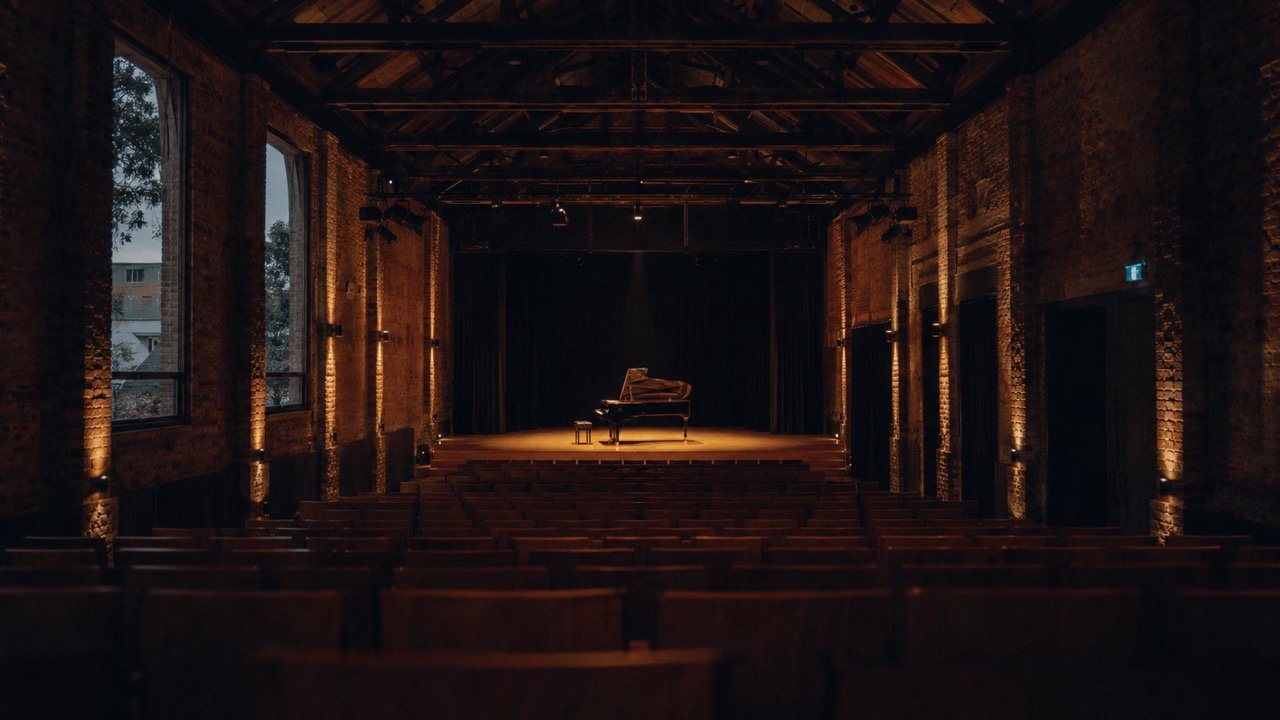
There is a specific sound that the Melbourne Symphony Orchestra has been developing over the past several years — warmer than a British orchestra at the same tier, more harmonically transparent than the Central European model, possessed of a particular quality in the strings that has something to do with the hall itself and something to do with the accumulated aesthetic decisions of Jaime Martín, who took the position of Chief Conductor in 2021. To describe it is difficult without becoming impressionistic; to experience it across a season is to understand that an orchestra, given sufficient time and a conductor with a genuine vision, develops a character that is its own. The MSO is in the process of becoming something specific, and that process is one of the more interesting things happening in Australian cultural life.
The conditions for this have been a long time in the making. Hamer Hall — the Arts Centre Melbourne’s main concert room, originally designed by Roy Grounds and opened in 1982 — was renovated between 2010 and 2012 by ARM Architecture and Marshall Day Acoustics in a $136 million project that transformed it from a hall with acoustic problems into one of the better concert rooms in the southern hemisphere. The renovation reduced the stalls width by three metres on each side, installed a new acoustic reflector above the stage, and retuned the room’s reverberant character toward a sound that serves orchestral music rather than fighting it. The result — subtly warmer in colour, the orange of the seat fabric replacing the original red — is a room that allows the orchestra to play at its actual capacity rather than compensating for the space.
Martín’s MSO: Australian Sound and International Ambition
Jaime Martín came to Melbourne from a career that included significant orchestral relationships in Europe — he has been chief conductor of the Gävle Symphony in Sweden and principal conductor of the RTÉ National Symphony in Ireland — and brought to the MSO a clarity of purpose that has been visible in the programming from his first season. His conviction is that an Australian orchestra should not sound like a minor approximation of a European one; it should develop a sound informed by the orchestral traditions it inherits while being responsive to where it is and what it is playing.
In practice, this has meant a genuine and non-token commitment to Australian composition. Works by Brett Dean, Carl Vine, Peter Sculthorpe, and a generation of younger composers have been programmed not as obligatory local content but as genuine centrepieces of seasons otherwise built around the canonical European repertoire. The MSO’s recording and broadcasting activity — the orchestra records regularly and has a streaming presence that extends its reach well beyond Hamer Hall’s regular audience — gives these premieres and Australian performances a durational life beyond the concert itself. This matters for how Australian composition is perceived internationally: an MSO recording of a Brett Dean work carries different weight than a regional première.
The orchestra’s relationship with its hall is, under Martín, becoming the kind of mutual calibration that distinguishes the great orchestral partnerships from the merely competent ones. Martín rehearses at Hamer Hall in ways that use the space’s acoustic as an instrument rather than a constraint, and the result is audible in the quality of pianissimo playing — the most sensitive measure of any orchestra’s development — in recent seasons. When the MSO plays quietly at Hamer Hall now, it is playing quietly in the specific way that this hall allows, which is different from quiet in any other room in the city.
Hamer Hall, Arts Centre Melbourne, 100 St Kilda Road, Southbank. mso.com.au
How to Attend
The serious concert-goer in Melbourne develops an opinion about seats. Hamer Hall’s stalls are acoustically excellent but the rake is modest, which means that the optimal position balances proximity to the stage with a clear sightline above intervening heads. Rows H through N of the orchestra stalls — centre and slightly off-centre — are generally the position from which the orchestra’s balance is most completely present. The dress circle, which wraps the room at first-balcony level, is warmer in tone and rewards those who prefer a slightly more reverberant experience; it is also where the hall’s ARM renovation is most visible in the changed ceiling geometry.
Pre-concert talks, run by the MSO on subscription evenings, are worth attending if your interest in the programme runs to structural analysis. The talks are given by musicians and musicologists of genuine expertise, not by development staff. The MSO’s free concerts — a regular feature of the annual programming, often held at Hamer Hall and occasionally in outdoor venues across the city — are among the more generous acts of cultural access in Australian public life, and they are consistently well-attended by audiences who do not ordinarily buy subscription tickets. This is the MSO building its future audience with patience and genuine commitment.
Hamer Hall, Arts Centre Melbourne, 100 St Kilda Road, Southbank. mso.com.au. Season runs approximately February to November.
The Chamber Music Dimension
The MSO’s chamber music activities — smaller ensembles drawn from the orchestra’s principal players, performing in more intimate venues across the city — represent a different register of the institution’s culture, and a revealing one. The musicians who play chamber music under their own authority, making interpretive decisions collectively rather than under a conductor’s direction, are the musicians who shape the orchestra’s ensemble culture from the inside. The MSO’s chamber series, which has used venues including the Melbourne Recital Centre and Hamer Hall’s smaller ancillary spaces, consistently produces playing of a quality and spontaneity that the full orchestral context cannot always generate.
The Melbourne Recital Centre, adjacent to Hamer Hall on Southbank, is also worth holding as a separate destination: its main hall, Elizabeth Murdoch Hall, is acoustically superior to almost any room of its size in the country and has a chamber music life of its own — visiting ensembles, local chamber groups, early music programming — that is distinct from but complementary to the MSO’s main season.
Melbourne Recital Centre, 31 Sturt Street, Southbank. mrc.org.au