
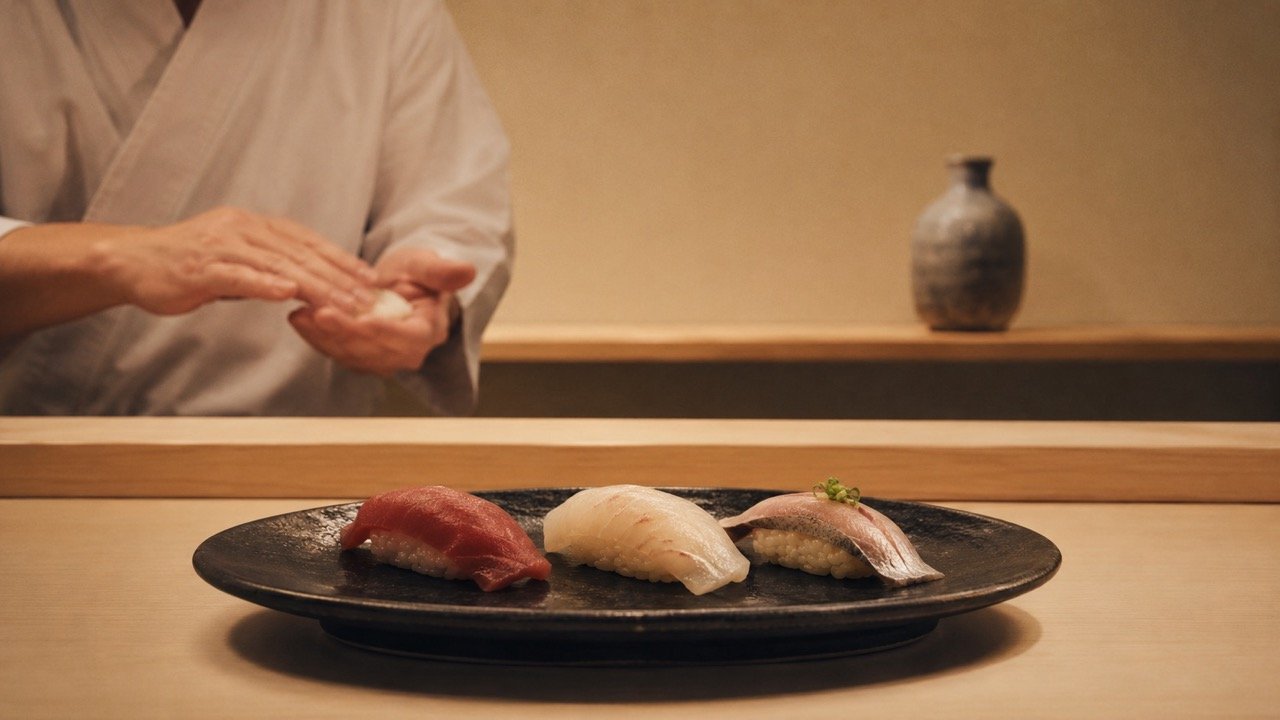
The word omakase translates, approximately, as “I leave it to you” — but that rough English equivalent misses the full weight of the arrangement. When you sit at a Japanese chef’s counter in Melbourne and say omakase, you are not merely agreeing to a set menu. You are entering a relationship of trust that extends backwards through the supply chain, to the fish market, to the fishing vessel, to the specific waters off the Australian coast or the Toyosu floor in Tokyo. You are agreeing to receive the kitchen’s complete intelligence about what is best today. That is a fundamentally different proposition from choosing from a menu, and it requires a fundamentally different kind of attention from the diner.
Melbourne has earned a serious Japanese chef’s counter culture not through novelty but through the depth and longevity of its Japanese community, and through the discipline of a handful of chefs who spent years working in Japan before bringing an uncompromising standard to the southern latitude. The city’s best counters are not performing Japaneseness for a Western audience — they are practising Edomae and kaiseki traditions with the same rigour as their Tokyo counterparts, adapted only where the geography of Australian seafood demands it.
What separates a serious omakase from a sushi restaurant is not primarily the price or the setting. It is the shari — the seasoned rice — and the sourcing programme. Any restaurant can buy premium fish. The serious counter controls rice temperature to the degree, seasons with a specific rice vinegar blend, and shims each piece of nigiri to a particular thickness based on the density and fat content of the fish. The great counters make this visible. You watch the chef’s hands and you understand that the fish is not the only thing that matters.
Minamishima
Koichi Minamishima opened his Richmond restaurant in 2014 and has maintained a standard of such unrelenting seriousness that it has become, by general agreement, the benchmark against which every other Japanese counter in the country is measured. The space on Lord Street is small, spare, and deliberately undistracted — the counter seats a specific number, the lighting is precise, and nothing in the room competes with what is happening behind the wood. You are here for one purpose.
The shari at Minamishima is made fresh throughout the service. The temperature is maintained — neither cold nor body-warm, but the specific warmth that allows the rice grains to hold their integrity while yielding cleanly under a little pressure. This is not a small thing. Cold shari hardens the rice and dulls the interaction with the fish’s fat. Over-warm shari becomes tacky and loses its texture. Minamishima’s shari holds its warmth from the first piece of nigiri to the last, which in a multi-hour service is a genuine technical achievement.
The fish sourcing runs on two tracks: Australian waters and Toyosu Market in Tokyo, from which fish is flown direct. The combination means that the menu reflects both the best of what swims in Australian seas and the seasonal peaks of Japanese species — uni from Hokkaido in the northern summer, Spanish mackerel from Queensland waters, wild kingfish from the Bass Strait. The sequence is structured narratively: lighter, cleaner pieces first; richer, more complex pieces building through the middle; a cooked course or two to change register; the temaki hand-roll as the quiet, almost intimate conclusion. Each progression is considered.
4 Lord St, Richmond. minamishima.com.au
Ishizuka
Beneath Bourke Street in the CBD, down a set of stairs that lead you away from the city’s horizontal noise, Ishizuka operates one of the country’s finest kaiseki programmes. Where Minamishima is emphatically Edomae — Tokyo-tradition sushi of precise, controlled minimalism — Ishizuka works in the kaiseki register: a sequence of small courses that moves through different cooking techniques and temperatures, structured around seasonal Japanese culinary principles adapted to Victorian produce.
Executive Chef Katsuji Yoshino arrived at Ishizuka after serious training in Japan and the deep understanding of kaiseki logic shows in how the menu is sequenced. A kaiseki meal is not a tasting menu with Japanese ingredients — it is a formal grammar, with specific courses that serve specific purposes in the progression. The sakizuke (opening seasonal morsel) is not there to impress; it is there to calibrate your palate and signal what season you are entering. The suimono (clear soup) is not a palate cleanser — it is the kitchen’s most technically demanding course, because a well-made dashi requires a clarity and depth of flavour that cannot be faked or corrected.
The subterranean location on Bourke Street — a basement room that seats sixteen — intensifies the focus. There is no ambient street energy at Ishizuka. The quiet is part of the experience. Two Chef Hats at the Good Food Guide Awards reflect what the cognoscenti already know: this is one of the most demanding and rewarding dining experiences in Melbourne, operating in a tradition that most Australian restaurants do not attempt.
Basement B01/139 Bourke St, Melbourne CBD. ishizuka.com.au
On Sitting at a Japanese Counter Properly
There is a body of knowledge around Japanese counter dining that Australian diners often acquire mid-experience, which is the worst way to acquire it. A brief note before your first serious sitting.
Do not add soy sauce to nigiri. The chef has already seasoned each piece, often with a specific brushed condiment — nikiri soy, ponzu, yuzu kosho — calibrated to that fish. Adding table soy is not wrong in the way that wearing shoes at a temple is wrong; it simply means you are tasting something different from what the chef intended. If you want to experience what the kitchen is actually making, receive it as it comes.
The tempo is the chef’s. Do not try to slow or accelerate the service. Each piece is handed across or placed at the moment the chef judges it ready. If a piece of nigiri sits for two minutes between preparation and consumption, the shari temperature changes, the neta (topping) begins to warm, and the structural integrity the chef worked for is compromised. Eat it when it arrives.
Drink sake or white wine, not red. Reds — even light, low-tannin ones — flatten the delicacy of raw fish. The counters keep excellent sake lists and usually a thoughtful white wine selection. At Minamishima in particular, the sake programme is worth exploring as a parallel experience to the food.
Reserve early and cancel with respect. Both Minamishima and Ishizuka operate on small seatings with tight margins. A no-show at a twelve-seat counter is a genuinely significant economic event for the kitchen. These restaurants deserve the same consideration you would extend to any serious private engagement.
On tipping the comparison. Minamishima and Ishizuka are not in competition — they are working in different traditions and asking different things of the diner. Edomae versus kaiseki is not a hierarchy; it is a vocabulary difference. Going to both, ideally in the same year, gives you something the separate experiences cannot: a sense of how Japanese culinary philosophy accommodates entirely different conceptions of what a meal should do.