
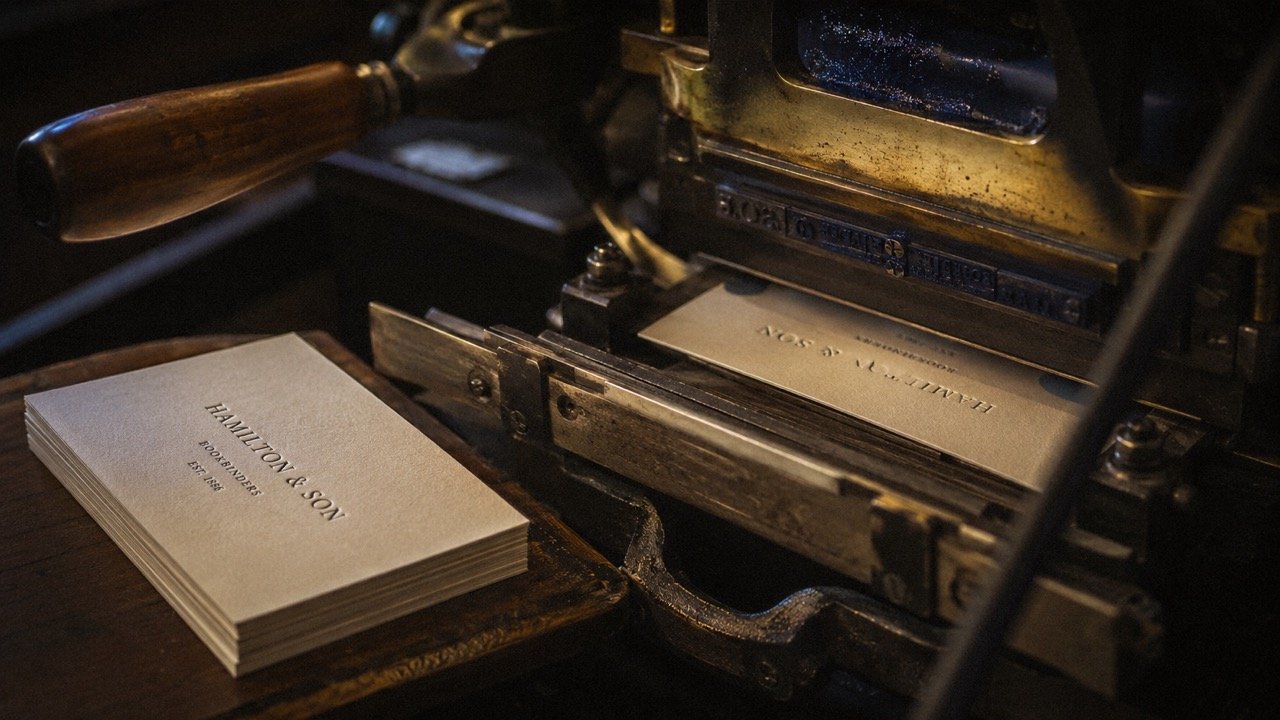
The argument for letterpress — for hand-setting type in metal and running it through a press, for relief printing with woodblocks and linocuts, for producing an edition that has physical variation across its twenty-five copies because twenty-five individual impressions were made by hand — is not a sentimental argument. It is a material argument. The surface of a letterpress-printed page is different, physically, from a digitally printed page: the ink is pushed into the paper’s grain by the pressure of the type, leaving an impression that is both visual and tactile, a mark that reflects light differently from the surface it surrounds. This difference is not subtle to a trained hand. It is what the medium produces and what no digital facsimile can replicate, any more than a JPEG of a ceramic reproduces the clay.
Melbourne’s artisan print culture operates in the productive space between heritage and contemporary practice. The city has a cluster of letterpress, etching, and screen-printing studios in its inner north — concentrated around Fitzroy, Collingwood, and the Abbotsford Convent arts precinct — that treat their medium not as a romantic recovery of something lost but as the deliberate choice of a specific material vocabulary. These are makers who could produce a result in less time by other means and have decided not to, because the result would be different in ways that matter to them. The collector who understands this — who approaches a hand-printed edition not as an artisanal curiosity but as an object with material properties that justify its production method — will find this community unusually candid about its motivations and unusually rewarding to patronise.
The print culture intersects with Melbourne’s serious small-press literary scene in ways that reflect the city’s broader creative interconnectedness. Giramondo — one of Australia’s most rigorous literary publishers, whose list includes Gerald Murnane, Alexis Wright, and a sustained commitment to experimental and translated literature — is a Melbourne house. Arcadia Books and the city’s poetry micro-press networks produce editions that are, at their best, objects worth owning as objects as well as reading as text. The hand-binders of the Nicholas Building complete the picture: an edition printed in a Fitzroy studio, bound by a Nicholas Building bookbinder in a cloth chosen by the writer, is a form of publication that has no digital equivalent and no pretension about what it is.
Ink & Spindle: The Abbotsford Convent Textile Press
Ink & Spindle, founded in 2008 and based within the Abbotsford Convent on the Wurundjeri lands of the Kulin Nation, occupies the intersection of print culture and textile practice. The studio produces hand-screen-printed fabrics on organic cotton/hemp and eco-linen basecloths — botanical imagery, Australian native flora rendered in water-based, solvent-free inks — that function as both studio practice and production. The work is sold by the metre as well as made into homewares, and the studio operates as a showroom within the Convent, where the production process is visible and the relationship between making and selling is direct.
What makes Ink & Spindle relevant to the broader print conversation is its commitment to materiality in exactly the terms that letterpress commits to it: every metre is printed in their Melbourne studio, by hand, with a surface quality that mass-production cannot replicate. The registration of hand-printing — the slight variation in colour density, the occasional mis-register that is the honest record of a human body applying pressure through a squeegee — is not a defect but an argument. These textiles bear the evidence of their making in a way that photographed-and-printed patterns cannot. When you cut and sew a garment from Ink & Spindle cloth, you are wearing that argument.
1 Saint Heliers Street, Abbotsford (Abbotsford Convent). inkandspindle.com.au
5 Press and the Artists’ Book Tradition
5 Press — a Melbourne-based artists’ book practice — represents the upper end of what Melbourne’s print community produces: editions in which the book-object is itself the artwork, in which typography, paper, binding, and content are integrated decisions made by a single creative intelligence. Artists’ books in this tradition are not illustrated books or deluxe editions in the commercial sense; they are objects in which the physical form of the book — its sequence, its materiality, its behaviour in the reader’s hands — is as significant as the text or image it contains.
The artists’ book community connects to the hand-binding studios of the Nicholas Building in a practical way: printers who produce texts without binding capacity collaborate with binders who can resolve the physical form of an edition. The result is work that circulates through Craft Victoria, through specialised fairs including Sydney’s Printed Matter events, and through the international artists’ book network that Melbourne’s print community has long been embedded in. Collecting artists’ books requires a different orientation to value than collecting paintings or ceramics — these are not unique objects but small editions, and their value is the value of the idea fully resolved in physical form.
The Nicholas Building Bookbinders: Commission Work
The hand-binding studios in the Nicholas Building produce work that ranges from edition bindings for small-press publications through to one-of-a-kind personal commissions. The binding of a book — the covering of boards in Japanese tissue paper, Italian bookcloth, or leather; the rounding and backing of a spine; the sewing of a textblock through signatures rather than gluing it into a case — is a form of making that requires tools (bone folders, finishing tools, backing hammers, a standing press) and knowledge that take years to accumulate and that produce, at their best, an object intended to outlast a century of use.
A bespoke commission from a Nicholas Building bookbinder might involve rebinding a significant personal book in a cloth or leather chosen for it, creating a journal or commonplace book in a specific size and format, or binding a small press edition that the publisher wishes to distinguish from its trade copies. The conversation between client and binder is itself generative: a binder who has spent years thinking about the relationship between text, paper, and physical form will ask questions about how a book is to be used that reshape what the client thought they wanted. This is the value of working with a maker rather than ordering from a catalogue.
37 Swanston Street (various floors), Melbourne CBD. nicholasbuilding.org.au
The Protocol of the Print Collector
Melbourne’s print community is accessible at multiple levels: the Abbotsford Convent Maker’s Market provides entry-point access to print artists in person; Craft Victoria’s gallery programme curates the more developed work; the Nicholas Building studios require direct approach but reward it. The Rose Street Artists’ Market in Fitzroy adds a further venue for print editions, particularly at the affordable end.
For the collector beginning to engage with print as a serious medium: buy works on paper first, before investing in artists’ books or hand-bound editions. The Craft Victoria gallery and the Abbotsford Convent Open House events are the best contexts for seeing Melbourne’s print range in a concentrated form. Once you understand the range — the difference between a screenprint edition of fifty and a letterpress edition of twenty and a unique copperplate etching — the decisions become more specific, and more satisfying.