
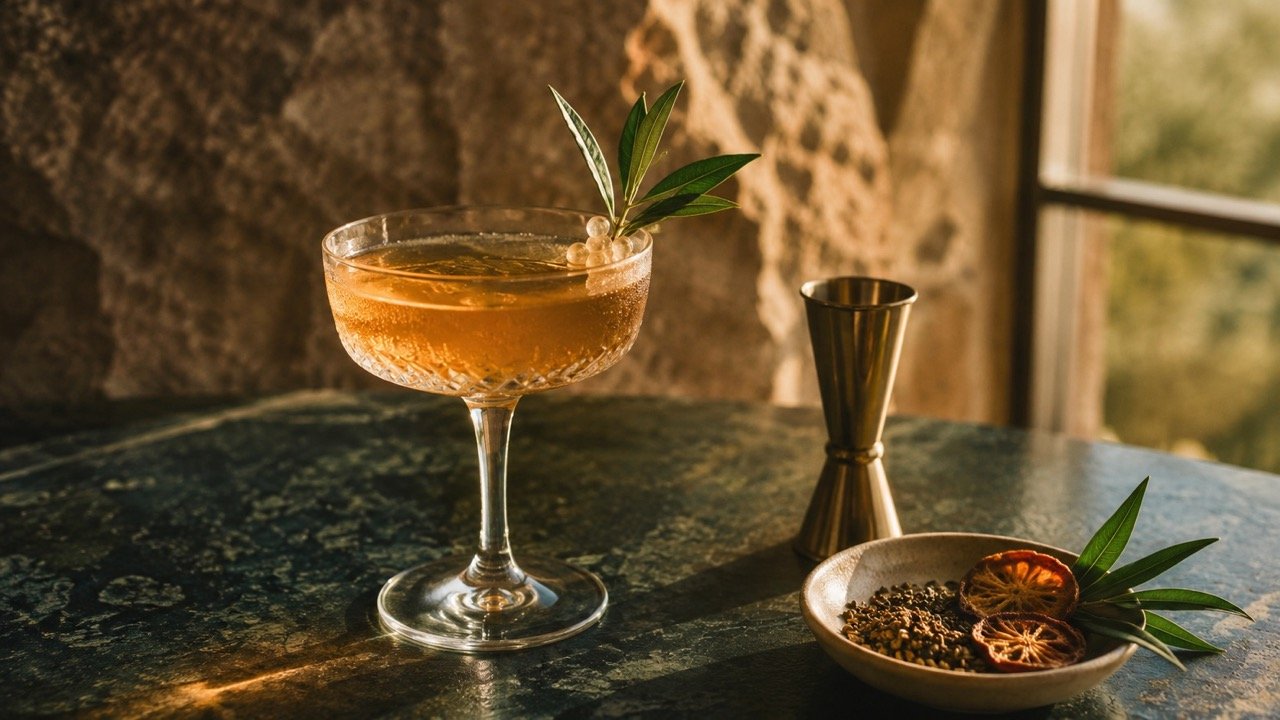
The Australian cocktail was, for too long, an international drink served with Australian ingredients as decoration — a gin and tonic with a wattle sprig, a pisco sour renamed for the occasion. What is happening now in Sydney’s most serious bars is more interesting than that: the native botanical is no longer garnish. It is architecture.
The shift has been driven by bartenders who began treating Australian flora with the rigour that was previously reserved for European spirits categories. Lemon myrtle as a foundational note rather than a perfumed afterthought. Wattleseed as a roasted, nutty base that carries spirits differently than any Old World analogue. Davidson plum — a Daintree rainforest fruit with the acidity of tamarind and the colour of crushed garnets — as a souring agent that produces something functionally impossible to replicate with citrus alone.
The result is a category of cocktail that tastes specifically, irreducibly Australian. And Sydney has the bars to find it.
The Botanicals: A Working Vocabulary
Before the rooms, a brief field guide to the plants that are reshaping the Australian glass.
Lemon myrtle (Backhousia citriodora): Native to Queensland’s subtropical rainforest, containing the highest natural concentration of citral of any plant — the compound responsible for lemon and lime aroma. Used as a leaf infusion in spirits or as a dried powder in syrups, it produces a citrus note cleaner and more aromatic than lemon juice, with none of the acid. Best with gin, vodka, and light rum bases.
Finger lime (Citrus australasica): The interior contains caviar-like pearls of juice in a sharp, grapefruit-forward flavour profile. As garnish these pearls burst on the palate and release acidity at the moment of drinking rather than in the mixing. As pressed juice, the flavour is more complex than conventional lime and adds a textural dimension to cocktails built around mouthfeel.
Wattleseed (Acacia): Roasted and ground, wattleseed has a flavour profile somewhere between coffee, chocolate, and hazelnut. As a syrup base or infused into spirits, it adds a warm, bitter-roasted quality that bridges the gap between spirits and dessert. Pairs particularly well with aged rum, whisky, and digestif-style cocktails.
Davidson plum (Davidsonia pruriens): Deeply purple-red, intensely sour, with berry and stone-fruit undertones. The puréed fruit produces a souring agent with ten times the complexity of lemon juice. The colour alone — a deep, jewelled magenta — transforms the appearance of any cocktail it enters.
Riberry (Syzygium luehmannii): A small rainforest fruit with a clove-cinnamon spice and a tart berry finish. Used as a syrup or compote, it adds a distinctly Australian warmth to cocktails that would conventionally reach for amaretto or allspice.
The Baxter Inn, Sydney CBD
The Baxter Inn has no sign at street level. The entry is through an unmarked door off a laneway off Clarence Street, down a narrow staircase, into a basement lined floor to ceiling with approximately two thousand bottles of whisky. The bar has been Sydney’s most serious spirits room for over a decade, and its engagement with Australian whisky — now extending to cocktails built around native botanical spirits — reflects the house’s characteristic combination of obsession and restraint.
The native cocktail programme here is not seasonal or themed — it is integrated into the menu as permanent expressions of specific Australian spirits. A cocktail built around a Port Phillip Distillery gin with a lemon myrtle simple syrup and finger lime air. A whisky sour adapted with Davidson plum as the souring agent in place of lemon, allowing the Sullivans Cove single malt to come forward rather than retreating behind citrus.
The team are expert enough to explain why each choice was made. The conversation is, as in all good bars, part of the drink.
152–156 Clarence Street, Sydney CBD. Entry via laneway. Open Monday to Saturday from 4pm. thebaxterin.com.au
Maybe Sammy, The Rocks
Maybe Sammy trades in a different register to the Baxter Inn — brighter, more theatrical, with a bar programme that prioritises craft and creativity in equal measure. The 1950s Italian-American aesthetic of the room is a counterintuitive context for native Australian botanical cocktails, which is precisely the point: the tension between the setting and the ingredients produces something more interesting than either could generate alone.
The house’s wattleseed Espresso Martini — built on Cold Drip coffee, a Tasmanian single malt, and wattleseed syrup, served with a native pepperberry floated on the surface — is the most intelligent version of this particular category of cocktail available in the city. The wattleseed adds a roasted depth that the conventional recipe, with its vodka and coffee liqueur, cannot access.
The cocktail menu rotates regularly. Whatever the season, there will be at least two compositions that use native botanicals as primary rather than decorative elements. Trust the floor staff to navigate the rotation.
115 Harrington Street, The Rocks. Open Tuesday to Saturday from 5pm. maybesammy.com
Bulletin Place, Sydney CBD
Mentioned in this edition’s sommelier guide for its wine programme, Bulletin Place deserves a second appearance for the seriousness of its cocktail approach to seasonal and native Australian ingredients. The menu changes daily — every day, not seasonally, not monthly — built around what the kitchen considers exceptional that morning, which in a bar context means botanicals sourced from specialist Australian ingredient suppliers who operate on agricultural rather than commercial cycles.
The result is a programme in which the native botanical is not a fixed category but a fluid one: some days a Davidson plum shrub anchors three separate cocktails; other days the focus shifts to finger lime or riberry depending on what has arrived. The theoretical framework is consistent — Australian terroir expressed through bartending craft — and the execution is among the most technically accomplished in the city.
10–14 Bulletin Place, Sydney CBD. Open Tuesday to Saturday from 4pm. bulletinplace.com
Island Lime, Circular Quay
Island Lime is the only bar in this guide that places the native botanical programme within an explicitly Pacific Islands cultural context, drawing on the overlap between Australian Indigenous botanical knowledge and Pacific Islander traditional uses of native plants. The cocktail list is shorter than the others listed here and more focused: perhaps eight cocktails, each built around a specific botanical pair — lemon myrtle and pandanus, wattleseed and coconut vinegar, riberry and fresh turmeric.
The bar occupies a narrow terrace level at Circular Quay with a view across to the ferry wharves. In summer, the late-afternoon sitting — before the dinner crowds arrive — offers the combination of native botanical drinks and harbour light that is specific to this city and this bar.
Circular Quay, Sydney. Hours vary; check current schedule.
On Building a Native Botanical Home Bar
For those interested in replicating at home, a brief sourcing note.
The most reliable national supplier of premium native Australian botanicals for culinary and beverage use is Outback Spirit and Australian Native Food Co., both of whom supply dried and preserved botanicals directly to consumers. For spirits, the Archie Rose Distilling Co. in Rosebery maintains a core range of Australian-botanical gins that are available from the distillery cellar door and from premium bottle shops nationally.
The most useful starting combination for a home programme: lemon myrtle simple syrup (one part lemon myrtle leaf simmered in two parts sugar syrup), finger lime pearls (available fresh from specialty grocers seasonally, or preserved from the suppliers above), and a bottle of Archie Rose White Rye, which functions as the most versatile Australian spirit base for botanical experimentation.
What to build with these three components is, from this point, the most rewarding question in Australian bartending.