
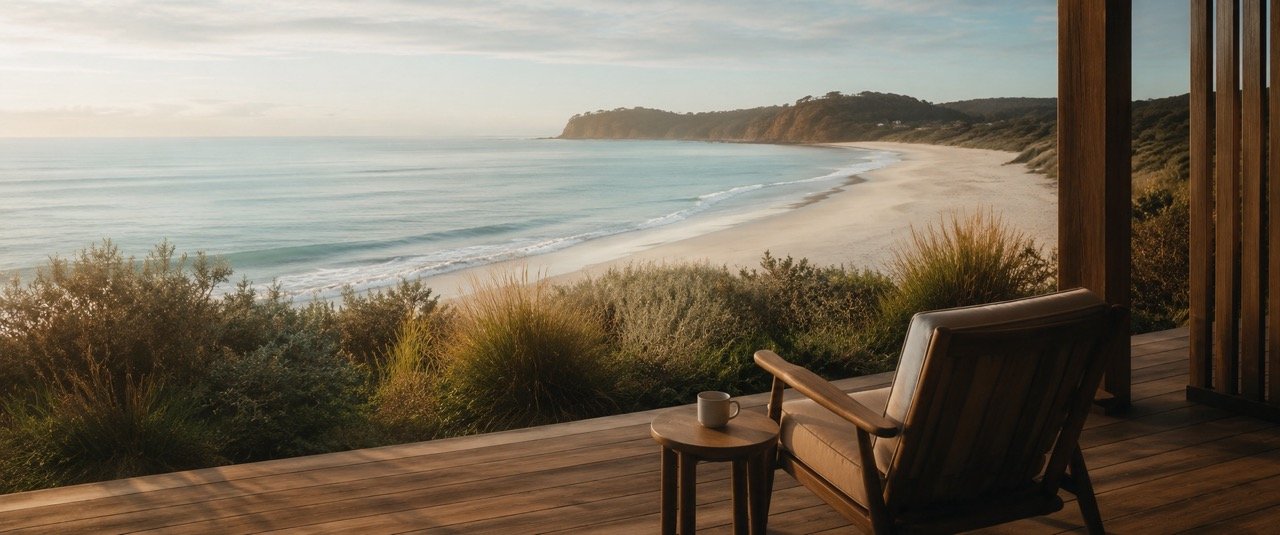
Phillip Island exists in the Melbourne imagination primarily as two things: the penguin parade and the Motorcycle Grand Prix circuit. The penguin parade draws a million visitors a year to watch Little Penguins waddle up Summerlands Beach at dusk — a genuine and affecting wildlife spectacle, managed with reasonable care, and available in several ticketing tiers depending on how close you wish to stand in a crowd. The Grand Prix circuit runs a motorcycle race each October and a support category for V8 Supercars. Both are fine and neither is the reason to come.
The island that sits 140 kilometres southeast of Melbourne, connected to the mainland by a bridge over the Narrows at San Remo, is an island in the meaningful rather than administrative sense: a place shaped by water on all sides, by Bass Strait to the south with its long-period swell from the Southern Ocean, by Western Port Bay to the north with its mangroves and shallows, and by the constant southwesterly winds that have determined what grows here — coastal heath, moonah trees with their tortured limbs, she-oaks that bend permanently in the direction of the prevailing weather. This is the windiest, most elemental coastline in southern Victoria, and for people who understand why that matters, it has no real rival in easy reach of the city.
Churchill Island Heritage Farm
Churchill Island connects to Phillip Island by a short causeway off the bridge road, and the farm that occupies it is, historically speaking, the oldest in Victoria. European farming began here in 1801 when Samuel Amess established the first crops — the documentation of this is in the homestead’s heritage record — and the island has functioned as working agricultural land, with interruptions, ever since. The current farm retains heritage buildings from the 1860s and operates daily demonstrations of the crafts that sustained Victorian rural life: sheep shearing, blacksmithing, working dogs, and the particular mid-nineteenth century rhythms of a self-sufficient farm in a challenging location.
None of this sounds, in summary, remarkable. In practice, Churchill Island is one of the few places in Victoria where the nineteenth century agricultural landscape — the ancient Moonah trees, the heritage wetlands, the 1862 Rogers family cottage — is intact enough to be felt rather than explained. The birds are exceptional: wetland species in the tidal flats on the northern shore that reward binoculars and patience, and raptors over the open paddocks in the late afternoon that are operating on their own schedule entirely. Come in the morning, before the tour buses, and walk the perimeter track through the Moonah woodland in the hour when the light is still low and angled.
Churchill Island Heritage Farm, via Phillip Island Road, Newhaven. penguins.org.au.
Cape Woolamai and the Bass Strait Headlands
Cape Woolamai is the most significant piece of landscape on the island and the least visited by the penguin parade crowd, which is to say that its walking tracks are rarely congested and its headlands are reliably quiet. The cape is a mass of pink granite rising to 100 metres at the southeast corner of the island, with Bass Strait on three sides and a view south that reaches, without interruption, to the horizon of open ocean. The long-period swell that arrives at the base of these headlands — groundswell generated by depressions crossing the Southern Ocean, travelling thousands of kilometres to break against this particular formation of granite — is audible before it is visible, a low percussion that gets louder as you descend the track toward the water.
Walk the Woolamai circuit — 7.5 kilometres from the surf beach car park, through the granite headland, along the clifftop above the swell, back through coastal heath — in the late afternoon when the south-facing rock has taken on warmth from a sun already declining in the northwest. The heath is extraordinary in spring: coastal tea-tree and banksias in bloom, the heath at its most colourful against the grey-blue of the strait. In winter, the cape is something else: cold, horizontal wind, spray visible from the clifftop a hundred metres below, and a quality of exposure that is correctly described as elemental and not otherwise.
Cape Woolamai Walking Track, off Cape Woolamai Road. Free access, year-round.
The Bass Strait Shore and the Coast That Is Not the Beach
The southern coast of Phillip Island, from Woolamai west through Smiths Beach and Cat Bay to Cape Grant, runs along Bass Strait with the unobstructed fetch of open ocean and produces surf beaches that are serious cold-water surf — water temperature around 14 degrees in winter, double overhead sets in large southern swells — and a coastal landscape of sand dunes, coastal banksia scrub, and heath that has no resort management whatsoever. This is state park, managed by Phillip Island Nature Parks, and the tracks that run through it see fewer visitors than the beaches.
Smiths Beach is a white sand beach in a sheltered bay with a surf club and a small cluster of houses; it is the island’s best swimming beach and pleasant in summer without being crowded in the way of the mainland beach strips. The views east toward Cape Woolamai — granite headland, lighthouse, the swell wrapping around the point — are the compensation for the cold water. Spend the afternoon here, watch the light change on the headland, and drive back north through the island’s farmland in the dusk light. The island is small enough — 26 kilometres long, nine wide — that this circuit takes an hour.
A Note on Timing
The island is worth two days rather than one: Churchill Island in the morning on arrival, Cape Woolamai in the afternoon, Smiths Beach the following morning. Accommodation in Cowes or Rhyll keeps you on the island overnight rather than commuting from the mainland, which is the difference between experiencing the island’s rhythm — quiet evenings, the sound of Bass Strait from any elevated point, the specific morning quality of a small island waking up — and simply passing through it. The penguin parade remains available in the evening of your first day if curiosity wins out. It is, for the record, affecting.