
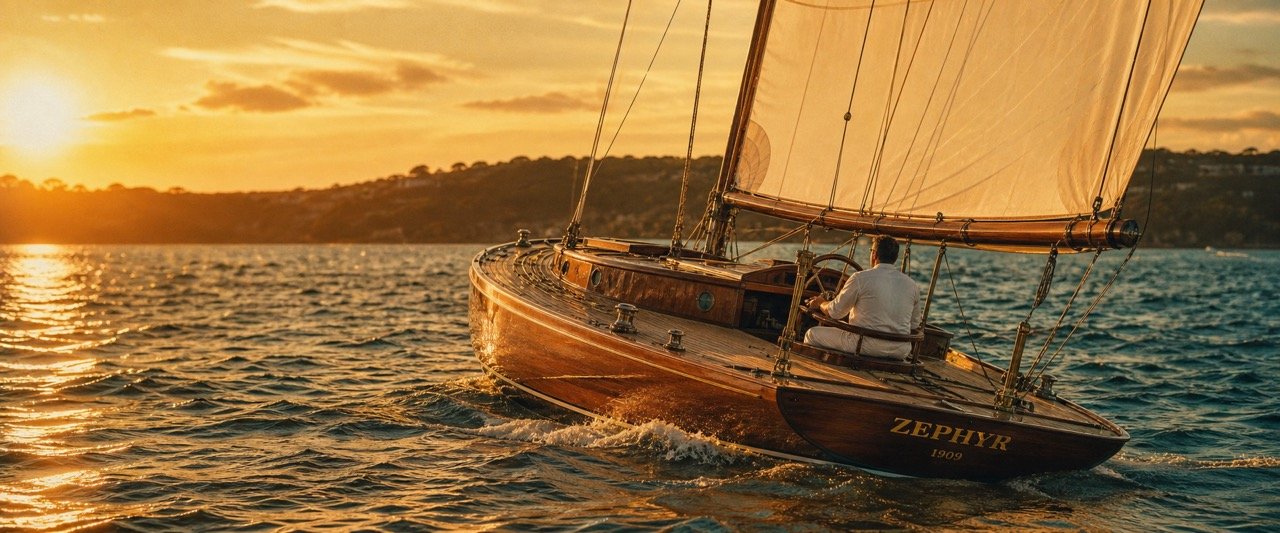
Port Phillip Bay is 1,950 square kilometres of sheltered water, and the phrase “sheltered water” requires qualification. The bay has an average depth of thirteen metres, which means that when the afternoon sea breeze builds — typically northwest-to-southwest, typically reaching twenty to thirty knots by 2pm in the summer sailing season — it pushes a short, steep chop that has none of the long-period roll of ocean sailing but all of the boat-handling demands of sailing in significant wind. A flat-bottomed chop in thirty knots on a short tack is technically more demanding, not less, than the same wind on open water where the waves run with a longer period and the boat’s motion is more predictable. Port Phillip Bay, in other words, teaches sailing in a way that the more romantic venues do not.
The bay’s sailing culture goes back to the earliest years of European settlement. The Royal Melbourne Yacht Squadron — the correct full name — was established at St Kilda in 1876, one year after the Royal Brighton Yacht Club, and both clubs organised the yachting events at the 1956 Melbourne Olympics. This is a sailing culture with 150 years of institutional continuity and a competitive infrastructure — weekly racing, offshore series, keelboat and dinghy fleets, interclub competitions — that is considerably more serious than its visibility in the city’s cultural conversation suggests. The people who sail the bay tend to regard the bay as sufficient and do not require it to be glamourised.
Royal Melbourne Yacht Squadron, St Kilda
The RMYS sits at the end of St Kilda Pier Road, adjacent to the pier and the penguin colony, and has occupied this foreshore location in some form since 1876. The current facilities — a modern marina with approximately 250 pens and around 115 swing moorings in the St Kilda Harbour — support a fleet that races on Saturday afternoons, Wednesday afternoons, and occasional Sunday series. The club ran the keelboat and dinghy events at the 1956 Melbourne Olympics, which establishes its historical standing in Australian sailing, and the current competitive program ranges from social club races to interclub series against Brighton and other bay clubs.
The sea breeze that drives Saturday afternoon racing typically develops from the southwest between noon and 1pm and builds to its peak of twenty to thirty knots by 2pm, creating conditions that produce genuinely fast fleet racing on courses set off the St Kilda foreshore. Watching from the club’s balcony — the fleet running downwind in a building breeze, spinnakers set, the CBD visible across the water — has the quality of a city’s civic pleasure being exercised in public. The clubhouse is open to members and guests; a proper understanding of what the bay can produce is best obtained from the water, which requires membership or an invitation from a member.
Royal Melbourne Yacht Squadron: Pier Road, St Kilda. rmys.com.au.
Royal Brighton Yacht Club
The Royal Brighton Yacht Club, established in 1875 at one year’s seniority over the RMYS, operates from the foreshore at 253 Esplanade in Brighton and runs a racing calendar that covers keelboats, sportboats, and trailer-sailers across the summer season and continues with winter racing for the committed. The club’s position on the eastern shore — the prevailing sea breeze comes from the south and southwest, building across the bay toward Brighton — means the racing beat is typically a port-tack reach into the breeze, and the course setting takes advantage of the unobstructed fetch across the bay’s width.
The offshore racing program, which runs a summer series including races to and from the Heads and around marks set in the shipping channel, extends the bay’s technical demands into longer distances where navigation and tide management become as important as boat-handling. The tides at the Heads — Port Phillip’s narrow entrance between Point Nepean and Point Lonsdale — run at six to eight knots on a strong spring ebb, which produces standing waves and confused swell at the entrance that are instructive even for experienced ocean sailors encountering them for the first time.
Royal Brighton Yacht Club: 253 Esplanade, Brighton. rbyc.org.au.
What the Bay Teaches
The specific educational value of Port Phillip Bay for a sailor is the absence of the ocean’s cushioning. On open water, the swell period — typically eight to fourteen seconds in Bass Strait — gives a boat time to respond between waves, and the motion, however violent, has a rhythm. On the bay in a sea breeze, the chop period is two to three seconds, which means the boat is always on a wave, always adjusting, always being tested on rig tension and helm feel and crew weight placement. Sailors who grew up on the bay and then went ocean racing often report that the transition felt easier than expected: the bay had already required everything.
The Port Phillip sailing season runs from October through April, with the sea breeze most reliable and most powerful from December through February. Winter sailing continues — the wind is often stronger and the sky more dramatically overcast, the CBD to the north a grey silhouette against grey cloud — but the exposure on the water in July without adequate preparation is real. The bay is never tropical and is not designed to be. It is a Victorian body of water in the Victorian weather, and it rewards the sailor who dresses for it and treats it accordingly.
A Note for Non-Members
Both the RMYS and RBYC welcome expressions of interest from experienced sailors seeking crew positions on race days. The custom on Port Phillip Bay, as in most competitive yacht club cultures, is to ask at the bar after a club race whether any boats need crew — the answer is frequently yes, the initiation is genuinely hospitable, and the experience of sailing in a race fleet on the bay in a building afternoon sea breeze is worth whatever discomfort accompanies the first time you find yourself hiking out on a rail-down forty-footer in twenty-five knots of flat-chop sea breeze. Wear dedicated footwear. The decks are wet from the start.