
St Kilda has been gentrified at least twice and rediscovered approximately six times in the past thirty years, and it is still not entirely clear whether the suburb that emerges from each cycle is better or worse than the one that preceded it. The Fitzroy Street strip has moved through rough-trade to cafes to restaurants to more restaurants, and the Acland Street of the current decade — prosecco bars and brunch menus, the Continental reopened in a different register — is not the Acland Street of even fifteen years ago. This is the nature of inner suburbs in global cities, and St Kilda is no exception to the process that has also worked through Fitzroy, Richmond, and Collingwood.
What is unusual about St Kilda is the degree to which the process has left certain things intact. Not preserved, not gentrified back to a heritage version of themselves, but genuinely continuing — surviving the pressure because of what they are rather than what they represent. The suburb still produces what Melbourne, uniquely among Australian cities, has always been capable of: a register in which bohemianism and respectability are not opposites but neighbours, in which the front bar and the concert hall are two doors apart, in which a cake shop that opened in 1934 and has no interest in rebranding is the most correct destination on the street. The things that remain in St Kilda are worth understanding as things that chose to remain, which is different from things that were preserved.
The Esplanade Hotel
The Espy, built in 1878 and sitting at 11 The Esplanade since before St Kilda was an inner suburb of anything, has operated as a music venue and front bar for long enough that its history contains almost every significant period of Melbourne’s live music culture. The bands that played the front bar before they were famous are too numerous to constitute a list without becoming a Melbourne cultural mythology checklist; the point is that the front bar still functions as a room where music happens because the people in it require it, not because a hospitality group has determined that live music increases per-head spend.
The 2018 renovation was substantial — the building reopened after a significant refit with new bars, upgraded stages, and a rooftop addition — but the front bar retained what makes it itself: the view of Port Phillip through the bay-facing windows, the worn floor, the proximity to the stage in a room that is sized for music rather than capacity. Come on a Wednesday evening when nothing particular is scheduled and the front bar has the quality it has always had — a room full of people who are there because they prefer to be there. Order whatever is on tap. Do not take a table away from the window if you can avoid it.
11 The Esplanade, St Kilda. espy.com.au.
Monarch Cakeshop
The shop now at 103 Acland Street, St Kilda, was established in this location in 1934 by a Polish-immigrant family who had been baking Central European cakes at an earlier address in Carlton and followed their clientele south as the Jewish community moved toward St Kilda. The recipes in production today — the szarlotka, the poppy seed rolls, the babka, the sacher torte — arrived with the family from Poland in the 1930s and have not been modernised, which is to say they have not been made more approachable or given new names or reframed as artisanal interpretations of Central European tradition. They are Central European cakes made to Central European recipes by a family business that has been in the same premises for more than ninety years and sees no reason to change.
The shop has no Instagram account that constitutes part of its identity, no branding in the contemporary sense, no tasting notes beside the glass cabinets. There are cakes in the cabinet and a counter and people who know what they want. In a street that has changed almost entirely around it, Monarch functions as a kind of argument: that the best reason to survive is to do the thing you do without apology or adaptation, and that the right customers will find you. The szarlotka on a Saturday morning with a coffee from a place nearby constitutes one of the suburb’s more reliable pleasures.
103 Acland Street, St Kilda. monarchcakes.com.au. Open daily.
The Pier and Its Rituals
The St Kilda Pier extends 900 metres into Port Phillip Bay from the foreshore at the bottom of Jacka Boulevard, and it has been there since 1857. The kiosk at the far end — a hexagonal Art Deco structure — serves coffee and has been serving it in some form since the kiosk was built. The penguin colony that inhabits the rocks at the end of the breakwater, a year-round population of Little Penguins that has established itself under the pier kiosk platform, is monitored by volunteer rangers in the evenings and is visible any evening from dusk — not the managed spectacle of Phillip Island, but a colony living in its chosen location in the middle of a bayside suburb, which is its own kind of marvel.
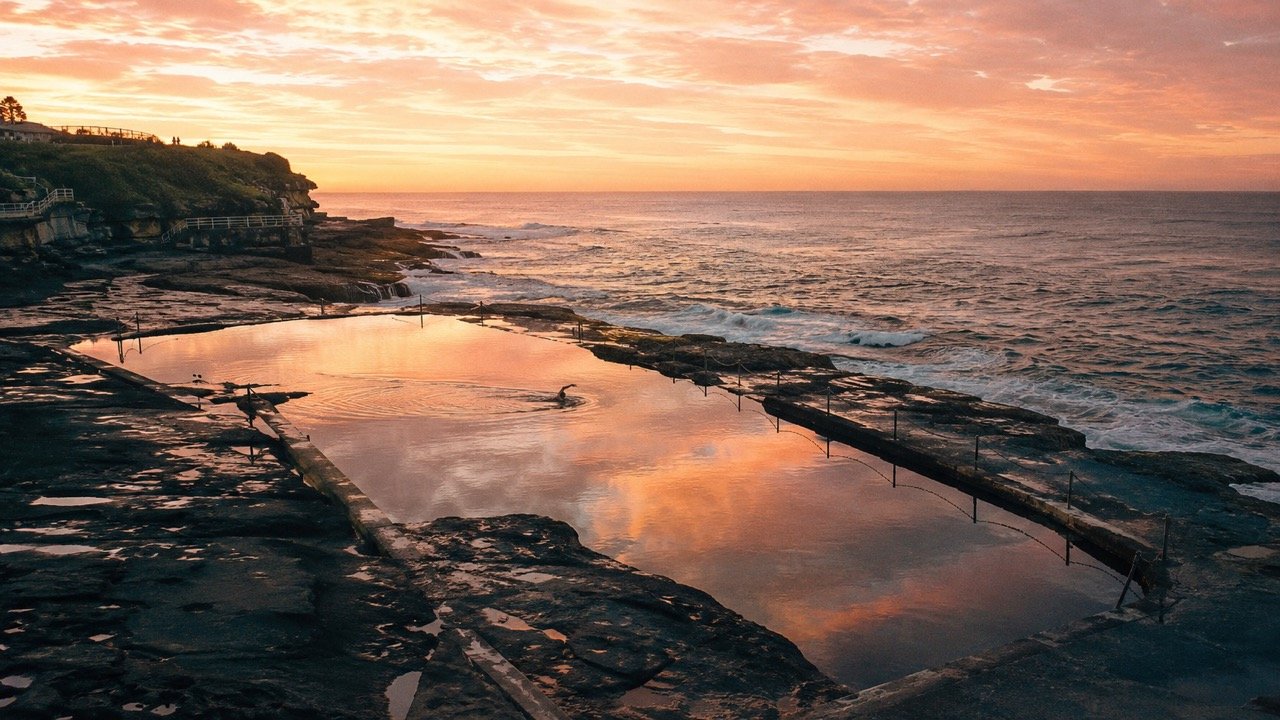
The pier at 7am on a Sunday morning — before the day trippers, before the cyclists, before the coffee queue at the kiosk — has the quality of the wider city at that hour: honest, quiet, unhurried. The bay is flat and grey, there is usually a single swimmer in the water off the pier, and the city is visible across the bay to the north in a skyline that is more beautiful at this hour and from this distance than from any other. Walk to the end, sit on a bench, watch the light change on the water. It is free, it is available every morning, and it is one of the genuinely understated pleasures of living in this city.
St Kilda Pier, Jacka Boulevard, St Kilda. Free access year-round. Penguin viewing from dusk, monitored by volunteers.
Luna Park and the Architecture of Irony
Luna Park at 18 Lower Esplanade opened in 1912 and the mouth — the gaping face of Mr Moon, built in 1912 — has been the entrance since the beginning. It is one of the oldest continuously operating amusement parks in the world, and the face is one of the most recognised images in Melbourne, which makes it easy to overlook as a piece of genuine architectural thinking. The mouth as irony made architectural: you enter through a face that is laughing at you, which is the correct relationship between a fairground and its visitors. The Scenic Railway, built in 1912 and the oldest continually operated wooden rollercoaster in the world, runs on its original timber structure with a brakeman riding each car — not because this is more efficient but because the ride was designed that way and changing it would not improve it.
Luna Park is heritage-listed, occasionally controversial about expansion proposals, and reliably present on the foreshore as something that refuses to be repositioned as anything other than what it is. It sits between the Espy and the pier, in a suburb that has been gentrified repeatedly around it, and it does not attempt to make itself more sophisticated than a 1912 amusement park. This is correctly understood as a form of integrity.
18 Lower Esplanade, St Kilda. lunapark.com.au. Check operating hours — weekends and school holidays guaranteed; weekdays variable.