
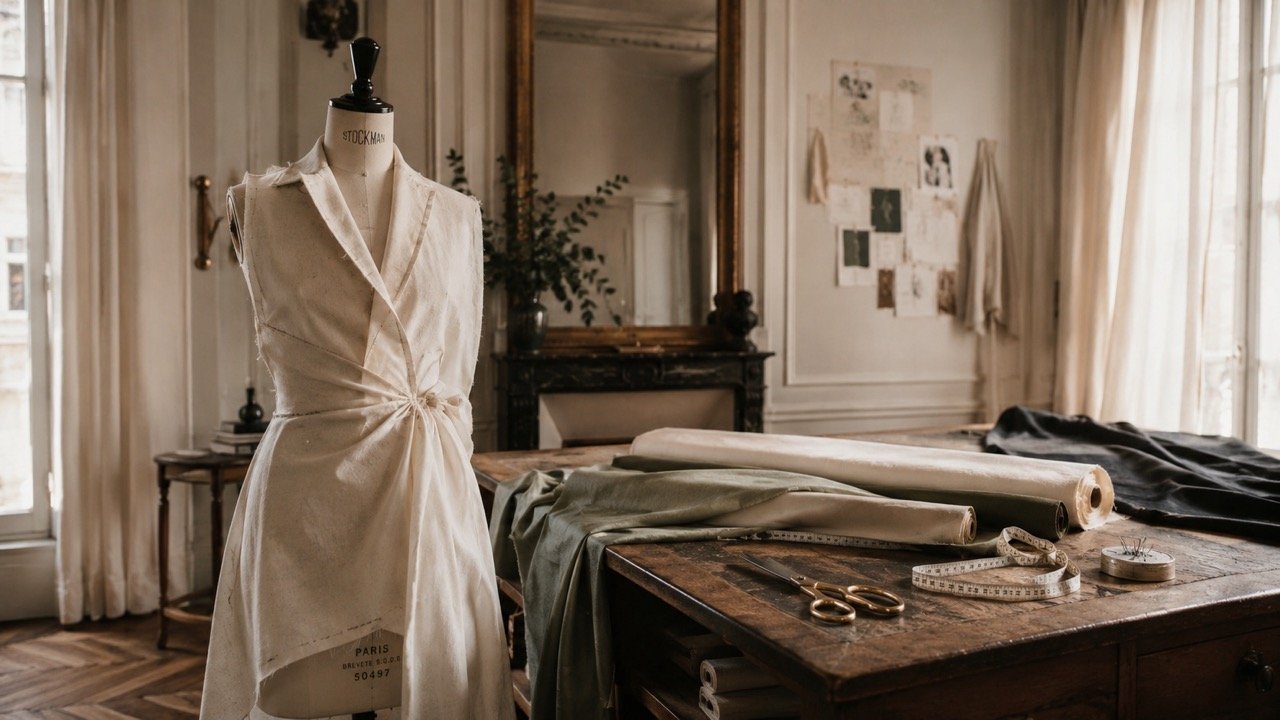
In Paris, the couture calendar is a liturgy — dates as fixed as feast days, maisons as ancient as the boulevards themselves. In Sydney, the atelier tradition is younger, less codified, and precisely because of that, more interesting. The people working here did not inherit their workrooms from three generations of family precedent. They chose this, deliberately, in a city that did not yet have the language for what they were doing.
The results, for those who know where to look, are remarkable.
What Bespoke Actually Means
Before the rooms: a clarification that matters more than it should need to.
Made-to-measure and bespoke are not synonyms. Made-to-measure begins with an existing pattern, adjusted to your measurements. Bespoke begins with nothing — a blank cutting table, a conversation, a length of cloth, and the construction of a pattern specific to your body and your intentions. The latter requires more time, more skill, and considerably more cost. It also produces something that fits in a way that ready-to-wear, however well-tailored, cannot approximate.
The ateliers below offer true bespoke work. The process typically involves two to three fittings over six to twelve weeks. The conversation at the first appointment will cover not only measurements but context: where the garment will be worn, how the wearer moves, what they feel when they are dressed well. This conversation, more than any technical specification, is what separates a good commission from an exceptional one.
Calibre Clothing, Sydney CBD: The Standard-Bearer
Calibre’s bespoke division — separate from its ready-to-wear retail operation — operates out of a quieter consultation space and remains one of the most technically accomplished tailoring ateliers in the country. The cutting is clean and architectural: the Sydney Calibre aesthetic tends toward a slightly extended shoulder, a suppressed waist, and a chest that sits without padding while still holding its shape.
The house has a longstanding relationship with several Italian and British cloth merchants, and the fabric consultation is genuinely educational for the client who arrives knowing little about suiting. The distinction between a 240-gram Delfino tweed and a 270-gram Scabal flannel is demonstrated physically, the cloth draped over the shoulder in the light to show how weight affects drape.
For women’s bespoke — Calibre handles this with equal rigour — the house has developed a vocabulary for structured separates and occasion pieces that fits the Sydney client’s particular register: formal enough for the most significant rooms, relaxed enough for the harbour-side lunch that follows.
By appointment. George Street, Sydney CBD.
Belinda, Mosman and Sydney CBD: The French Sensibility
Belinda has occupied its position in Sydney’s upper tier of fashion for long enough that the name functions as shorthand — if you know the store, you already understand what it represents. What is less widely known is the extent of the bespoke and made-to-measure capability that runs alongside the retail operation.
The house carries a strong French sensibility in its custom work: a preference for drape over structure, for fabric that suggests rather than declares, for the kind of elegance that reads across a room without arriving before its owner. For occasion pieces — a dress for a gallery opening, a coat for a winter vernissage in Melbourne — the in-house design team works closely with the client through multiple fabric samples and proportion discussions before a single pattern piece is drawn.
The archive of European fabrics maintained at the Mosman atelier is worth a visit in its own right. Pieces of Lesage-quality brocade, lengths of Lyon silk in colours that have no names in English, samples of Portuguese linen so finely woven that they feel like cool water. The fabric is the beginning; the conversation that follows determines what it becomes.
By appointment. Military Road, Mosman, and in-store at the Sydney CBD flagship.
Gary Bigeni, Surry Hills: The Australian Modernist
Gary Bigeni’s atelier in Surry Hills occupies a different register to the others listed here — less European inheritance, more the development of a distinctly Australian sensibility in luxury womenswear. The house has dressed some of the most significant figures in Australian cultural life, and the aesthetic — fluid, precise, attentive to the way Australian bodies and Australian light interact — is instantly recognisable.
Bigeni works extensively with Australian and Pacific fabrics, and has developed a long relationship with several artisan textile producers in New South Wales. The custom work often begins with a fabric discovery: a length of naturally dyed silk, a handwoven cotton from a regional producer, a wool from a specific Merino station. The garment is built around the cloth rather than the cloth selected for the garment — a reversal of the conventional commissioning process that produces results of unusual originality.
The house’s approach to construction is deeply considered: Bigeni trained under significant Australian and European designers, and the attention to internal structure — to what happens inside the garment that the wearer never sees but always feels — sets the work apart.
By appointment. Surry Hills. garybigeni.com
The Commission: What to Expect
For those commissioning for the first time, a brief guide to the process:
The first appointment (allow ninety minutes) begins with conversation, not measurement. What occasions does the piece serve? What does the client already own and love? What do they reach for when the stakes are highest? The answers to these questions are the brief.
Measurements follow — not just circumference and length, but posture, the way the shoulder sits, the drop between front and back waist. A skilled cutter reads the body as a landscape.
The first fitting (four to six weeks later) is with a toile — a working version of the garment in an inexpensive fabric, used to test proportion and fit before the real cloth is cut. Alterations at this stage cost nothing. Alterations after the real cloth has been cut cost significantly more.
The final fitting confirms the finished work. Minor adjustments are made. The garment is collected or delivered pressed and on a cloth-covered hanger.
The result, if the relationship between cutter and client has been honest and attentive, is a piece of clothing that will be in use twenty years from now.
All ateliers listed work by appointment only. Lead times vary from six to sixteen weeks depending on commission complexity and current studio schedules.