
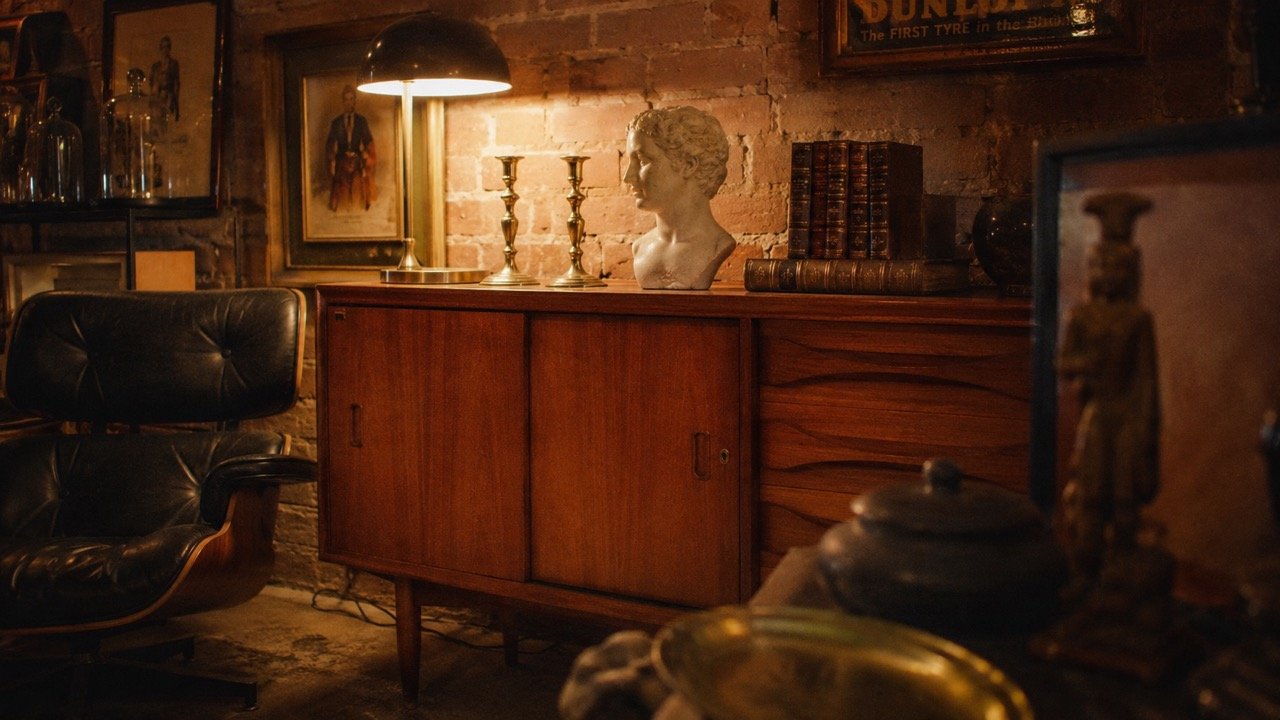
The acquisition of antiques is a discipline that requires a different temporal register to contemporary retail. You do not enter a dealer’s showroom with a specific shopping list and expect to leave with the exact dimensions and colours required. You enter to see what has survived. You enter to be educated by people who have spent their lives looking at the backs of drawers, the patination of bronze, and the specific way light falls on three-hundred-year-old walnut.
Sydney’s community of serious antique dealers has contracted over the past two decades — the casualty of shifting tastes and the relentless inflation of retail rents — but the dealers who remain are the ones who operate at the highest level of international practice. They are scholars of their specific periods, and their showrooms function as private museums where the collection is, occasionally, available for acquisition.
Martyn Cook Antiques, Rushcutters Bay
Martyn Cook occupies the absolute summit of the Australian antique trade. Since the 1980s, the gallery has been the primary source for the country’s most significant private collectors and public institutions, dealing in English, European, and occasionally colonial Australian furniture and objects of museum quality.
The aesthetic of the showroom — now located in Rushcutters Bay after decades in Woollahra — is unapologetically grand. This is the domain of Georgian mahogany, of Regency giltwood, of exceptional eighteenth-century clocks and nineteenth-century bronzes. But what separates Martyn Cook from merely expensive furniture dealers is the rigour of the provenance and the depth of the historical knowledge. The gallery does not deal in the reproduction or the heavily restored; it deals in authenticity.
A relationship with the gallery is essential for collectors operating at this level. The most significant pieces often transition from one private collection to another without ever being publicly displayed, mediated entirely through the dealer’s knowledge of where the objects belong.
Rushcutters Bay. By appointment recommended for serious enquiries. martyncook.com
The Antique Guild, Sydney CBD (and Brisbane)
While technically based in Brisbane, The Antique Guild maintains a significant presence for its Sydney clientele and operates at a level of international sourcing that makes it essential for serious buyers in this city. The focus is on fine silver, significant jewellery, and smaller decorative objects — the categories where provenance, condition, and maker’s marks require the highest degree of specialist literacy.
Their silver collection — particularly English silver from the Georgian and Victorian periods — is among the most comprehensive available in the country. For the collector assembling a serious dining table (as discussed in The Cultivated Table), the Guild is the correct source for the candelabra, the flatware, and the centrepieces that contemporary silversmithing rarely replicates.
The buying trips the directors undertake into Europe yield pieces that have been out of market circulation for generations. The newsletter, which documents these acquisitions, is required reading for the local antiquarian community.
Nicholas & Alistair, Online (Melbourne-based, National Reach)
For the collector of twentieth-century design, the definition of ‘antique’ has necessarily shifted to include the mid-century. Nicholas & Alistair — operating from Melbourne but with a strong Sydney collector base — are the most rigorous dealers in the country for post-war European design, particularly Italian and French pieces from the 1950s through the 1970s.
Their edit is flawless. They do not deal in the ubiquitous Scandinavian mid-century pieces that saturate the wider market; they focus on the architect-designed, the small-production, and the highly specific. A typical catalogue might include lighting by Arredoluce, seating by Gio Ponti, and ceramics by the major Italian mid-century studios.
The pieces are restored with museum-level care before sale — an intervention that, in twentieth-century design, is often necessary but rarely executed with the correct restraint. The photography on their site is exceptional, allowing Sydney buyers to acquire with confidence without physical inspection.
Anne Schofield Antiques, Woollahra
Anne Schofield is to antique jewellery in Australia what Martyn Cook is to furniture. Since opening her Woollahra boutique in 1970, she has become the acknowledged national authority on eighteenth-, nineteenth-, and early twentieth-century jewellery, consulting to museums and advising the country’s most serious collectors.
The boutique on Queen Street is small and the inventory is exquisite. The focus is heavily on English and European pieces — Georgian mourning jewellery, Victorian jet, Art Deco diamonds — with a specific emphasis on condition and original settings. The pieces here are not ‘estate jewellery’ (a term that often masks poor quality or broken sets); they are intact historical objects that happen to be wearable.
Schofield is also the co-author of the definitive text on Australian antique jewellery, and the boutique occasionally holds significant pieces from the colonial and Federation periods that represent the highest achievement of local nineteenth-century making.
36 Queen Street, Woollahra. Open Tuesday to Saturday. anneschofieldantiques.com
The Art of the Dealer Relationship
The most common mistake new collectors make is treating the antique dealer as a retailer. The dealer is an advisor.
When you enter a serious gallery, look carefully before speaking. Identify the pieces that draw your attention, even if they are beyond your budget. The questions you ask about those pieces — about their timber, their maker, their particular patination — signal to the dealer the level of your interest. A dealer who recognises a genuine aesthetic curiosity will spend an hour discussing an eighteenth-century chair with someone who is clearly not going to buy it today, because they understand that collectors are built over decades.
If you are looking for something specific, tell them. The international network of the top dealers is extensive; if you require a specific dimension of Regency dining table or a particular maker of Art Deco glass, they will find it on their next buying trip.
Finally, trust their eye on condition. In the upper tiers of the antique market, original condition — even with visible wear — is almost always preferable to aggressive restoration. The dealer who explains why a faded surface is correct is the dealer you want to buy from.