
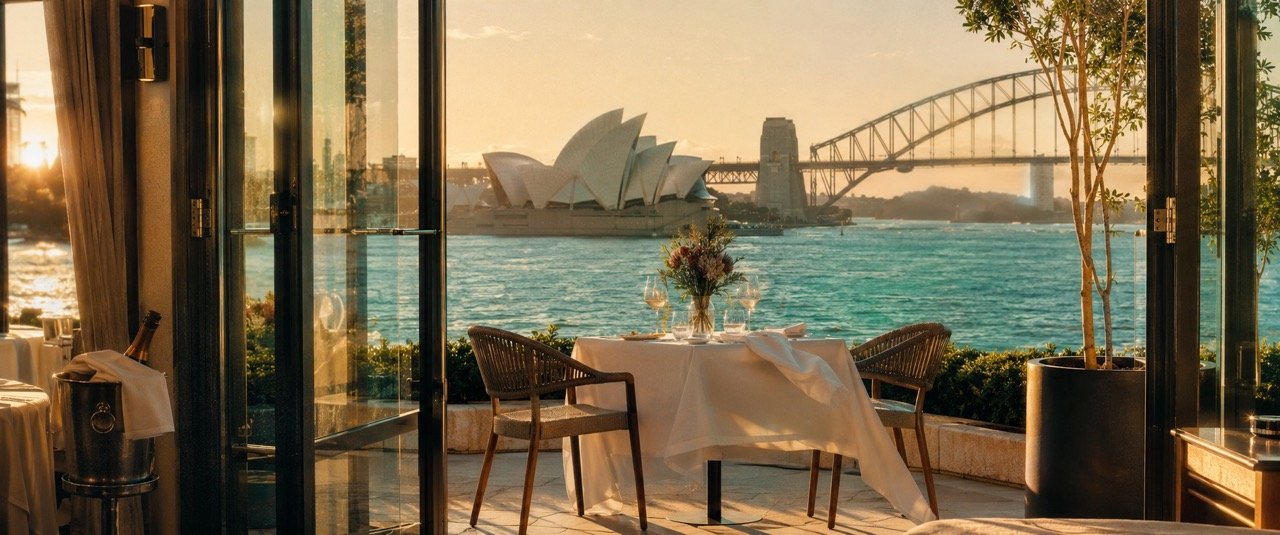
The long lunch is a specifically Sydney institution. In a city with a harbour at its centre and a climate that makes eating outdoors a reasonable proposition for eight months of the year, the extended midday meal acquired a particular character here that London and New York cannot replicate: the water as a third party at the table, changing the light, anchoring the mood, providing the excuse — as if one were needed — to order another bottle.
The rooms below are those where the long lunch is an understood format rather than a tolerated one: where the kitchen does not begin suggesting the bill at two in the afternoon, where the sommelier is prepared to continue a conversation about what to drink rather than presenting a final glass, where the view — the harbour, the water, the particular gold of a Sydney afternoon — is treated as the fourth element of the service.
Aria, Circular Quay
Aria occupies a position at the opera house end of Circular Quay with views directly onto the sails and the harbour beyond them — a setting that has generated some of the most photographed restaurant views in the country and that, in the two-hour window around midday, produces light across the room from the north-east that renders every glass, every white napkin, and every plate of food in the most flattering possible terms.
The cooking is Modern Australian at the serious end of the genre: technically accomplished, produce-focused, with a confidence in the local supply chain that decades of the same sourcing relationships provide. The roasted Bannockburn chicken — carved at the table — has been on the menu long enough that its absence would constitute a genuine loss. The wine list is among the most considered in the city for a room of this stature: deep in aged Hunter Semillon and Hunter Shiraz, with the European selections curated by a team that takes the Burgundy category with appropriate seriousness.
The harbour table request: ask for a table in the section directly facing the harbour rather than the Opera House end. Counter-intuitive, but the harbour view sustains longer than the Opera House view without losing anything.
1 Macquarie Street, Sydney CBD. Lunch daily. ariarestaurant.com
Catalina, Rose Bay
Catalina is the long lunch restaurant that Sydney’s most experienced long-lunchers return to with the regularity of a ritual. The room — perched on the Rose Bay seaplane base above the water, with the eastern harbour spreading north to Middle Head and south to the city — has been producing reliable, honest pleasure for over twenty years, which in the Sydney restaurant landscape is a form of achievement that insufficient respect is paid.
The food has a directness that the more conceptually ambitious restaurants in the city sometimes lack: excellent seafood — the Sydney Rock oysters, the whole Murray cod, the blue-eye trevalla with whatever is good from the market — presented with the confidence of a kitchen that understands its strengths and sees no reason to embellish them.
The seaplane departures from the adjacent base are genuinely distracting in the best possible way: at irregular intervals through the afternoon, a float plane taxis past the restaurant windows and lifts off the harbour, which is the kind of incidental spectacle that no amount of interior design can produce.
1 Sutherland Avenue, Rose Bay. Lunch Tuesday to Sunday. catalinarosebay.com.au
Manta, Woolloomooloo
The Woolloomooloo finger wharf — a restored 1915 wool storage facility projecting into the harbour — contains several restaurants within its timber-and-iron structure. Manta, at the end of the wharf, occupies a position that faces west across the harbour as the afternoon light moves toward sunset, which means that a late lunch becomes, without any transition, one of the finest seats in the city for the hour before dusk.
The seafood focus is appropriate to the setting: raw oysters and Yamba prawns at the beginning, whole grilled fish and crustacean platters through the middle, with a wine list that emphasises the coastal and maritime character of the food. The by-the-glass Semillon programme is the most accessible entry into aged Hunter whites without committing to a full bottle.
The outdoor deck, available in warm weather, extends the waterfront character of the room into something more immediate — the harbour is at arm’s reach and the light is unmediated. In the warmest months, reserve the deck specifically.
6 Cowper Wharf Road, Woolloomooloo. Lunch and dinner daily. mantarestaurant.com.au
Doyles on the Beach, Watsons Bay
Doyles is Sydney’s oldest operating seafood restaurant — established in 1885, in continuous operation since, at the same Watsons Bay location. This historical fact alone does not justify inclusion in a guide of this character; the food and the setting do.
The setting: outdoor tables on the sand at Watsons Bay, with the ferry from Circular Quay arriving at the adjacent wharf and the harbour spreading north and west. It is the most casual setting in this guide, and it is intentionally included to make the point that the long lunch is a format that does not require white tablecloths. The combination of the location, the fish and chips eaten outdoors, and the specific quality of a bottle of Riesling drunk in harbour sunshine at two in the afternoon is a Sydney pleasure that no level of formality can improve.
The fish and chips are not a concession. They are, when made well and eaten where Doyles makes and serves them, the correct response to the setting.
11 Marine Parade, Watsons Bay. Lunch and dinner daily. doyles.com.au
On the Protocol of the Long Lunch
A brief structural note for those whose experience of formal lunches has been shaped by offices with a two-hour expectation.
The long lunch begins not at the first course but at the first glass. It requires a conscious decision, made before sitting down, that the afternoon belongs to the table. The phone becomes a camera and nothing else. The emails exist in a category of activity that is not relevant until tomorrow morning.
Water comes first, always, and continues throughout. The wine will require it and so will the afternoon that follows.
Order in the sequence the kitchen suggests, not the sequence your hunger dictates. The long lunch kitchen has structured its menu for pacing; disrupting the pace by ordering two mains or skipping the cheese is an editorial decision that goes against the design of the experience.
The dessert wine — a late harvest Riesling, a Pedro Ximénez poured sparingly over vanilla ice cream, a glass of Sauternes with the final piece of cheese — is the correct ending. It signals to the kitchen that the table has taken the afternoon seriously. In the best rooms, this signal produces attentions that the table did not request.