
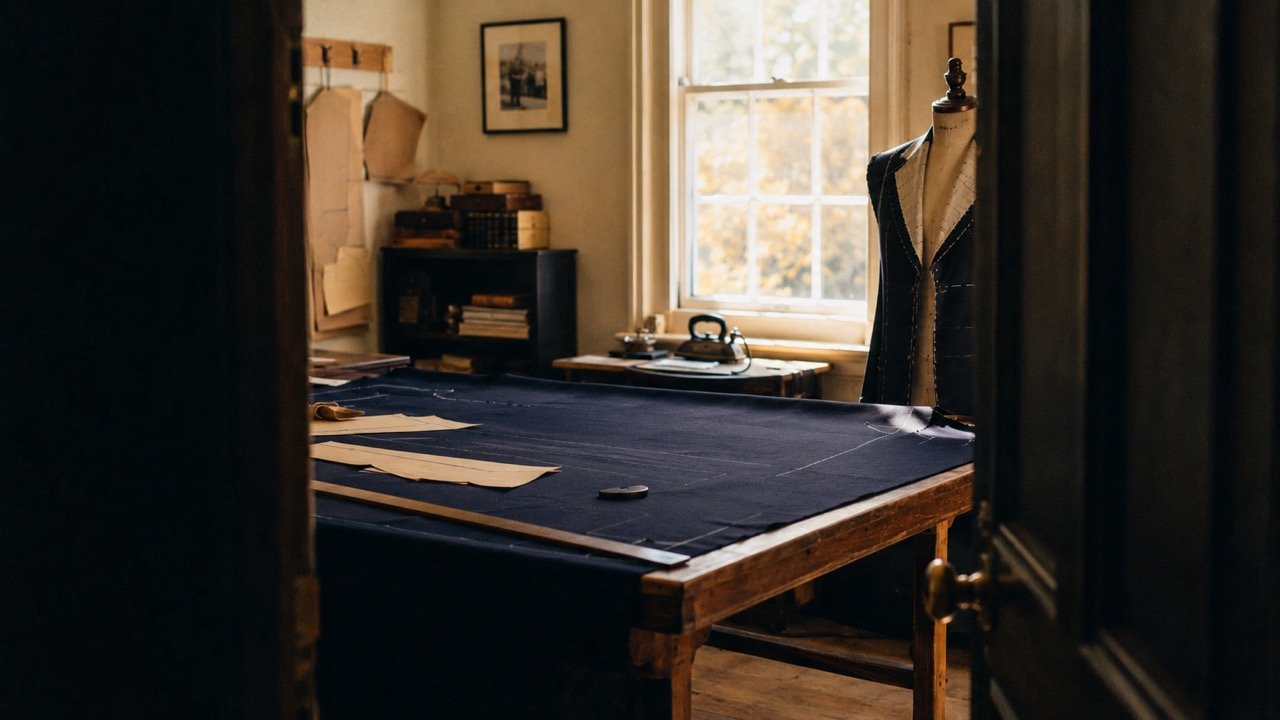
The suit that fits is not a luxury. It is the baseline of a dressed person’s credibility — the garment from which everything else in the wardrobe derives its meaning. And yet most men, even those who consider themselves well-dressed, have never owned a genuinely bespoke suit. They have worn made-to-measure work of varying quality, or they have been measured by a visiting tailor in a hotel conference room and received a passable result. What they have not experienced is the specific transformation of a garment cut from scratch for their particular body, constructed with full canvas interfacing, and fitted through multiple appointments to account for the way their left shoulder sits differently to their right. That garment — the actual bespoke article — changes the understanding of everything worn before it.
Sydney’s tailoring tradition is modest compared to London’s Savile Row or Naples’ via Chiaia, but the city has its own canon: a handful of houses, some with heritage measured in generations, that serve a clientele of discerning men who understand the difference between what a tailor does and what a retailer pretends to.
Zink & Sons, Darlinghurst
The case for Zink & Sons begins with the building. At 56 Oxford Street, Darlinghurst, the house occupies an Inter-War Functionalist shopfront entered on the New South Wales State Heritage Register — and it has been home to the Zink tailoring family since 1912. The original firm was founded in 1895 by Gustav Adolph Zink, making this one of the oldest continuously operating bespoke tailoring houses in Australia, with six generations of craft behind the current work.
The interior is a rare intact example of a 1920s purpose-designed tailor’s shop: low timber counters, the patinated grain of decades of use, cloth bolts stacked with the casual confidence of a house that does not need to perform its credentials. The style produced here runs to the classic British model — clean shoulders, slight suppression at the waist, a chest construction that flatters without exaggerating. Fabrics are sourced from the established English mills: Holland & Sherry, Scabal, Dugdale; the occasional Italian cloth for the client who wants something with more drape.
For a Sydneysider who already owns good suits and wants to go deeper, Zink & Sons offers something the visiting-tailor circuit cannot: a relationship conducted in the same room, with the same hands, over decades. The suit that comes back for a third fitting fifteen years later, to be slimmed or let out, remains a living object in the hands of people who made it.
56 Oxford Street, Darlinghurst. zinkandsons.com.au
Pascalis Bespoke Tailoring, Sydney CBD
Stavros Pascalis cuts from a basement atelier on O’Connell Street in the financial district, which is precisely the geography that informs the work: the clientele is senior finance, law, and corporate governance, and what is required of a garment in those rooms is the specific credibility of restrained authority. The Pascalis signature is a clean, structured suit — broad enough in the lapel to read as contemporary, disciplined enough in the silhouette to function in boardroom contexts for the next twenty years.
What distinguishes the Pascalis operation is the claim, verified by the work itself, that every garment is cut and made in Sydney. In an era when many self-described bespoke houses outsource construction to offshore factories, the distinction matters. A locally made garment means that the conversation between cutter and fabric — the adjustments made to account for individual posture, the hand-padding of a chest piece, the setting of a sleeve — occurs here, under the supervision of the person who takes your measurements and has a professional stake in the outcome.
The cloth selection at Pascalis runs to the Italian and English classics: Ermenegildo Zegna, Loro Piana for the finest weights, Dugdale Brothers for the hardy worsted wools that survive genuine daily wearing. A two-piece suit will require a minimum of two fittings and, for a first-time client, three is the more honest expectation.
Shop 5, 17 O’Connell Street, Sydney CBD. pascalisbespoketailoring.com
Oscar Hunt, The Strand Arcade
Oscar Hunt occupies the more accessible end of the spectrum — made-to-measure rather than fully bespoke — but the quality of the execution, the intelligence of the fabric offering, and the particular thoughtfulness of the Sydney showroom make it worth the serious dresser’s time. The Strand Arcade location is correctly understood as an appointment-first destination rather than a retail floor: a bar is set up inside, a tailoring workshop operates in view, and the conversation is calibrated to the client who already knows what they want and needs only to find someone capable of delivering it.
The distinction between bespoke and made-to-measure deserves a moment here. Bespoke work, properly defined, begins with a pattern drafted entirely from the client’s measurements — no pre-existing block, no adjustment of a standard size. Made-to-measure begins with an established template that is adjusted to fit. The former takes longer, costs more, and produces a result that fits nothing but the person it was made for. The latter, done well, produces a garment that fits exceptionally, delivers significant customisation in cloth and detail, and costs substantially less. Oscar Hunt operates in the made-to-measure category and does so with a level of finish and service that justifies a serious man’s consideration.
The fabric story here runs to a particularly intelligent Australian-market selection: lighter-weight wools and tropical-weight fabrics suited to Sydney’s ten months of warm weather, where a 280-gram cloth functions as a three-season garment. The linen and linen-blend offering is strong.
Shop 104, The Strand Arcade, 412–414 George Street, Sydney CBD. oscarhunt.com.au
On Shirting, Accessories, and the Complete Picture
The bespoke suit is only as good as what sits beneath and alongside it, and Sydney’s serious dressers source those elements with equal deliberation. For shirts, the conversation still routes through the London shirtmakers — Turnbull & Asser, Hilditch & Key — for those who travel and can visit in person, while locally made shirting is available through the more service-oriented tailoring houses, some of which extend their cloth-and-measurement process to shirts as naturally as they do to suits.
For ties and pocket squares, the collector’s approach applies: accumulate slowly, buy best. The London and Italian houses — Charvet, Marinella, Brioni’s ancillary work — remain the reference points, acquired in small numbers on travel. A single Charvet tie worn with deliberation communicates more than a drawer full of equivalent price-point alternatives.
The serious Sydney dresser understands that the wardrobe is a long project, not a seasonal refresh. The single best suit, commissioning over six months and worn for fifteen years, represents not only better value but a fundamentally different relationship to dress than anything bought off a rail. The goal is not the suit. The goal is the version of yourself in it that you could not have arrived at any other way.