
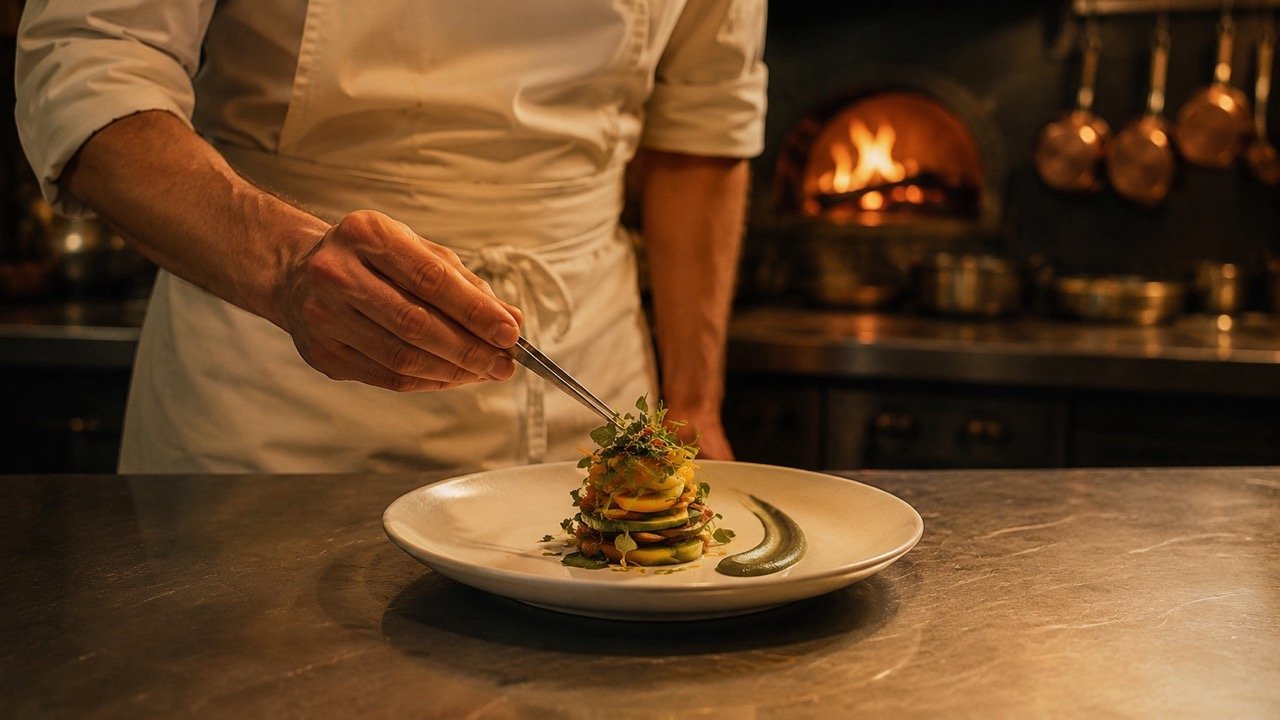
Every serious restaurant invokes provenance. Brae, Dan Hunter’s farm-restaurant in Birregurra, is one of the very few in the world where provenance is not a claim but a structural fact. The farm that supplies the kitchen is the farm that surrounds the dining room. The vegetables that appear on the plate were picked, in most cases, that morning. The gap between cultivation and consumption that most farm-to-table restaurants narrate as a marketing story is, at Brae, simply an architectural distance — perhaps forty metres from the growing beds to the pass. This is not a small distinction. It changes what is possible in the kitchen and what it means to eat there.
Brae sits on an 80-acre property in the Otways hinterland, 85 kilometres southwest of Melbourne, on land that the Wadawurrung people have known as Country for tens of thousands of years. Hunter and his team have spent over a decade converting the property from conventional farming to a regenerative agriculture model — no synthetic inputs, no pesticides, composting systems, cover cropping, soil health management that treats the ground as a living ecosystem rather than a growing medium. The farm achieved three-star accreditation from the Sustainable Restaurant Association in 2024, which is among the most rigorous sustainability certifications available to a hospitality business. But Hunter does not make this the restaurant’s argument. The argument is on the plate.
Up to ninety percent of the restaurant’s produce is cultivated on the property itself. This figure is almost incomprehensible to anyone who has worked in a serious restaurant kitchen, where sourcing logistics are a constant, complex negotiation with geography, seasonality, and supply chains. At Brae, the negotiation is with the soil — whether the weather this month has produced the right conditions for the particular brassica Hunter wants to serve, whether the fermentation programme has yielded the preserves and condiments that will extend the summer harvest into the winter menu. The kitchen’s creativity is constrained and liberated simultaneously by the farm. What grows determines what is cooked. This is a discipline that produces cooking of a different kind.
The Logic of the Menu
Hunter’s tasting menu does not follow the conventional progression of a fine dining sequence — aperitif bite, amuse, multiple savoury courses, cheese, dessert — with borrowed logic from European haute cuisine. It follows the farm’s logic, which is a seasonal logic rather than a culinary-tradition logic. In winter, the menu is root vegetables, fermented things, preserved things, aged things — the kitchen drawing on what was banked in summer and what the cold season produces. In summer, it is alive with freshness, with raw and barely cooked preparations that reflect what happens when you eat something at its peak.
The dish that has become the restaurant’s most famous — the Brae Farm Vegetable Garden — is an ever-evolving composition of the farm’s harvest presented as a small landscape: multiple preparations of the same garden’s output, arranged with an attention to texture and temperature that makes the dish look like a garden and taste like one too. It changes every time you visit, because the garden changes every time you visit. It is the most honest expression of the kitchen’s philosophy: that the farm is the menu, not the other way around.
Other dishes that have defined Brae’s cooking: a compressed cucumber from the garden served with a sauce made from the cucumber’s own concentrated juices; aged duck from a regional producer with a fermented plum that spent months in the kitchen’s lacto-fermentation programme; a dessert — the “half-time choc-orange” — that is a fixed point of pleasure in what can be an austere sequence, a reminder that Hunter is also a very good cook of sweets. Nothing is on the menu because it is technically impressive. Everything is there because it tastes of the farm.
The Farm
The Brae Farm guided tours, which the restaurant offers to guests, are worth taking even if you have already eaten here multiple times. The tour makes visible the infrastructure of the kitchen’s commitment — the composting systems, the soil preparation, the no-dig growing beds that preserve the mycorrhizal networks in the soil, the herb and flower gardens that supply the micro-components of the kitchen’s finishing work, the orchard that feeds the dessert programme. Walking the farm before the meal produces a different relationship with what you eat at the table.
The broader property is set in the Otways hinterland, which gives the farm its microclimate — cooler and more maritime than the inland, with enough rainfall to support the year-round growing cycle that the kitchen requires. The landscape around the restaurant is the specific landscape that produced the food on the table: the same light, the same air, the same grey-green country. This coherence between setting and dish is rare in restaurant culture and it produces an experience that cannot be replicated indoors.
The accommodation — six suites in converted farm buildings around the property — extends this experience into the morning, when the farm is harvested for that day’s service. Staying overnight at Brae is not merely convenient; it changes the experience categorically. Breakfast the morning after the tasting menu is a quieter, more personal version of the same kitchen’s intelligence, prepared with ingredients from the same garden for a room of perhaps eight people.
The Distance as Feature
The 85 kilometres from Melbourne to Birregurra along the Princes Highway — through Geelong, through the You Yangs foothills, down into the Otways — is part of the Brae experience in the same way that the drive to El Bulli along the Costa Brava became part of the experience of dining there. The distance is not an obstacle. It is the transition between urban context and the specific agricultural world that the restaurant inhabits. You arrive with your city preoccupations still running and the drive, if you allow it, gradually replaces them with the particular quiet of a working farm in the Otways.
Hunter’s team understands this and does not try to overcome it with theatrical distractions. The dining room is warm, the service is informed and unaffected, the wine list is carefully chosen. But none of these things compensate for the drive — they are simply part of what awaits at the other end of it.
On Making the Reservation
Brae takes reservations months in advance and the demand has not diminished since the restaurant was listed among the World’s 50 Best. A few considerations:
Book the accommodation when you book the table. The overnight stay transforms the experience from a meal into a residency. You eat, you sleep in the quiet, you breakfast from the same garden the following morning. This is the Brae experience.
Go twice in different seasons. The menu’s seasonal dependency is so complete that summer Brae and winter Brae are almost different restaurants. The former is vivid and green and fresh; the latter is more introspective, more about depth and fermentation and the kitchen’s preserved larder. Both are essential.
Bring the right wine. Brae’s wine list is excellent but leans toward the natural wine spectrum. If you have a specific bottle — a Yarra Valley Pinot, a Mornington Chardonnay — call ahead and ask about corkage. The kitchen’s food pairs beautifully with serious Australian cool-climate wine, and the conversation between what is on the plate and what is in the glass is one of the meal’s pleasures.
The meal is long. Plan for three to four hours. The pacing is unhurried in the way that only a restaurant with this level of conviction in what it is doing can afford to be.