
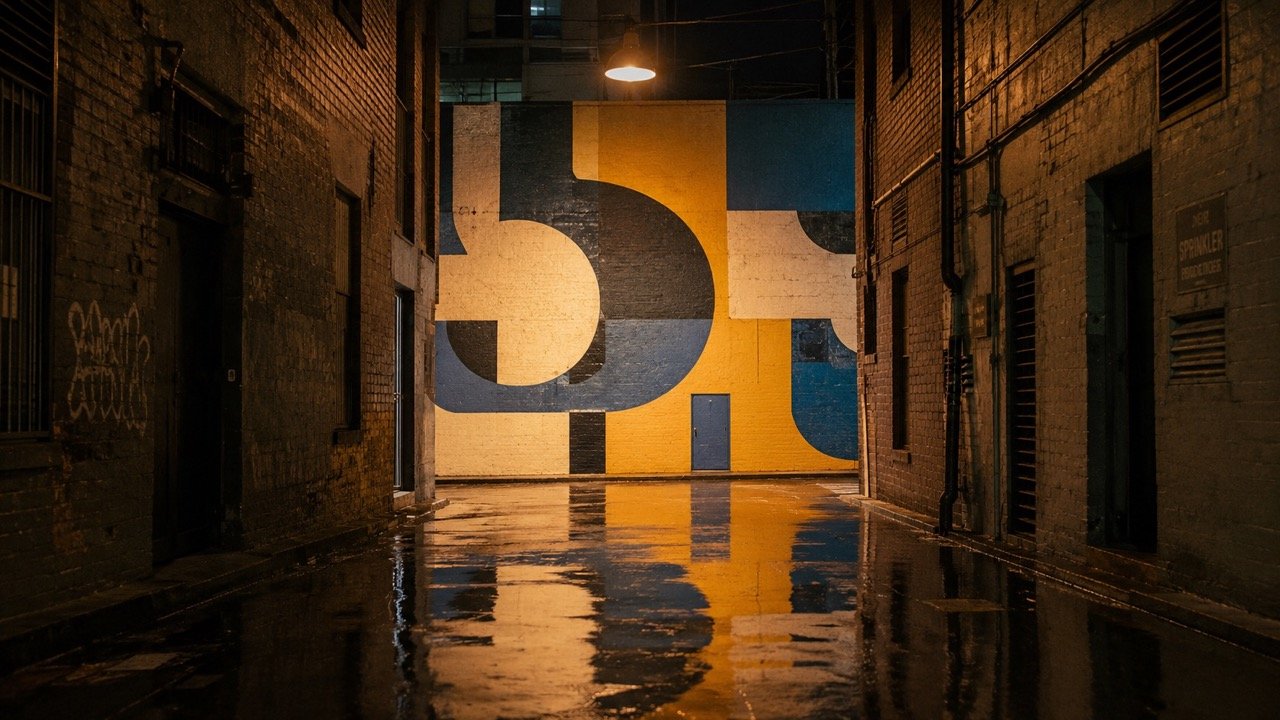
Hosier Lane exists. It is real, it has been there long enough to accumulate genuine texture, and some of what appears on its walls is, by any standard, skilled work. But Hosier Lane has also become a destination — a place where tour groups arrive with cameras and where the graffiti is, at this point, partly self-conscious: work made in the knowledge that it will be photographed and filed under “Melbourne street art” by several thousand visitors a week. This is not necessarily fatal to quality, but it changes the conditions under which street art functions. The city wall as argument, as civic statement, as community intervention — that practice is alive and well in Melbourne, but it happens in Collingwood and Fitzroy, not in a laneway off Flinders Lane.
The distinction is not snobbery. It is a question of what the work is doing and for whom. The commissioned murals of Collingwood and Fitzroy are made within a different set of conditions: they are authorised, often community-funded or government-assisted, painted at scales that require scaffolding and weeks of labour, and addressed to the specific communities that live within sight of them rather than to the international audiences that move through a tourist corridor. They are public art in the proper sense — not decoration applied to the city but conversation conducted through it.
Adnate and the Collingwood Housing Tower
In 2018, the Melbourne-based artist Matt Adnate — working with the street art collective Juddy Roller, with a state government grant of $150,000 facilitating the logistics — painted a mural on a Collingwood public housing tower that became, at twenty storeys, the tallest mural in the southern hemisphere. Its subject was the tower’s own residents: four faces chosen to represent the building’s population — an Ethiopian woman who had arrived as a refugee from Kenya, an Indonesian man who had moved in four months before the project began, a six-year-old child born in Melbourne, and a five-year-old Australian-Vietnamese girl. The faces are painted at a scale that makes them visible from several kilometres away, rendered in Adnate’s characteristically close-toned portraiture: hyperrealistic enough to be intimate, large enough to be civic.
This is what makes the Collingwood mural significant beyond its technical achievement. The decision to paint not the famous or the symbolic but the actual residents of a public housing estate — the people Australian cities tend to render invisible in their civic self-representation — is a political act conducted in the most visible possible medium. The work is generous and it is deliberate. Adnate has made large-scale portrait murals in many cities; the Collingwood work is among his most specific and most argued, rooted in a particular community’s particularity.
On Johnston Street, a separate Adnate work — a five-storey Indigenous portrait — stands as another register of the same practice: the use of scale and the language of portraiture to insist on the visibility of faces that public space habitually marginalises.
Johnston Street and around Wellington/Vere Streets, Collingwood.
The Collingwood Arts Precinct
The Collingwood Arts Precinct, centred on the former Collingwood Technical School buildings on Johnston Street and the surrounding blocks, is the institutional form of what has been happening organically in the neighbourhood for two decades: the concentration of studios, galleries, and cultural organisations in a post-industrial zone whose buildings were cheap and large in the 1990s and are now expensive but still, by Melbourne standards, spacious. The precinct includes artist studios, a print workshop, music rehearsal spaces, and the kind of small-scale exhibition spaces that support emerging practice before it enters the commercial gallery system.
The walls of the precinct — exterior and, where accessible, interior — carry commissioned works by artists with genuine gallery careers, not by taggers or aspiring exhibitionists. The difference in quality and intention is legible within minutes of looking. These are works made with an understanding of scale, light, and site: they respond to the specific walls they occupy, the specific communities that walk past them, the specific conversations the neighbourhood has been having for years about what Collingwood is becoming and whether it can remain a place where working artists can afford to live.
The precinct is best experienced on foot, moving east from Smith Street through the Johnston Street blocks and north toward the housing estates. The works change as commissions rotate and older pieces are painted over — ephemerality is part of the logic — but the character of the programme is consistent: serious, committed to the neighbourhood it occupies, interested in the same questions about visibility and representation that animate the best public art anywhere.
Collingwood Arts Precinct, Johnston Street, Collingwood. Accessible at all hours.
An Insider Note: The George Street Car Park
For those who want to move further from the obvious circuit, the George Street car park in Fitzroy — a brutalist structure whose concrete faces have been progressively covered with commissioned works over several years — represents the Fitzroy version of the Collingwood programme: larger works by established artists operating in the mural tradition, with enough wall surface to allow genuinely ambitious compositions. It is not signposted. It requires the willingness to walk a few blocks off Brunswick Street and look up. This is the correct way to encounter it: not as a destination but as a discovery, which is how the best public art in Melbourne has always worked — present to those paying attention, invisible to those looking for Hosier Lane.
George Street, Fitzroy. On foot from Brunswick Street.