
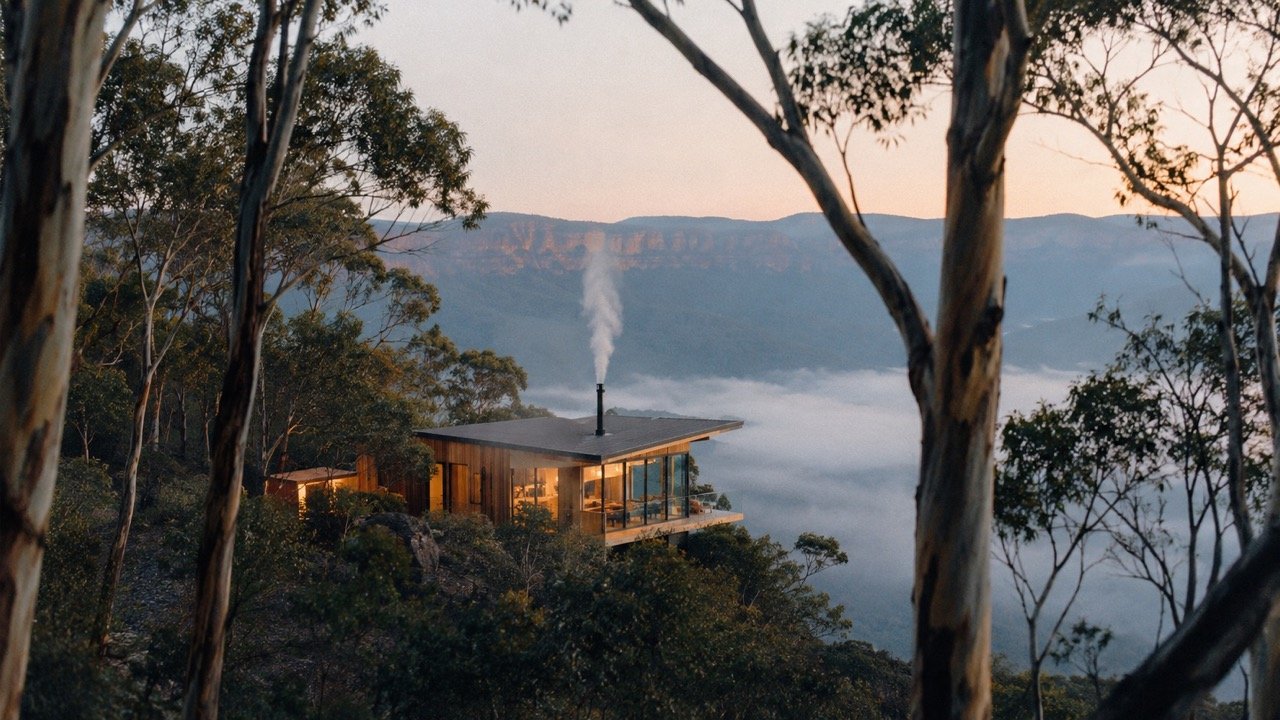
An hour east of Melbourne along the Burwood Highway, the Dandenong Ranges begin as a change in air pressure before they register as topography — the road begins to climb, the temperature drops, the eucalypts give way to mountain ash and then to tree ferns, and a landscape that operates on the time signature of old-growth forest asserts itself with the calm authority of something that has been here much longer than the suburbs below. The ranges are not vast — they run roughly 40 kilometres north-south and reach about 630 metres at Mount Dandenong’s summit — but they carry a density of green that is unusual in Victoria, a quality of diffuse cool light that photographers chase and painters have been trying to capture since the 1880s, and two places that reward serious attention.
The default Dandenongs experience involves a Devonshire tea at a timber-fronted cafe in Olinda, a walk through peppermint gum and the scent of damp bark, perhaps a glimpse of a lyrebird if the timing is right. This is not wrong. The Devonshire tea tradition in the ranges is legitimate cultural survival — the Cornish and English immigrants who settled these hills in the late nineteenth century brought their baking with them, and some establishments have been serving scones with cream and jam for decades without modification. But the ranges contain things that go considerably deeper than a cream tea, and they deserve to be explored at the pace appropriate to an old-growth forest: unhurried, attentive, willing to stop without a stated destination.
Cloudehill, Olinda
Jim Fogarty built Cloudehill over thirty years into what is now widely considered one of the finest garden experiences in Australia, and the description does not flatter it. The 89 Olinda-Monbulk Road address is misleading in its mundanity — what you enter through the gate is a series of twenty-five garden rooms divided by stone walls and clipped hedges, each with its own planting scheme, its own seasonal character, its own relationship to the cool temperate rainforest gully that drops away behind the property into ferns and mountain ash.
The garden rooms range from a formal peony border and a bulb meadow — sheets of bluebells and daffodils in spring that carry the specific quality of English garden craft transplanted into a climate that does not quite reproduce but does not resist it either — to wild plantings along the gully edge where cultivated and uncultivated meet in the most interesting way. What distinguishes Cloudehill from a tourism garden is that it remains a working proposition: plant breeding, trialling, the Diggers Club shop stocked with varieties that Fogarty has been growing and refining on the property. Come in November for the summer borders at their peak. Come in May for the autumn turning. Come at 9am on any weekday when the light is overcast and the garden is yours.
89 Olinda-Monbulk Road, Olinda. cloudehill.com.au. Open daily 9am–5pm. Entry $10; Diggers Club members free.
William Ricketts Sanctuary, Mount Dandenong
William Ricketts began purchasing land on Mount Dandenong in the 1930s and spent the following sixty years firing ceramic sculptures from his kiln and placing them in the four-acre fern gully that he considered his life’s work and his spiritual argument. Ninety-two sculptures now inhabit the sanctuary at Mount Dandenong Tourist Road — figures of Arrernte and Pitjantjatjara people, children, native fauna, and Ricketts himself, set among rocks and tree ferns, covered in moss where the moisture encourages it, integrated into the landscape with the intention that no glaze would prevent the natural world from claiming them back over time.
The result is genuinely strange in the best possible way. Ricketts spent years in Central Australia living with Aboriginal communities — this is documented, if the documentary record of the twentieth century’s attitudes toward appropriation and representation makes the sanctuary complicated to navigate, as it does. What is not complicated is the physical experience of the place: a cool, ferny gully on a mountain forty kilometres from the city, populated by 92 ceramic faces that emerge from rocks and tree roots with the quality of something only partially observed. Open year-round, managed by Parks Victoria, and consistently misrepresented as a curiosity when it is in fact one of the stranger and more affecting experiences in the ranges.
Mount Dandenong Tourist Road, Mount Dandenong. Managed by Parks Victoria. parks.vic.gov.au.
The Light and the Forest
The specific quality that makes the Dandenong Ranges worth seeking out — more than any particular destination — is the light. It is not the golden light of the inland, not the sea-bright light of the coast, but a diffuse cool-green quality that arrives through mountain ash canopy and tree fern fronds filtered to an almost subaquatic tone. On overcast days, which are frequent, the ranges operate at a luminosity that makes colours — the deep green of maidenhair ferns, the cream of mountain ash trunks, the rust of decomposing bark — register with an unusual saturation.
Walk the Kokoda Track Memorial Walk, which runs seven kilometres along the ridge through old-growth forest between Belvdere Road and Mountain Highway. Walk it alone on a weekday. The lyrebirds perform most actively between June and August, when the males are displaying — the mimicry, which extends to chainsaws and camera shutters, has an uncanny quality that stays with you, the forest impersonating the sounds of its own disturbance with apparent equanimity. The walk takes three to four hours. Bring waterproof layers regardless of the forecast; the ranges manufacture their own weather and it is not always communicated to the Bureau of Meteorology in time to be useful.
A Note on Sequence
The best day in the ranges begins before the tourist traffic arrives. Reach Cloudehill at 9am, spend two hours in the garden rooms, eat at the Seasons Restaurant overlooking the borders. Walk to William Ricketts Sanctuary in the afternoon — it is fifteen minutes by car along Olinda-Monbulk Road. Return via the Kokoda Track if the legs permit, or drive through Sassafras and Belgrave on roads that wind through tree fern gullies and past weatherboard houses with established gardens. The ranges do not require a plan so much as a willingness to stay longer than the schedule suggests.