
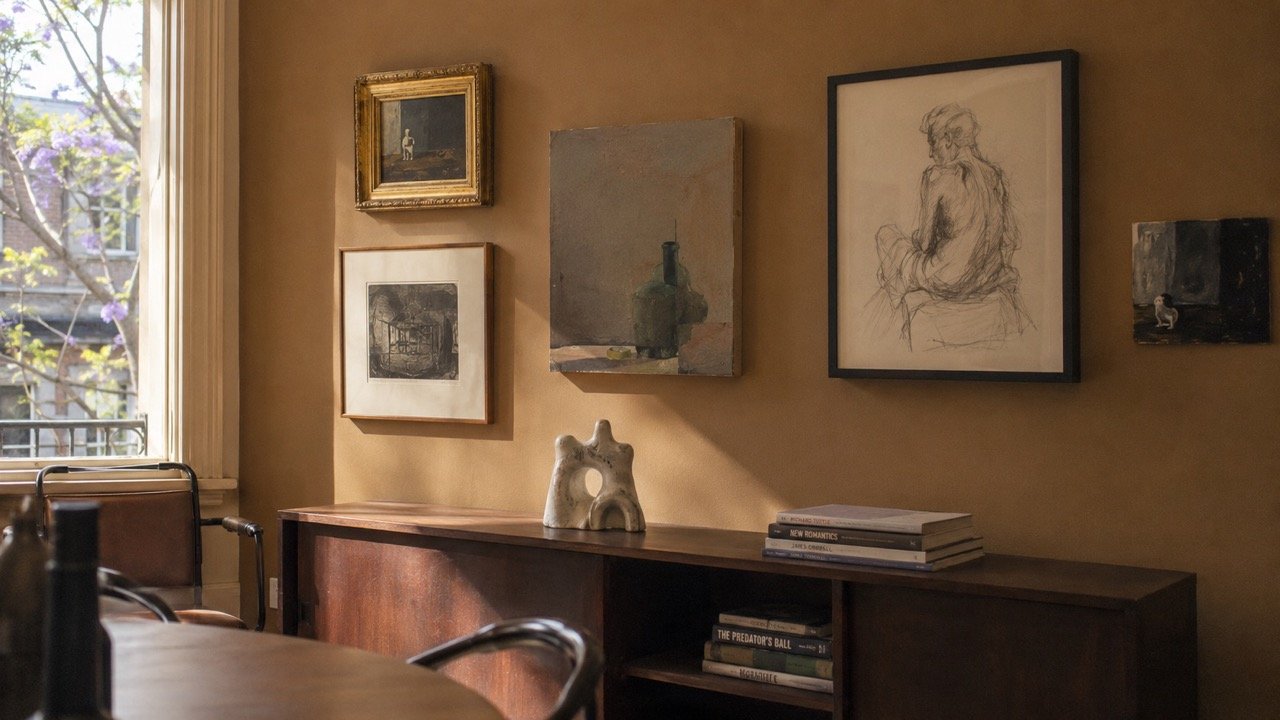
The question of when a well-made object stops being a functional item and becomes something that deserves the same quality of attention as a painting is not a question with a clean answer, but it is the question that Melbourne’s best design stores have been organised around for decades. Craft Victoria’s gallery-shop, Criteria Collection, and Design Stuff — three operations with different ownership, different geographies, and different aesthetic positions, but a shared conviction that the curated object deserves the same slow, serious looking that a gallery wall demands — are the rooms in this city where the collector who has stopped separating art from objects comes to understand that the separation was always provisional.
This is a position with intellectual antecedents. The Arts and Crafts movement — which had a significant Australian reception in the early twentieth century, particularly in Victoria — argued against the hierarchy that placed fine art above craft, and argued specifically that a well-designed chair or a beautifully glazed ceramic was not lesser than a painting but differently expressed. Mid-century Scandinavian design made the same argument at scale. The Japanese mingei (folk craft) tradition, which has influenced Melbourne’s ceramic and textile communities profoundly, pushed further: arguing that an object made without pretension by a skilled anonymous maker, in response to the demands of daily use, achieves an aesthetic quality that art-making-as-self-expression cannot always reach. Melbourne’s best design stores draw on all three traditions without being enslaved to any of them, and the resulting sensibility is specifically local: pragmatic about use, serious about making, suspicious of distinction-for-distinction’s-sake between fine art and functional craft.
The collector who comes to these rooms looking for homeware will be disappointed. The collector who comes looking for the same quality of curatorial intelligence that a good gallery offers — for objects selected because they are genuinely excellent rather than because they match a seasonal trend or a price-point category — will find something useful. What these stores offer, at their best, is not merchandise but a sustained editorial position about what good objects are and why they are worth attending to.
Craft Victoria: Watson Place
Craft Victoria’s gallery-shop — now at Watson Place off Flinders Lane, in a purpose-built space that combines a backlit foyer gallery, a main gallery, and a retail zone that refuses the usual retail logic — is the most institutionally robust design store in Melbourne, in the sense that it is backed by more than forty-five years of curator-maker relationships and the most sustained programme of craft advocacy in the state. What this means in practice is that the objects in the shop have been selected by people who know the practitioners’ full bodies of work, who can contextualise a piece within a practice, and who have no commercial incentive to select something that is merely pretty rather than genuinely interesting.
The range — jewellery, ceramics, glass, textiles, furniture, designed objects — reflects the full span of Melbourne’s craft community rather than a curated slice of it, which gives Craft Victoria a breadth that the other design stores in this category cannot match. It also means that the quality level varies: not everything in the shop is exceptional, and the experienced collector will learn to navigate the shop as they would any gallery, attending to some sections more carefully than others. The ceramic section and the jewellery section are consistently the strongest. The contemporary glass is worth examining for the technically ambitious work that appears periodically from Melbourne’s smaller glass studios.
The monthly exhibition programme changes the gallery spaces but not the retail logic: the exhibitions bring the most ambitious current work by specific practitioners into the space, and the shop continues to offer a wider, more accessible range alongside them. The two modes of the space reinforce each other productively.
Watson Place (off Flinders Lane), Melbourne CBD. craft.org.au
Criteria Collection: South Yarra
Criteria Collection — in a heritage-listed building in South Yarra, a deliberate distance from the Flinders Lane design strip — operates on a different principle. It is a design gallery-store that privileges limited-edition and atelier-produced furniture, lighting, and objects from international design capitals: New York, Milan, Paris, Antwerp, Gotland, Lisbon. The selection is made by people who attend the major European design fairs and who bring back not the commercially obvious but the intellectually rigorous — the Gotland ceramicist who is making the most interesting formal decisions in Scandinavian craft, the Antwerp lighting designer whose work rethinks the relationship between light source and fixture, the Lisbon cabinet-maker whose joinery references a pre-industrial tradition without nostalgia.
The interior is purposefully restrained — pale walls, generous circulation, objects presented as paintings are presented rather than as merchandise to be moved — and the experience of visiting is as close to a gallery visit as Australian retail provides. You are expected to look slowly. The staff will explain the provenance and the thinking behind a piece, not its dimensions and lead time. A piece from Criteria is typically significant in its category — a statement of position about what serious design is currently doing that a conventional homeware purchase cannot make.
South Yarra, Melbourne. criteriacollection.com.au
Design Stuff: Bourke Street
Design Stuff, on Bourke Street, operates at the intersection of the serious and the accessible — a design store whose range includes objects at a range of price points but whose curatorial logic remains consistent: everything in the room has been chosen for a reason, and that reason is not that it is currently selling elsewhere. The store has been part of Melbourne’s design conversation long enough to have developed a specific institutional knowledge of what Melbourne collectors collect and why, and its buying reflects this: the objects that appear here tend to be the ones that resolve a question about form or material that more obvious alternatives leave unresolved.
The store is most useful for the collector who is building a considered domestic environment incrementally — adding objects over time that are individually excellent and that accumulate toward a whole that is more coherent than the sum of its parts. Design Stuff is good at understanding this mode of collecting and at making suggestions that are adjacent to what you have already chosen rather than departing from it. This is the intelligence of a good gallerist rather than a retail buyer, and in a design-store context it is unusual.
Bourke Street, Melbourne CBD.
The Protocol of the Collected Room
The distinction between a decorated room and a collected room is not about price or category or the relative prestige of what it contains. It is about whether the objects in the room have been chosen with a consistent quality of attention — whether each piece was considered seriously before it was acquired, whether its relationship to the other objects in the room was part of that consideration, and whether the room as a whole reflects a sustained point of view rather than an accumulation of individually acceptable choices.
The rooms that Melbourne’s best design stores make possible — visited over time, with the patience to wait for the right piece rather than acquiring an acceptable one — are rooms that reward sustained occupation. They do not date in the way that trend-assembled interiors date, because their logic is not trend but quality, which is not a seasonal variable. The object on the shelf that you looked at seriously before you bought it, whose making you understand, whose provenance and material you can articulate, is an object that will continue to make its claim on your attention years after an impulse purchase has become invisible. This is what collecting — at any scale, at any price point — is for: the accumulation of objects that remain interesting, that continue to ask something of the person who lives with them.
Visit these stores without a shopping list. Walk through the room slowly. The protocol is: look at everything, sit with anything that stops you, ask why it stops you. The answer to that question — why this piece, in this form, with this surface, commands attention when another piece of apparent equivalent quality does not — is the beginning of the knowledge that serious collecting, over time, becomes.