
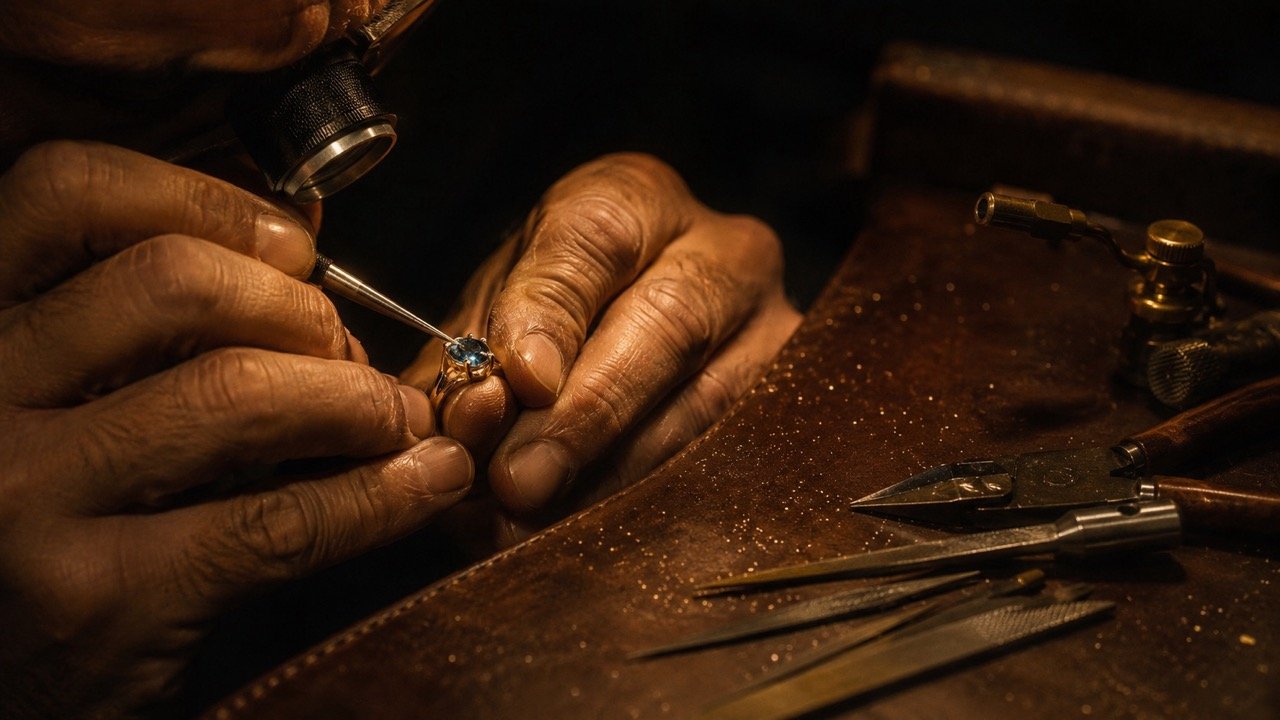
The argument for commissioning a piece from a Nicholas Building goldsmith rather than purchasing from a luxury brand rests on something more specific than the usual craft-versus-commercial distinction. It rests on knowledge: the knowledge of Australian geology that a Melbourne maker brings to the selection of a stone, the knowledge of European goldsmithing technique that an independent jeweller trained across multiple traditions brings to the construction of a setting, and the knowledge of the specific body that will wear the piece — its proportions, its movement, the light it habitually occupies — that only a direct maker-client relationship makes possible. A piece from the Nicholas Building carries all three. A piece from a luxury brand’s Melbourne store carries, at most, the third.
Australian gemstones are among the most extraordinary in the world. Opal — particularly the black opal of Lightning Ridge in New South Wales, and the boulder opal of Queensland — produces colour-play of a complexity and specificity that no other gemstone in any tradition achieves: the blue-green fire that shifts to red as the angle changes, the broad pattern of harlequin opal that operates almost as an abstract painting trapped in a stone, the subtle pinfire that is the most modest and most durable form of the same phenomenon. Argyle diamonds from the Kimberley — the mine closed in 2020 and the stones are now finite, their rarity and value escalating — include champagne, cognac, and pink diamonds whose colour range has no equivalent in the global market. Queensland sapphires run from the conventional blue through parti-sapphires whose green-blue-yellow split tone is unlike anything produced in Ceylon or Kashmir. These are not inferior alternatives to European or Asian gemstones. They are materials with specific properties, and the Melbourne goldsmiths who work with them understand those properties with the intimacy of people who have spent their careers in proximity to Australian mineralogy.
What the Nicholas Building jewellers bring to this material is technique grounded in European tradition — the bezel setting, the prong setting, the millgrain edge, the granulation work, the construction of a lost-wax cast with hand-finished surfaces — applied with the understanding that Australian stones often require adjustments that European stones do not. An opal is fragile in ways that a diamond is not, and the setting that protects it while allowing light to reach the stone requires specific engineering. A parti-sapphire’s colour-split needs to be oriented in the stone so that the wearer sees what the maker intends, which requires the kind of stone-specific knowledge that only direct working experience produces. These are the competences that make a Nicholas Building piece specifically different from an equivalent-price piece by a global house whose setters work with standardised stock.
Tiffany Parbs: Conceptual Goldsmithing
Tiffany Parbs — whose practice has been recognised by Creative Victoria’s Creators Fund and exhibited through Craft Victoria and the Australian Design Centre — works at the intersection of goldsmithing and conceptual practice in a way that challenges what jewellery is for before it addresses what jewellery looks like. Her work uses the body as primary reference: the changing body, the ageing body, the body as it is rather than as fashion represents it. A Parbs piece is a proposition about the relationship between the worn object and the body wearing it — about what it means to choose to adorn, and what that choice reveals about how we understand ourselves and our physicality.
This is not comfortable jewellery, in the way that a Cartier ring is comfortable — it does not flatter by association with institutional prestige, does not resolve itself into a familiar category. What it does is make the wearer aware of the piece in a way that most jewellery, in its ambition to disappear into elegance, does not. Parbs is a serious artist who happens to work in gold and silver, and commissioning her is an act of collaboration that requires the kind of client willingness to be challenged that serious art commissioning always requires.
Via Tiffany Parbs directly. tiffanyparbs.com
The Goldsmithing Tradition: Stones and Their Settings
The Nicholas Building’s independent goldsmiths as a community — beyond Parbs’s specific conceptual practice — share a set of commitments that distinguish them collectively from both high-street and luxury retail. They work with Australian stones: not exclusively, but with the specific knowledge of what is available from Australian deposits and the willingness to use it when it is the right material for a piece. They make settings by hand or with hand-finished castings rather than mass-production. They know their clients in the way that a tailor knows theirs — by name, by body, by the previous pieces commissioned and the contexts they were for.
The Argyle diamond in particular deserves attention from the perspective of long-term collecting. With the Kimberley mine permanently closed since 2020, certified Argyle stones — particularly the pink and violet diamonds for which the mine was most famous — are a finite resource whose value is increasing. The Nicholas Building goldsmiths who have working relationships with existing Argyle inventory can source stones and design settings that represent the most direct available access to this material. A certified Argyle pink diamond in a Melbourne-made setting, purchased from the maker’s studio in the Nicholas Building, is a specific object that will not become more common.
37 Swanston Street, Melbourne CBD. nicholasbuilding.org.au
Craft Victoria: The Jewellery as Gateway
Craft Victoria’s gallery-shop at Watson Place off Flinders Lane is the most reliable entry point for Melbourne-made jewellery at a range of price points and in a curated selection that reflects the curatorial intelligence of an institution with four decades of maker relationships. The jewellery in the shop is selected by people who know the makers’ broader practice — who can tell you that the earrings you are looking at are part of a larger body of work exploring a specific material question, or that the maker’s latest collection represents a departure from their previous approach and why.
Buying from Craft Victoria’s shop is a supported introduction to Melbourne’s jewellery community: the purchase comes with context, the context is reliable, and the piece is the entry point to a relationship with a practice rather than the end of a transaction. For a collector beginning to engage with Melbourne-made jewellery, this is the correct starting point — not because the shop is a substitute for a studio visit, but because it is the best orientation before one.
Watson Place, off Flinders Lane, Melbourne CBD. craft.org.au
The Protocol of Commissioning a Melbourne Jewel
Visit the studio before you commission. Sit with the maker’s existing work for as long as you need to — handle the pieces, understand the construction, identify whether the sensibility resonates. Melbourne’s Nicholas Building jewellers work in spaces that reward this kind of slow attention: a studio visit is not a retail appointment with a time limit but a conversation whose duration is appropriate to the seriousness of what you are considering.
Come with the context of use: not ‘I want an opal ring’ but ‘I wear rings on the right hand, I work with my hands in ways that require a setting that will not catch on anything, I want something that reads as significant without reading as formal.’ The more specific the context, the more useful the maker can be. A commission that begins with a question rather than a specification produces better work than one that begins with a reference image.
On stones: ask to see what is available before you specify what you want. A maker with an extraordinary stone in inventory — a Lightning Ridge black opal with harlequin fire, an Argyle cognac diamond of unusual depth — will produce their best work if they can build the piece around the stone rather than sourcing a stone to fit a predetermined design. The great jewels of any tradition are usually the result of this sequence: stone first, setting second.