
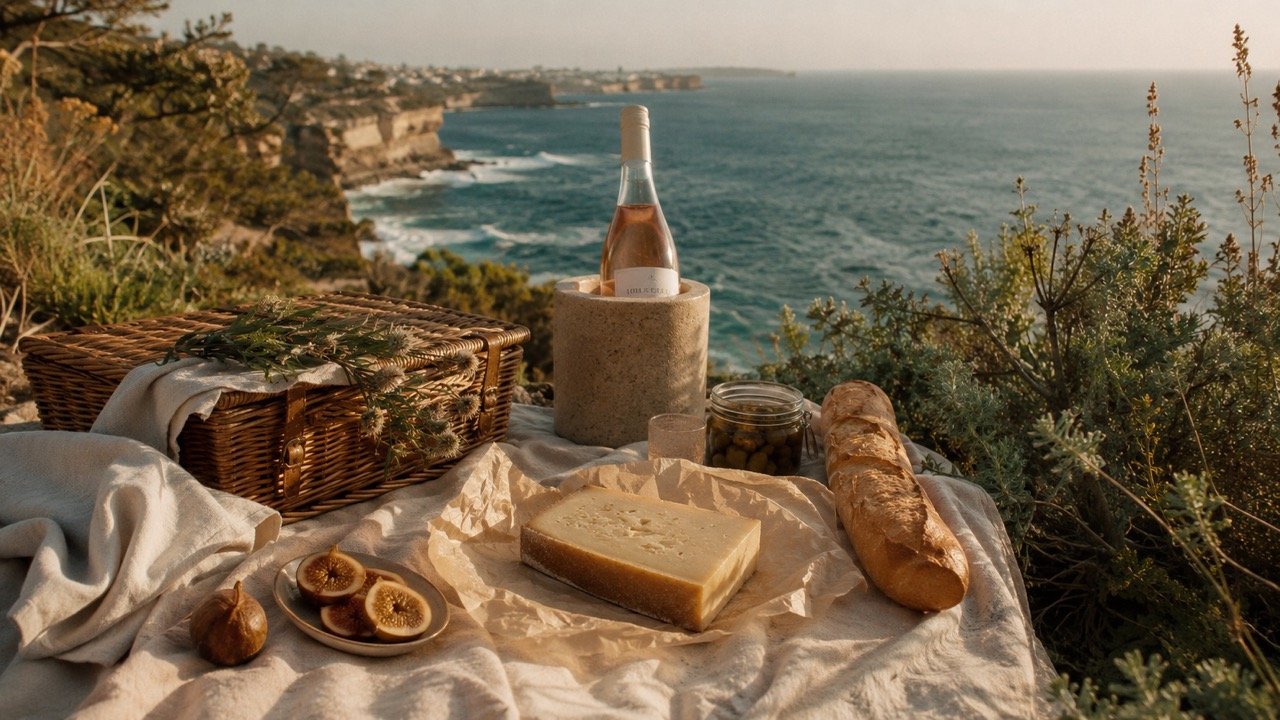
The Twelve Apostles sit on every travel poster, every screensaver, every brochure produced by Tourism Victoria. They are also, when you arrive in high summer with three coach parties and no shade, the least interesting thing on this road. The argument for the Great Ocean Road is not the sea stacks at the end of it. It is the 243 kilometres of geology, ecology, and culinary seriousness you encounter before you get there — if, indeed, you get there at all.
The road was built between 1919 and 1932 by returned soldiers, carved by hand into headlands that had resisted European navigation since Matthew Flinders. It was always a civic act as much as an engineering one, a means of opening an otherwise impenetrable coastline of hardwood forest and sheer cliff to people who deserved to see it. That ambition — the idea that a landscape this serious rewards effort — remains the right frame for driving it today. Come for the ecology. Come for the light. Come, above all, for Brae.
Brae, Birregurra
The correct approach to the Great Ocean Road is to book a table at Brae several months in advance, spend the night in the guest suites, and let the meal constitute the first argument for why you came. Dan Hunter’s restaurant at 4285 Cape Otway Road, Birregurra, sits on a 30-acre certified-organic farm inland from the coast, and it occupies a position in Australian cuisine — perhaps fourteen courses built almost entirely from what is grown within walking distance of the kitchen — that has no real equivalent elsewhere in the state.
This is not a restaurant making gestures toward locality. The wheat is grown on the farm, milled on the farm, baked into bread served that morning. Native ingredients that most fine-dining kitchens treat as garnish — mountain pepper, warrigal greens, saltbush — arrive here as the primary argument, handled with the technical seriousness Hunter acquired at Mugaritz in the Basque Country. The guest suites are understated and modern, set among kitchen gardens and established trees, and the correct sequence is to arrive for dinner, sleep well, and depart in the direction of the coast the following morning with the landscape already framed differently by what you ate.
4285 Cape Otway Road, Birregurra. braerestaurant.com. Book months ahead — the suites and the table simultaneously.
Cape Otway and the Lightstation Forest
The turn-off to Cape Otway Lighthouse Road arrives about 13 kilometres past Apollo Bay, and the road it leads you down is among the most quietly astonishing drives in the state. For twelve kilometres, old-growth manna gums close overhead — smooth-barked, towering, the trunks pale grey in the forest light — and the canopy is dense enough that the temperature drops several degrees before you reach the coast. Koalas occupy these trees in numbers that can seem almost theatrical, wedged in the forks of branches with the studied indifference of animals who have worked out that nothing here is going to disturb them. They are correct.
Cape Otway Lightstation, commissioned in 1848, is the oldest surviving lighthouse on mainland Australia, built from stone quarried locally and first lit against a coast that had already claimed dozens of ships attempting to round the cape in the era before reliable charts. The structure has the quality of all genuinely functional Victorian engineering: nothing decorative, everything structural, proportions that communicate the serious purpose of keeping ships off that particular piece of rock. Stand at the lighthouse in a westerly and the Southern Ocean’s exposure becomes physical — this is not a gentle coastline, not a bay. It is the bottom of the continent facing water that runs unimpeded to Antarctica.
Cape Otway Lightstation, Otway National Park. lightstation.com. Open daily — the forest road alone is worth the visit.
Lorne and the Cold-Water Culture
Lorne has been a summer town since Melbourne’s professional classes began arriving by steamship in the 1870s, and it has developed — across 150 years of weekend traffic — a genuine relationship with cold water that distinguishes it from the managed beach resorts further along the road. The Pier to Pub swim, held each January, draws thousands of entrants into water that sits around 17 degrees and rarely gets warmer. The swim is not the point exactly, though it is a spectacle. The point is that Lorne has a culture of people who actually get in the water, cold or not, and who have been doing so long enough that it reads as identity rather than novelty.
Erskine Falls, eight kilometres from the main street, rewards the short walk down through mountain ash and tree ferns to a 30-metre cascade that runs year-round. Most visitors spend twenty minutes at the lookout and leave. The better option is to descend to the base, where the air is at least five degrees cooler and the falls are genuinely impressive at volume. The surrounding forest — Otway Ranges cool-temperate rainforest, dominated by myrtle beech and mountain ash — is the same ecological community that once covered most of the ranges and now exists only in the wetter gullies. Give it longer than the lookout requires.
Erskine Falls: Erskine Falls Road, Lorne. Free access, year-round.
Airey’s Inlet and the Correct Pace
The trap of the Great Ocean Road is the tourist itinerary that treats it as a progression from Melbourne toward the Twelve Apostles, with stops determined by Instagram coordinates. The alternative is to understand that the road between Torquay and Apollo Bay — the section that runs along the base of the Otway Ranges, with the coast below and the old-growth forest above — is the argument, and that Airey’s Inlet is perhaps the best place on the road to grasp what you are actually looking at.
The Split Point Lighthouse at Airey’s Inlet sits on a headland above the wreck of the Bohemia (1907) and overlooks a coastline where the Bass Strait meets the Southern Ocean’s broader fetch. The town itself is small, unhurried, and not yet organised primarily around tourism — a cluster of houses above the beach, a general store, the lighthouse walk and little else designed to detain you. Spend the afternoon. Eat fish and chips on the beach in the company of silver gulls with no particular agenda. The road will still be there tomorrow, and it goes to Lorne, and then Apollo Bay, and then the forest, and then Brae — and none of it benefits from being rushed toward a formation of limestone stacks at the far end.
Airey’s Inlet is 95 km southwest of Melbourne via the B100. Split Point Lighthouse: Great Ocean Road, Aireys Inlet.
A Note on Pacing
The drive from Melbourne to Apollo Bay along the Great Ocean Road — the coastal section before the road turns inland through the Otways — is approximately 200 kilometres and requires most of a day to do with any attention. Plan for two nights minimum: one at Brae or nearby in Birregurra (the most civilised approach), one in Lorne or Apollo Bay. The section from Apollo Bay to Port Campbell, through the Great Otway National Park and out onto the exposed limestone plateau of the Shipwreck Coast, adds another 90 kilometres and a different ecological register entirely. The Twelve Apostles are there if you want them. They are not the reason to come.