
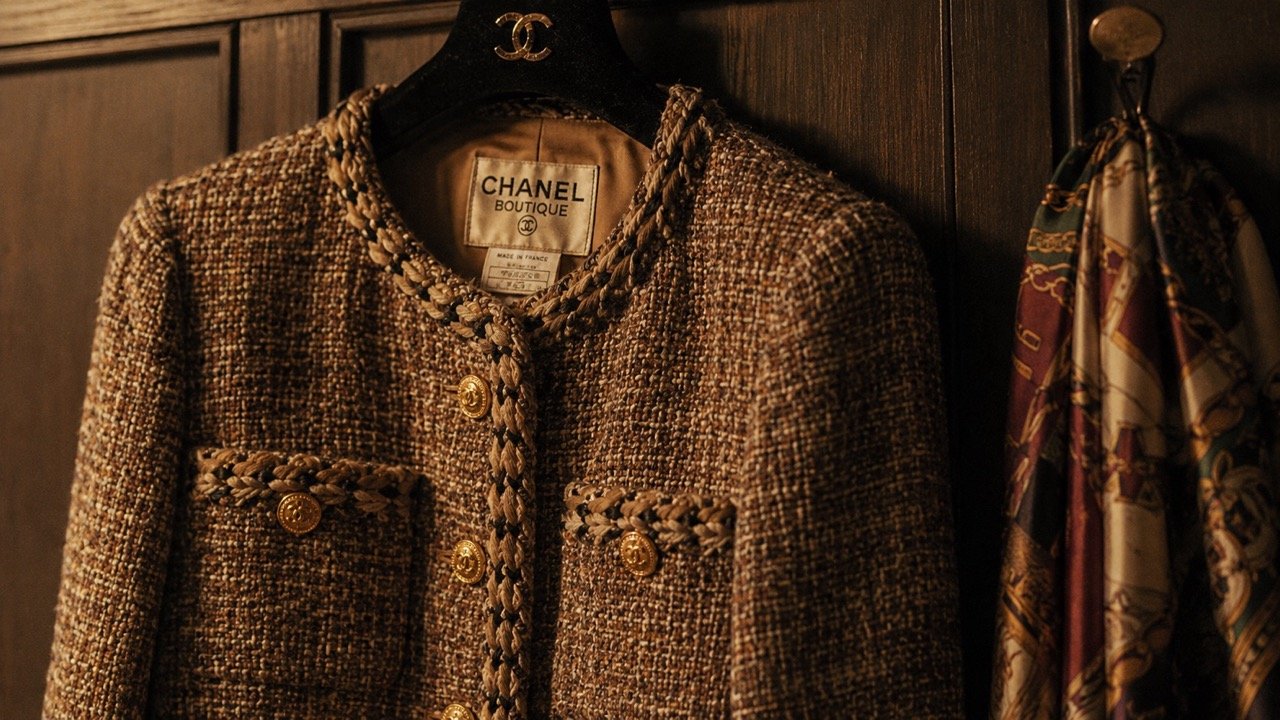
There is a quality of knowledge that Melbourne’s inner-north vintage economy produces in its best practitioners that is not available anywhere else: the ability to recognise, in a rack of garments that has not been curated to flatter the buyer’s taste, an object whose construction, material, and proportion make it genuinely worth owning. This is not nostalgia literacy — not the ability to date a label or identify a decade from a silhouette. It is something more substantive: the ability to evaluate a garment’s quality independent of its age, to hold a sleeve hem and understand from the stitching density whether it was made to last, to assess a wool’s weight and finish against the body and know whether it is a garment that will work in a contemporary wardrobe or merely a garment that once worked in an earlier one.
This knowledge is not mystical. It is the practical result of spending time — real time, repeated time — in the kind of environments that Melbourne’s Fitzroy, Brunswick, and Collingwood have sustained for several decades: op shops with donated stock from wardrobes accumulated across lives of serious dressing; warehouse markets with buying criteria more specific than size and colour; dealer-curated vintage edits that reflect genuine aesthetic intelligence rather than trend-following. The inner north’s vintage economy is, at its best, an education in clothing as material object — a context in which the question ‘is this good?’ is posed and answered purely in terms of what the thing is, not what it signifies.
Melbourne’s vintage culture connects to the city’s broader fashion seriousness in ways that are worth mapping. The same customers who commission bespoke suits from South Melbourne satorias buy Japanese cotton from Lost and Found Market. The same designers who work for Alpha60 shop Brotherhood of Saint Laurence op shops on Tuesday mornings. This is not a contradiction — it is the coherent position of someone who has decided that quality is worth pursuing at every price point, that a $40 vintage piece that is beautifully made is more interesting than a $400 fast-fashion piece that is not, and that the skill required to identify the former is the same skill that makes the latter unnecessary.
Lost and Found Market: 288 Brunswick Street, Fitzroy
The heritage building at 288 Brunswick Street, Fitzroy — upstairs, through a door that the street does nothing to distinguish — contains 900 square metres of what Melbourne’s vintage buying culture looks like at its most serious and least curated. Lost and Found Market stocks fashion, furniture, lighting, art, vinyl, and books in a single space that operates as both market and archive: the clothing racks contain garments from the 1920s through the 1990s in conditions ranging from museum-quality to working-wardrobe, and the buying requires the same slow attention that a serious antiquarian bookseller’s stock requires.
The market is open seven days, but the serious finds arrive in the inventory rotation — check in more than once and the stock will have shifted. The fashion buyers who use this space professionally know that the best Japanese cotton is here in March, that the wool blazers replenish in May, that certain periods of Italian tailoring appear more reliably than others because of the demographics of Melbourne’s Italian immigrant community and when their wardrobes become available. This is the kind of market-specific knowledge that develops only through sustained patronage, and the market rewards it by revealing more to people who have been there before.
What makes Lost and Found genuinely editorial rather than merely large is the range of quality within the stock: on any given day, a 1970s Courreges piece might sit adjacent to a 1990s warehouse-brand blazer, and the skill of the visit is in distinguishing them. This is not curated to your taste; it is curated to the possibilities of what a city’s wardrobes contain, which is a more interesting proposition.
Upstairs, 288 Brunswick Street, Fitzroy. lostandfoundmarket.com.au
Brotherhood of Saint Laurence Op Shops: The Distributed Network
The Brotherhood of Saint Laurence, which has operated op shops across Melbourne and Greater Geelong since its founding in the 1930s, is the city’s most significant distributed vintage resource — not in spite of the fact that it is a charity op shop network rather than a curated vintage dealer, but because of it. Melbourne has always had a class of dressor whose donated stock is significant: the wardrobe of a woman who wore serious fashion in the 1970s and 1980s, given to a Fitzroy BSL store; the estate contents of a man who wore bespoke English tailoring in the 1960s, donated in South Yarra; a collection of Japanese garments from the 1990s, brought in by a family clearing a house in Carlton. The BSL network is the point at which these wardrobes re-enter circulation.
The catch, and it is a real catch, is that this resource requires frequency and timing. The BSL network does not curate; it prices quickly and moves stock. The buyers who find exceptional pieces here visit specific stores regularly, understand which locations receive which demographics of donation, and arrive early in the week when new stock has hit the floor. The Fitzroy and Collingwood stores have historically been the most productive for serious fashion because of the inner-north demographic; the South Yarra and Armadale stores produce more formal tailoring and occasion wear.
Hunter Gatherer, the BSL-affiliated curation project at 246 Brunswick Street, provides a resolved version of the same resource for buyers who prefer the edit to the archaeology — staff here handpick from across the BSL network, selecting garments with a genuine eye for quality and contemporary wearability. It is smaller, more expensive by op-shop standards, and considerably more reliable.
BSL op shops across Melbourne. Hunter Gatherer: 246 Brunswick Street, Fitzroy. bsl.org.au/services/op-shops
American Vintage Clothing Co.: The Import Expertise
The American Vintage Clothing Co. in Fitzroy brings a different expertise to the inner-north vintage economy: imported American workwear and casualwear — the Levi’s selvedge, the vintage Carhartt, the 1950s bowling shirt, the 1960s Pendleton wool — that the Australian market historically produces less of. The knowledge required to buy well in this category is material knowledge: the difference between a red line selvedge Levi’s and a later production, the thread count of a 1940s Oxford shirt against a 1980s reproduction, the specific canvas weight that distinguishes a first-run Carhartt jacket from a later iteration.
The store operates with collector-grade seriousness in a category that attracts collector-grade buyers: people who know exactly what they are looking for and who the store provides access to at the reliable end of the market. For the Melbourne buyer whose wardrobe already includes serious tailoring and who wants to understand why a vintage American work shirt at $150 makes a different argument than a new one at the same price, this is the most efficient available education.
Fitzroy. americanvintageclothingco.com
The Protocol of Buying Vintage in the Inner North
Go on a weekday. The best vintage buyers in Melbourne work the BSL shops on Tuesday and Wednesday mornings, when weekend donations have been processed and before the weekend crowd arrives. Lost and Found has fewer weekday visitors and more time for considered browsing.
Trust the quality test, not the label test. Feel the weight of the cloth, open the seams and examine the stitching, look at the lining. A garment with a good label but a fused chest and machine-sewn buttonholes is a worse purchase than a garment with no label but a floating canvas and hand-sewn buttons. The inner north’s vintage economy rewards the buyer who has learned to read construction rather than consume branding.
Bring something that needs a match. The most productive vintage visit is one with a specific problem — a jacket that needs a trouser, a shirt that needs a jacket — rather than open-ended browsing. The constraint produces better decisions.