
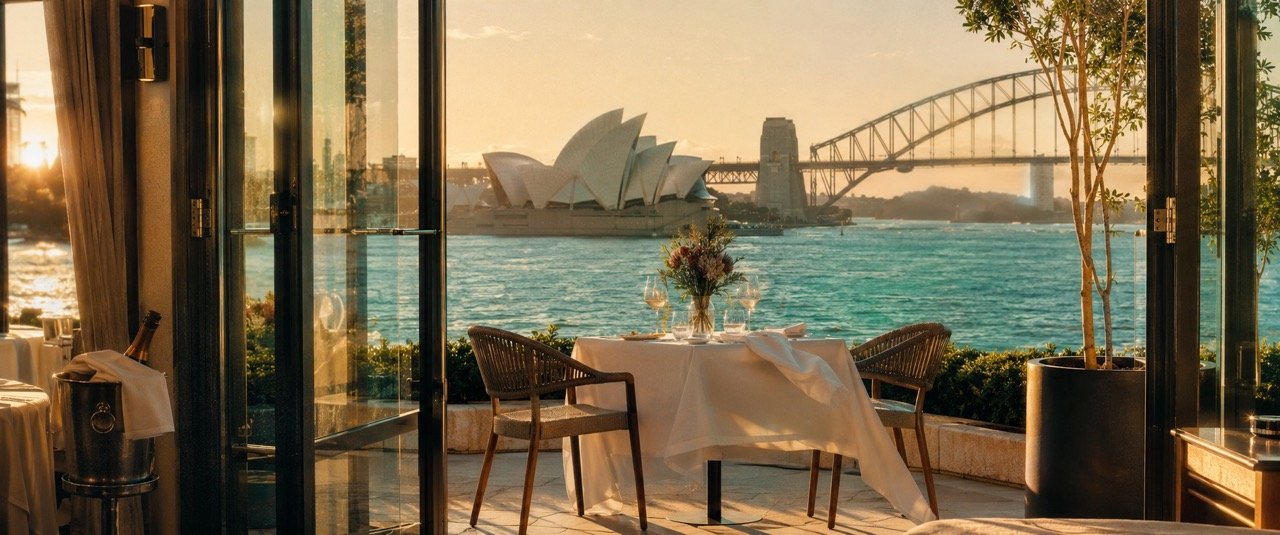
The long lunch is a fundamentally different category of eating from dinner. Dinner is a performance with a curtain time and a role for candlelight; it arrives with a social script and a designated end. The long lunch has no curtain — it ends when the conversation exhausts itself, which, if the wine is good and the company is right, is considerably later than expected. Melbourne understands this. Not in the way that Paris understands it — where the long lunch is a civil institution, practically codified — but in its own particular register: the city’s best midday rooms are designed for people who have earned the right to eat slowly, drink well, and consider the afternoon a legitimate occupation rather than a concession.
The cultural argument for Melbourne’s long lunch is partly geographic and partly temperamental. The city’s latitude — southern, cool, European in light quality — makes afternoon restaurants feel different from their Sydney counterparts. There is no harbour glare to squint against, no urgency of a hot sun overhead. The light at two o’clock on a Wednesday in Fitzroy is the kind of diffuse grey-gold that makes a second bottle feel like a reasonable idea. The Melburnian temperament, shaped by waves of Italian and Greek immigration, has internalised the continental understanding that a meal that earns your attention for three hours is not an indulgence — it is the right use of an afternoon.
The rooms that do this best in Melbourne are not the most expensive rooms. They are the rooms that understand hospitality as a form of intelligence: the right amount of space between tables, service that is present without hovering, a wine list that rewards exploration rather than defaulting to the famous names, and food that arrives at a pace that extends rather than punctuates the conversation.
Cumulus Inc.
Andrew McConnell’s Flinders Lane flagship has been the city’s most reliably excellent long-lunch destination since it opened in 2008, and the longevity is itself the argument. In a restaurant culture obsessed with the new, Cumulus Inc. has achieved something more interesting: it has become the room where Melbourne’s serious eaters return, year after year, without the experience losing its intelligence. The space — an industrial warehouse conversion on Flinders Lane with a long white marble bar, high ceilings, and the specific warmth that good fit-out decisions produce — ages well precisely because it never tried to be fashionable.
The kitchen’s register is the French-inflected bistro mode that McConnell brought to Melbourne and made distinctly his own — precise without fussiness, seasonal without the self-congratulation that often accompanies farm-to-table declarations. The braised lamb shoulder that has appeared on the menu in various forms across the years is the most quoted example: slow-cooked until the texture becomes something between pulled and sliced, served with a jus that has been reduced and concentrated to a depth that a faster kitchen cannot produce. The tartare is made to order. The charcuterie comes from McConnell’s own Meatsmith operation.
The wine list is the long lunch’s key variable and Cumulus Inc.’s list has always been one of the city’s best-curated. The balance between natural wine and more conventional producers reflects the sensibility of a team that is interested in wine without being ideological about it. Ask the sommelier what they are currently most excited by — the answer is usually informative and often leads somewhere the menu doesn’t.
45 Flinders Lane, Melbourne CBD. cumulusinc.com.au
Embla
Dave Verheul and Christian McCabe opened Embla on Russell Street in 2015, on what had been the Pizza Napoli site for decades, and converted it into a wine bar with a wood-fired kitchen that has become one of the most significant rooms in Melbourne’s contemporary culinary conversation. The space is mid-size, always lively, and anchored by a kitchen that does serious things with fire: the menu is built around what the grill and the wood-fired oven can do, and the resulting food has a depth and savouriness that is not achievable through other means.
What makes Embla a proper long-lunch destination rather than merely a wine bar with good food is the intelligence of its pacing. The kitchen sends things out at a tempo that builds — small plates early, richer courses later, the bread arriving warm at precisely the right moment. Verheul’s menu tends toward the architectural simplicity that distinguishes really good European cooking: a piece of fish, a specific vegetable, a sauce that took longer than the plate suggests. The wine list is a collaboration with French natural wine figure Eric Narioo and Patrick Sullivan, one of Victoria’s most interesting natural winemakers, and it leans emphatically toward low-intervention producers — Australian and European — that you will not find on most Melbourne lists.
The bar seats offer the most honest long-lunch proposition: you are visible, you can watch the kitchen through the pass, and you are in the room’s most alive position. Embla is not a quiet room — the acoustics are live, the energy is genuine — and this suits the long lunch better than a hushed dining room. You want the afternoon to feel inhabited.
122 Russell St, Melbourne CBD. embla.com.au
Tipo 00
On Little Bourke Street, Tipo 00 has built the most focused serious-pasta programme in Melbourne, and the focus is precisely the point. Where Cumulus is about range and Embla is about fire and natural wine, Tipo 00 is about pasta — the craft of it, the specific hydration levels and flour blends and bronze-die extrusion that produce a texture no industrial process can match. The room is tightly configured, the service is quick and knowledgeable, and the wine list is one of the city’s best Italian selections.
The pasta here is not a vehicle for sauce — it is the argument itself. The tagliatelle has a coarseness and porosity that comes from hand-rolling and that makes the ragù adhere differently from how it would to an industrially smooth pasta. The bottarga pasta carries the compressed intensity of dried, cured fish roe that makes you rethink what a pasta dish is capable of. The fresh egg yolk pasta, in whatever configuration it arrives on the menu that day, demonstrates what Italian flour and technique can do when taken with total seriousness.
Tipo 00 ranked fifth in Monocle’s global restaurant rankings in 2017 — an unusual distinction for a pasta restaurant — and the recognition reflects the rare thing the kitchen is actually doing: practising a single culinary tradition with an obsessive rigour that exceeds what most broader-menu restaurants achieve. Order the pasta. Order more pasta. The long lunch here is built around thirds, and the thirds are the point.
361 Little Bourke St, Melbourne CBD. tipo00.com.au
On the Practise of the Long Lunch
The long lunch demands a specific approach that is different from dinner-planning:
Arrive at noon, not twelve-thirty. The room is yours for longer, the kitchen is at its sharpest before the midday rush peaks, and the afternoon becomes genuinely elastic.
Order the wine before you order the food. At all three of these rooms, the wine list is part of the argument. At Embla in particular, let the sommelier guide the list before you fix your food order — the wine will shape what you want to eat.
One bottle becomes two. Build this into your afternoon’s plan. The long lunch that ends at a single bottle was the wrong kind of long lunch.
At Cumulus: the marble bar over the dining room. The energy at the bar is better; you are closer to the action, the room is alive around you.
At Tipo 00: go for lunch midweek. Weekend lunch is busier and shorter. The Tuesday long lunch at Tipo is the version the room was designed for.
Take the afternoon. The existential threat to the long lunch is the four o’clock meeting. Clear your diary before you sit down. The point is the time, not just the food.