
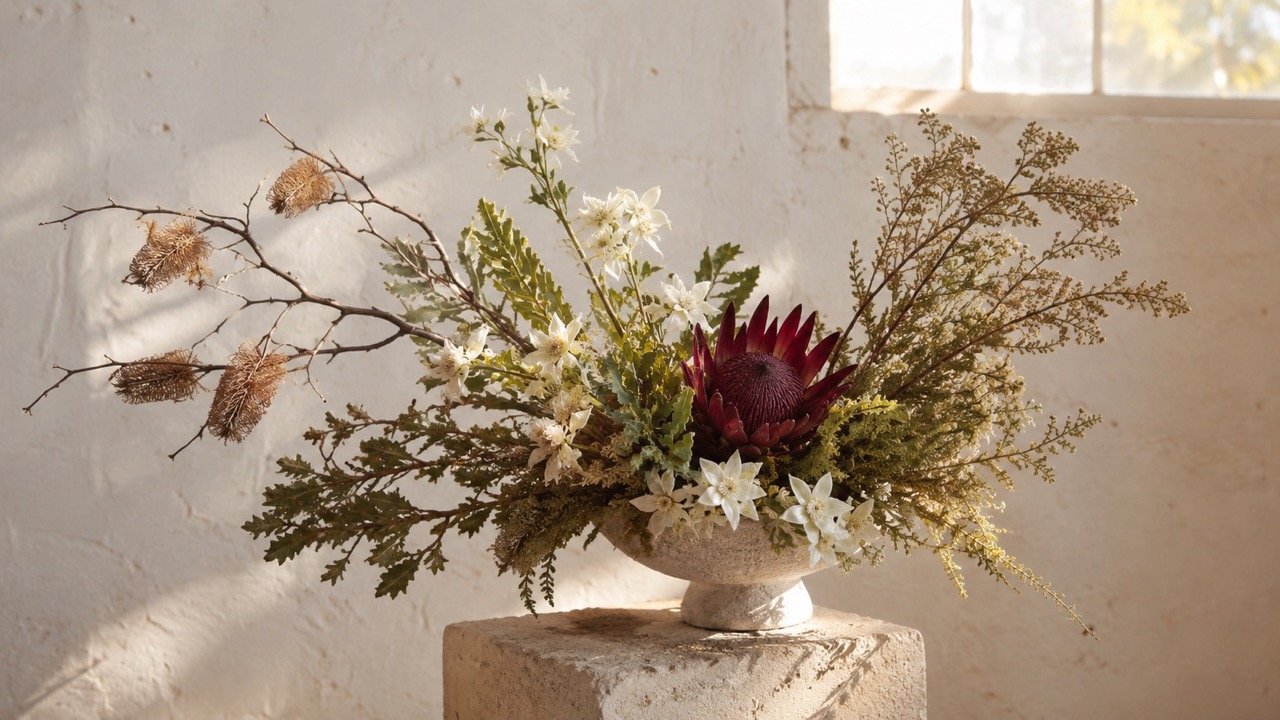
Melbourne’s best florists have more in common with the city’s architects than with the industry’s decorative mainstream. They think about negative space: the gap between stems, the void that gives a form its integrity, the absence that makes the presence of a single branch legible rather than lost. They think about light — specifically Melbourne’s light, cool and grey-gold and diffuse, which reveals a plant’s true colour rather than flattering it and which makes white flowers read as architectural rather than romantic. They think about the relationship between an arrangement and the room it occupies, the way that a cluster of banksia and smoke bush in a concrete vessel on a raw timber table makes a different argument than the same plants in a terracotta pot on a linen tablecloth, and they think about this with enough precision to ask what the table is, what the light source is, and what the room is for before they make a proposal.
This is not universal to the industry. Most florists produce beautiful things without thinking architecturally — they arrange with the intelligence of colour, of seasonal material, of the accumulated knowledge of what combinations read well. Melbourne’s particular floristry intelligence adds a spatial dimension: the best practitioners here are thinking about the arrangement as an object that occupies volume in three dimensions, that has weight and proportion in relation to its context, and that changes as you move through the room and the light shifts. This is the difference between an arrangement and an installation, and Melbourne’s most serious florists are operating somewhere in the productive ambiguity between the two.
The specific botanical material that Melbourne’s florists work with has shaped this spatial intelligence. Australian natives — banksia, protea, waratah, kangaroo paw, smoke bush, paperbark — have structural properties that European flowers do not: they hold their form when dried, develop colour complexity over weeks, and read as architectural in a way that roses and peonies do not. A Melbourne florist who works with Australian natives is working with a vocabulary that teaches architectural thinking, because the material itself demands it. This is not nationalism; it is pragmatics. The materials that are available, in season, from sustainable sources in this specific climate produce a specific aesthetic intelligence when a maker commits to them seriously.
Flowers Vasette: The Fitzroy Original
Flowers Vasette, founded by Cherrie Miriklis in Fitzroy in 1989, is the city’s most sustained argument for botanical design as a form of serious practice. Operating originally from 247 Brunswick Street, Fitzroy, the business has grown to include a boutique at Chadstone’s Market Pavilion and a presence at MECCA on Bourke Street — each space designed with the same architectural attention that the arrangements themselves receive. The Chadstone boutique features unique brass door handles and a reflective chrome lily pad ceiling; these are not interior-design conceits but extensions of the same spatial intelligence that Miriklis brings to the work.
The sourcing process is worth understanding: buyers from Vasette meet at 2:30am, three days a week, at the Epping flower market, to select from what is exceptional rather than what is available. This is the discipline that produces the consistency of quality that the operation’s reputation is built on — not a preference for specific flowers but a willingness to be driven by the market’s best offering at any given moment, and the skill to compose with whatever that turns out to be. An arrangement from Vasette is seasonal in the truest sense: it reflects this week’s extraordinary material, not last week’s standard stock.
247 Brunswick Street, Fitzroy; Chadstone boutique and MECCA Bourke Street. flowersvasette.com.au
The South Melbourne Market Flower Hall: The Buyers’ Environment
The South Melbourne Market flower hall — within the covered market at Cecil Street, South Melbourne — is the city’s most concentrated public access to serious cut flower material. The independent flower designers who trade here are not gift-shop florists. They are buyers who attend the Epping market themselves, who know the farms that supply what they want, who work with seasonal Australian natives as well as European cut flowers, and who have developed the specific intelligence of people who handle excellent material daily and have learned what it does in different contexts.
Buying from the South Melbourne Market flower hall requires some adjustment of expectation: this is not a service environment in the way that a boutique florist is, and the best experience comes from arriving early (the market opens at 8am on Wednesday, Friday, and Saturday), taking time to look at what is on every stall before choosing, and being willing to tell a stallholder what you have and what the room needs rather than asking for a specific flower. The sellers here are botanically intelligent; they will give you better material than you would have chosen yourself if you give them the context to choose for you.
Cecil Street, South Melbourne. southmelbournemarket.com.au
The Ikebana Influence: Restraint as Practice
Melbourne has a substantial Japanese community, particularly in the southern suburbs and the inner east, and its influence on the city’s botanical culture is not merely demographic. Ikebana — the Japanese discipline of flower arranging, which treats the disposition of stems, the use of negative space, and the relationship between the arrangement and its container as a continuous compositional problem rather than a question of abundance — has worked its way into Melbourne’s florist sensibility in ways that are rarely explicit but consistently visible.
The best Melbourne arrangements often use fewer stems than a conventional European arrangement would, allow the container to be visible and part of the composition, and treat space between elements as a positive component rather than a gap to be filled. This is not a wholesale adoption of ikebana’s formal rules; it is the absorption of its underlying spatial logic into a practice that is also shaped by European and Australian botanical traditions. The result is a specifically Melbourne aesthetic: generous but not profligate, architectural but not cold, seasonal in its material but timeless in its compositional logic.
The Sogetsu school of ikebana, which is the most flexibly contemporary of the major schools and which allows non-Japanese materials and non-traditional containers, has had classes and practitioners in Melbourne for decades. A serious flower buyer who wants to understand the spatial logic behind Melbourne’s better arrangements would find a term of Sogetsu study more useful than any number of workshops in conventional European arranging.
Sogetsu Melbourne: sogetsumelbourne.org.au
The Protocol of Commissioning Floral Work in Melbourne
Brief a florist for a commission the way you would brief an architect: tell them about the room, the light source, the furniture, the occasion’s register. Tell them what you do not want as well as what you do. Give them permission to depart from your brief if the market on that day offers something better than what you expected. The florists who work at the level described here are better equipped to make material decisions than you are, and the best commissions are the ones where the client’s constraint and the maker’s expertise produce something neither would have arrived at alone.
For a standing domestic arrangement: visit the South Melbourne Market flower hall on a Wednesday morning with a vessel in hand and ask a stallholder to fill it for the week. The constraint of the specific vessel, placed on the specific surface where it will live, produces a more successful arrangement than a general brief and a general vessel. The material will change weekly and the room will be different each time, which is the point of seasonal work.