
Melbourne performs itself spectacularly well from midday onwards — the long lunch, the wine bar, the evening degustation, the theatre of a city that has thought carefully about what it wants to be and constructed the infrastructure accordingly. But the city’s most unmediated and genuine hour is the one before eight in the morning, when the performance hasn’t started yet and the city is just being itself: the baker loading the oven, the fishmonger laying the ice beds, the market vendor arranging produce that arrived from the farm two hours ago. This is the city’s working face, and it is more revealing than the curated one.
The morning in Melbourne is not brunch. Brunch is a social event performed at a table with other people for the benefit of being seen at a table with other people. The morning is singular, quieter, and more honest — a cup of something excellent drunk standing up at a counter, a pastry eaten without ceremony on the way somewhere, a produce market traversed before the tourist half of the city wakes. What the morning reveals, in this city more than most, is the infrastructure of the culinary culture that the restaurants and wine bars depend upon: the quality of the base ingredients, the discipline of the people who grow and process and prepare them, the network of relationships that connects a farm in the Yarra Valley or the Otways to a marble counter in Carlton or Fitzroy.
Understanding this requires being up early. It requires not sleeping through it. The reward is a Melbourne that is, in a meaningful sense, more real than the one that appears after ten.
Lune Croissanterie
Kate Reid trained as an aerodynamic engineer — she worked in Formula 1 — before founding Lune Croissanterie in 2012, first in Elwood and then in the warehouse space in Fitzroy that has become one of the most talked-about bakeries in the world. The connection between aerospace engineering and croissant lamination is not as oblique as it sounds. Both disciplines require obsessive attention to the physical properties of materials, the management of temperature and humidity, and the understanding that small deviations from specification produce large deviations in outcome.
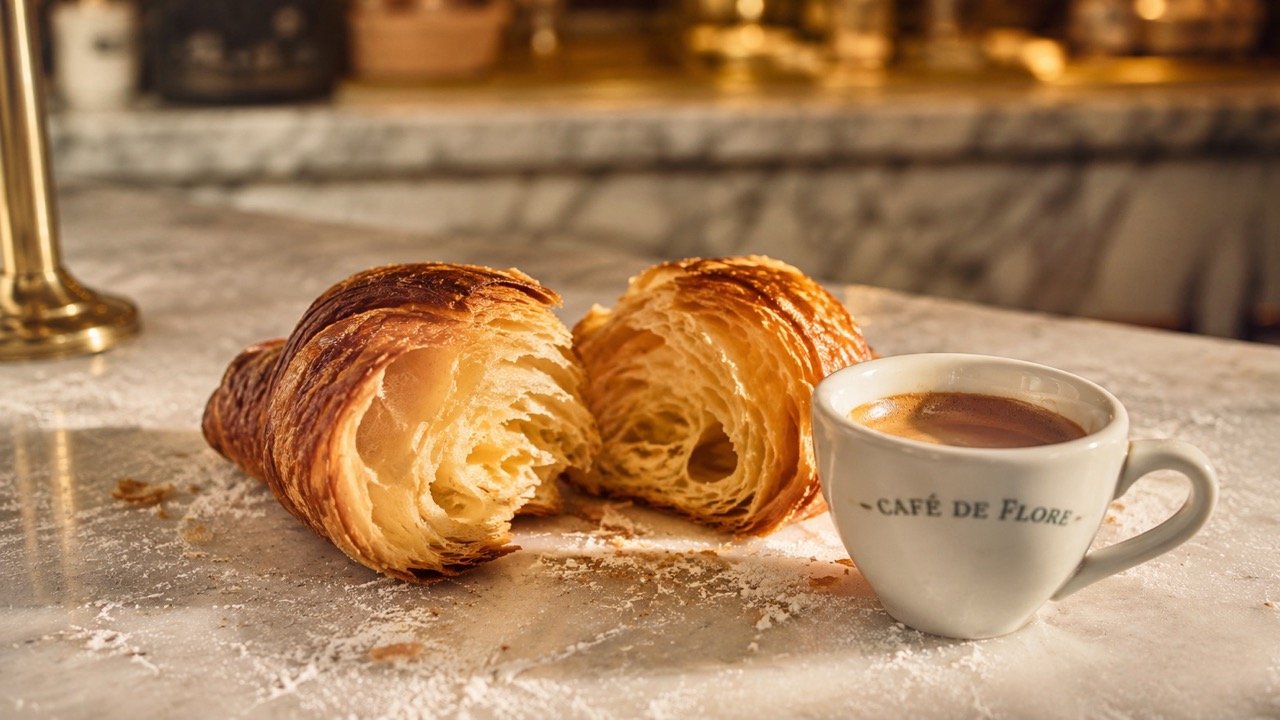
Reid developed a lamination technique that does not rely on a commercial dough sheeter — instead building the dough’s structure through a specific sequence of hand folding and refrigeration that maintains the integrity of the butter layers in a way that the mechanical approach cannot. The result is a croissant with a honeycomb interior that is visibly different from any other croissant in the city: more aerated, with more distinct strata, the butter distributed with a precision that is apparent in both the texture and the flavour. The exterior is lacquered, brittle, and architectural.
The Cube — a glass-walled room in the centre of the Fitzroy warehouse — makes the production visible: the lamination, the shaping, the proofing, the loading of the oven. You are watching something being made with the same level of technical seriousness as a watch movement or an aircraft component, except that the output is edible and requires almost no cognitive effort to understand as extraordinary.
Arrive at seven-thirty. The croissants are at their best in the first two hours of service. Order one plain, one with the kitchen’s current filling. The queue is real; it is worth the wait.
119 Rose St, Fitzroy. lunecroissanterie.com
Queen Victoria Market: Before Eight
The Wurundjeri Woi Wurrung people’s Country extends across the land that now houses the Queen Victoria Market, the largest open-air market in the Southern Hemisphere, operating on a site in the north of the CBD since 1878. Before eight on a Tuesday or Thursday morning — the market’s quieter weekday sessions — the QVM operates as the city’s most authentic food infrastructure: the wholesale meat hall and fish stalls are doing the business of feeding restaurants, the produce vendors are dealing with the chefs and serious domestic cooks who have learned that the quality of the market’s fruit and vegetables is highest earliest in the session, before the retail crowds arrive and the best lots move.
The fish hall is the place to be before seven-thirty. The selection at this hour — whole fish, unfilleted, still in the arrangements of a proper wholesale display — tells you what is genuinely in season and what has been caught recently. At the retail counter, the interaction is different from a restaurant supply: you can ask the vendor which of the whole fish arrived this morning versus yesterday, which is the question that will determine the quality of what you cook for dinner. The vendors know the answer and will tell you, which is a form of service that no packaged supermarket can replicate.
The corner cheese stalls and the imported goods vendors carry the imported Italian and Greek products that the inner-city restaurant scene relies upon: the preserved anchovies, the specific grades of olive oil, the dried pasta in shapes that most supermarkets do not stock. Shopping here before eight, when you have the vendor’s full attention and the displays are unplundered, is a different experience from the tourist Saturday market that most people know.
Corner of Queen and Victoria St, Melbourne CBD. qvm.com.au
The Corner Café on Gertrude Street
There is a specific kind of Melbourne morning experience that has no name and cannot be fully prescribed — the corner café on Gertrude Street, or Smith Street, or Brunswick Street, that has been there since the 1980s and has not changed its format because the format works. An espresso machine of some vintage, a counter that has taken ten thousand elbows, a group of regular customers who come every weekday morning and whose presence makes the café feel like a club rather than a business. These places are not landmarks. They are not on the lists. They are identified by the length of the morning queue and the average age of the regulars, both of which indicate sustained local trust.
The Fitzroy stretch of Gertrude Street — between Smith Street and Brunswick Street, on land historically part of the Wurundjeri’s Woiwurrung Country — remains the best postcode in Melbourne for this kind of café. The specific corners change as leases expire and rents rise, but the type persists because the neighbourhood’s character persists: the proximity of the public housing estates to the terrace houses to the small-bar and restaurant strip produces a morning street life of genuine mix and genuine energy.
What makes these cafés worth seeking out is not the coffee, which is usually good but rarely exceptional, and not the food, which is typically the kind of reliable breakfast-café cooking that Melbourne does better than anywhere in the country. It is the room’s relationship with the morning — the sense that this is a place where the city is being genuinely itself, unmediated and unperformed.
Sensory Coffee
On Smith Street in Collingwood, Sensory Coffee operates as a specialty roaster and café with the unusual distinction of sourcing coffee with the same transparent, relationship-based programme as the city’s leading roasters while maintaining a room quality — the furniture, the light, the service — that rewards the morning sitting rather than the takeaway cup. The filter programme here is one of the city’s most interesting: the rotation of single-origin lots is responsive to what the sourcing team is finding, and the tasting notes are honest rather than promotional.
The morning espresso at Sensory is an argument for what Melbourne’s best specialty cafés can do with the format — a clarity of flavour that the flat white dilutes and that the straight double expresses most directly. Order it without milk.
285 Smith St, Fitzroy. Verify current details before visiting.
On the Morning Protocol
The city’s best morning move: Lune at 7:30, one croissant eaten standing, then QVM fish hall before 8:00, then an espresso at whichever corner café the queue says to trust.
Tuesday and Thursday at QVM. The weekend market is a social event. The weekday market is where the city’s food network is actually operating. Go when it is working.
Do not plan the morning. The morning’s value is in its ambient quality — the random encounter, the vendor who mentions that the local snapper was excellent this week, the croissant better than expected. Over-scheduling converts it into an itinerary.
The flat white is fine at a corner café. It is the correct choice at 7:45 on a Tuesday. Save the filter programme for a longer morning.