
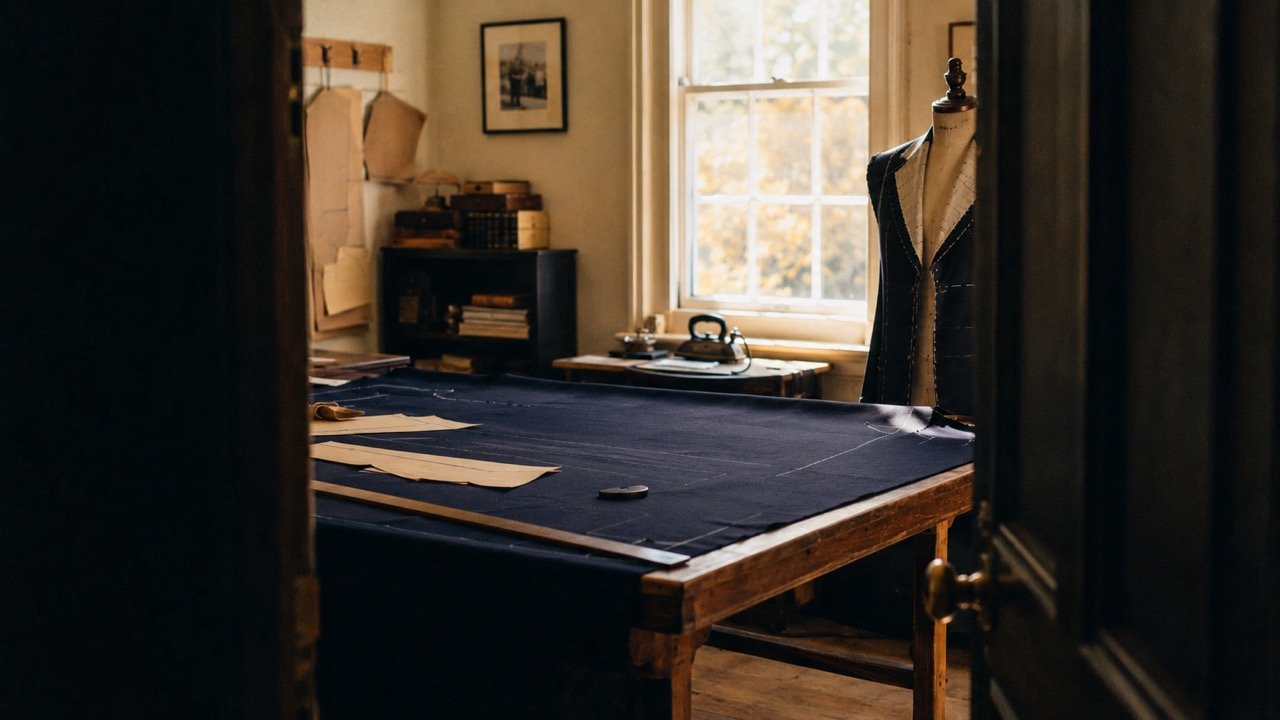
The question of what distinguishes a Melbourne suit is not a question of lapel width or trouser silhouette — those are fashion variables, seasonal and reversible. It is a question of construction, which is the part of a garment that you cannot see but can feel against the body from the first wearing and which determines whether it will still make you look correct in twenty years. Melbourne’s specific tailoring tradition — built on the knowledge of European craftsmen who arrived in the postwar decades and trained the next generation in techniques developed across Milan, Vienna, and Budapest — produces a particular philosophy: a chest built on floating canvas rather than fused interfacing; a shoulder with sufficient padding to hold the garment’s line without caricature; a sleeve head that allows for arm movement without the back pulling; a constructed, shaped front that flatters the living body rather than imposing a template upon it.
This tradition is worth understanding because it is the basis on which all claims about Melbourne tailoring should be evaluated. The word ‘bespoke’ is used liberally in the industry and precisely almost nowhere: a genuinely bespoke garment is one cut from a pattern drafted for your body alone, constructed by hand, fitted across multiple appointments, and completed by a cutter whose skill is sufficient to make something that neither a block pattern nor a computer algorithm can produce. Made-to-measure, which is different and considerably less, involves choosing a base pattern and adjusting it — the result is better than off-the-rack but not what the word ‘bespoke’ should denote. In Melbourne, the distinction matters because both are available, and the price difference between them reflects a skill difference that is worth understanding before committing.
The city’s variable climate — genuinely cold from June through August, deceptively warm in spring, capable of producing all four seasons in an afternoon — has shaped its tailoring in practical terms. Melbourne suits are made in worsted wools that sit in the 280–340 gram weight range: heavy enough to hold their shape in a cool morning, light enough to travel through a warm afternoon without distress. The construction is typically half-canvas at minimum, full-canvas for bespoke work; the lining is chosen for function rather than spectacle; the detailing is considered but never decorative for its own sake. A Sydney suit often reads as summer-optimised; a Melbourne suit is built for the year.
Sarti: South Melbourne Sartoria
Sarti — at 281 Cecil Street, South Melbourne — is the address that Melbourne’s most considered dressers reach when they have exhausted the made-to-measure options and decided that the body deserves something drawn for it specifically. Founded by master tailor Celia Coate, who trained across European and Asian tailoring houses and subsequently assembled a team whose cumulative experience spans more than a century of construction knowledge, Sarti operates as a private sartoria: appointments by arrangement, measurements taken in a room that smells of pressing cloth and chalk, a consultation that begins with the cutter asking what the garment is for and listening carefully to the answer.
The construction philosophy is full-canvas throughout: a horsehair-reinforced chest that moulds to the wearer’s body across multiple wearings, developing a fit that no fused garment can achieve because fusion cannot respond to the body. The shoulder is padded — not heavily, but sufficiently to maintain the coat’s line when the arm is raised — and the sleeve is set by hand in a way that permits a fuller range of movement than machine-sewn sleeves allow. The fabric consultation draws on English and Italian mills: Loro Piana, Scabal, Holland & Sherry, with seasonal weight recommendations specific to Melbourne’s climate rather than a European default. A first commission takes several months and multiple fittings. This is correct.
281 Cecil Street, South Melbourne. sarti.com.au
The Bespoke Corner: South Yarra
The Bespoke Corner, at 36 Toorak Road, South Yarra, brings a different tradition to the same project. Founded by Miles Wharton and Rami Mikhael, the business offers both bespoke and made-to-measure with English and Italian cloth, and operates with the particular intelligence of tailors who have studied the garment both as construction and as expression — who understand that a suit is a social instrument as much as a physical object, and that its success is measured against the context in which it will be worn. The South Yarra location gives the Bespoke Corner a clientele that spans corporate, cultural, and creative; the makers’ ability to shift register across those contexts — to produce a suit that reads as serious in a boardroom without reading as corporate in a gallery — is a specific competence.
The cloths available extend to shirtings and accessories, which matters because the best tailors understand that the coat does not work without the shirt, and the shirt does not work without considering the collar and the cuffs, and the cuffs do not work without considering whether you are wearing a watch. A full-dress consultation at the Bespoke Corner proceeds as a sequence of such decisions, each contingent on the previous, with the makers guiding without prescribing. The result, if you engage seriously, is a wardrobe rather than a garment.
36 Toorak Road, South Yarra. thebespokecorner.com
Germanicos: The CBD Tradition
Germanicos Tailors — with its long Melbourne CBD presence — represents the other strand of the city’s tailoring culture: the European family tradition, passed across generations, with the production discipline and institutional knowledge that time produces. The business offers bespoke alongside a made-to-measure programme that is genuinely structured rather than merely labelled. The CBD location means the clientele has always included Melbourne’s professional and legal community, and the construction reflects this: conservative in silhouette, precise in execution, built to last and to read correctly in formal contexts across multiple decades.
What distinguishes Germanicos from made-to-measure chains that use the same words is production: the garments are constructed in-house, in Melbourne, by cutters who have been doing this for years, using a technique that involves hand-padding, hand-stitching of critical seams, and pressing at each stage of construction rather than pressing only the finished garment. The pressing is not cosmetic; it is structural, and a tailor who does not press correctly at each stage is producing a different garment, regardless of what they call it.
Melbourne CBD. tailor.com.au
The Protocol of Commissioning a Melbourne Suit
Commission with a conversation, not a catalogue. The first appointment with any serious Melbourne tailor should involve articulating what the garment is for, when and where it will be worn, and what physical realities it needs to accommodate. Bring the best suit you own to the first appointment — the tailor’s response to it tells you something about their knowledge and their honesty.
Understand the difference between full bespoke and made-to-measure before you begin, and ask any tailor directly which they are offering. Full bespoke costs more and takes longer. It is worth the difference if you wear suits seriously, and not worth the difference if you do not. A made-to-measure garment from a good Melbourne house is an excellent outcome; a bespoke garment from a master cutter is a different object and a different relationship.
Wool weight is the most important single specification decision. Ask your tailor to specify the gram weight of the cloth they are recommending and to explain why that weight is appropriate for your pattern of use. Anything below 260 grams is summer-optimised and will not survive Melbourne winters with its shape. Anything above 380 grams is an overcoat. The sweet spot for a year-round Melbourne business suit is 280–320 grams.