
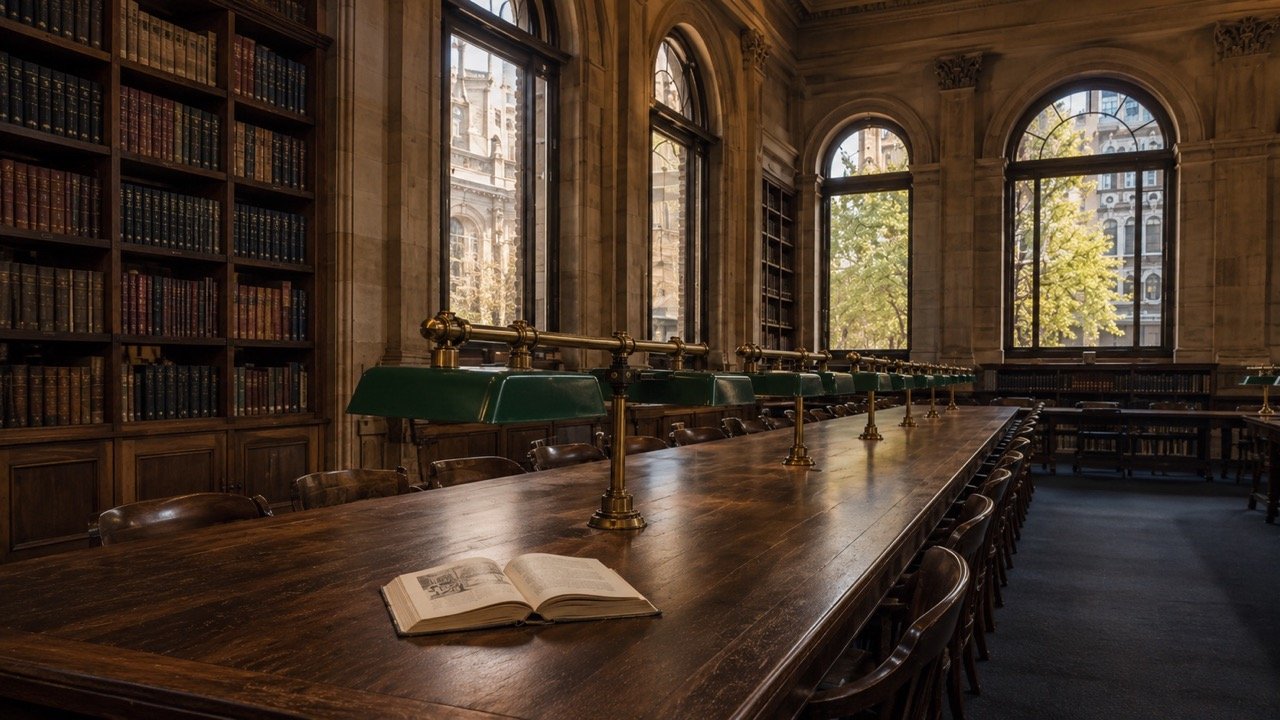
Melbourne’s most consequential creative address is not a gallery, not a precinct, and not a design district with a name. It is a ten-storey commercial palazzo on the corner of Swanston Street and Flinders Lane, completed in 1926 to the designs of Harry Norris, and it looks exactly as it should: grand in its proportions, indifferent to the decades that have passed through it, alive in ways that new buildings cannot contrive. The Nicholas Building at 37 Swanston Street houses something rarer than a blue-chip gallery programme or a curated boutique strip — it houses a culture of independent making, sustained across multiple generations of tenants, that has resisted the centripetal force of gentrification longer than almost any comparable space in an Australian city.
The building’s upper floors are arranged around a central light well. Each level has a ring of smaller corridor studios on the interior, a corridor running the perimeter, and outer studios with windows onto the street or the lane below. This is not a co-working space with standing desks and kombucha on tap. It is a working building: plaster dust in the corridor, the smell of flux and heated metal, a printer’s ink-stained rag on a window ledge. The Nicholas Building Association has managed the tenancy culture for decades, maintaining a deliberate mix of disciplines — jewellers, textile artists, printmakers, bookbinders, milliners, designers, gallerists — that keeps the building from collapsing into any single aesthetic or commercial logic. A jeweller on the fourth floor has been there for twenty-five years. A printmaker on the eighth moved in before the internet changed what printmaking meant. This persistence is the building’s great achievement.
What makes the Nicholas Building important is not that it exists — Melbourne has other heritage commercial buildings — but that it functions. The studios are working spaces first, and the creative community that has grown around them is networked in the way creative communities used to be before they became brands: through proximity, disagreement, shared lunches, borrowed tools, the knowledge that the person three doors down has solved a problem you haven’t. When Craft Victoria held its Open Studio Night events in the building, visitors discovered not a curated showcase but a messy, serious, productive reality. The Nicholas Building doesn’t perform creativity. It practices it.
The Jewellers: Fourth Floor and Above
The upper floors of the Nicholas Building have been the address of choice for Melbourne’s serious independent jewellers for at least three decades. Tiffany Parbs — a conceptual jeweller whose practice has been recognised by Creative Victoria’s Creators Fund and exhibited at Craft Victoria — works in the building, her practice rooted in a sustained inquiry into the relationship between the body, worn objects, and the narratives we construct around ageing and self-representation. Her pieces are not decorative in the conventional sense; they are propositions. To commission one is to enter into a conversation that takes time.
The building’s jewellers typically work with Australian material — opal from Coober Pedy and Lightning Ridge, sapphire from Queensland’s gemfields, the complex champagne and cognac tones of Argyle diamond melee from the now-closed Kimberley mine — and bring to it techniques rooted in European goldsmithing traditions. The result is work that carries a specific geographic intelligence: stones that could only come from this continent, set in metalwork that knows Antwerp and Munich as well as it knows Collingwood. A piece from this floor costs significantly more than a high-street jeweller and significantly less than a luxury brand; it costs correctly, for what it is.
The experience of visiting a Nicholas Building jeweller is not retail. You take the lift — original 1920s cage, recently updated but still slow enough to be a small ceremony — to whichever floor the studio is on, knock if the door is closed, and enter a room that is simultaneously workshop and showroom. You sit, you look at work in progress, you are shown a stone and told where it came from. You leave having learned something about the object you might acquire, the person who made it, and the minerals beneath the Australian continent. This is what distinguishes the Nicholas Building jewellers from Collins Street boutiques: a commission here is accompanied by its full story.
37 Swanston Street, Melbourne CBD. nicholasbuilding.org.au
The Printmakers and Bookbinders: Upper Floors
The printmaking community in the Nicholas Building operates in a tradition that predates digital production by a century and has simply declined to be superseded by it. The upper floors house studios where letterpress, etching, and screen printing are practised not as heritage curiosities but as considered choices — decisions about surface, texture, and the physical relationship between ink and substrate that a digital file cannot replicate. Print editions from these studios are small: sometimes ten, sometimes twenty-five. They circulate through Craft Victoria, through Rose Street Artists’ Market, through quiet word-of-mouth among Melbourne’s serious collectors of works on paper.
The bookbinders occupy a particular niche within this ecosystem. Hand-binding — the covering of boards with Japanese tissue or bookcloth, the rounding of spines, the gold-tooling of leather covers — requires a workshop that smells of hide glue and bone folder and time. The Nicholas Building binders produce work ranging from edition bindings for small-press publishers through to one-of-a-kind artists’ books and bespoke personal commissions: a volume of family correspondence bound in a fabric chosen by the client, a notebook that will outlast its owner. This is the opposite of disposability, which is precisely the point.
Within the broader Melbourne print culture, the Nicholas Building exists in productive dialogue with Ink & Spindle at the Abbotsford Convent (hand-printed textiles on organic cotton and linen) and with the Centre for Books, Printing and Paper’s successor practitioners in inner-north studios. The city’s print community is small enough to know itself but large enough to produce genuine variety. A collector working across disciplines — buying ceramics in Collingwood, prints from the Nicholas Building, bound books from a Fitzroy binder — will find that many of these practitioners know one another, have collaborated, have argued productively about what their medium is for. This is what a creative ecosystem looks like from the inside.
37 Swanston Street, Melbourne CBD. nicholasbuilding.org.au
The Textile Artists and Milliners
Millinery has no practical purpose that a cheaper hat could not serve. This is its point. The milliners of the Nicholas Building — several have worked in the building across the years; the turnover is slow, as it is everywhere here — produce work for the racing season, for weddings, for the kind of woman who understands that a well-made hat is a statement of aesthetic seriousness rather than an accessory. But the work extends beyond occasion wear: textile artists in the building produce pieces that sit as comfortably in a gallery as on a body, explorations of hand-dyeing, weaving, and constructed fabric that treat the textile surface as the site of inquiry rather than merely the material of garment-making.
Melbourne’s fashion community has always had a more ambivalent relationship with wearability than Sydney’s. Here, a textile piece that is partly sculpture, partly garment, partly proposition about what clothing is for, finds an audience — collectors who buy it as they would a painting, who hang it or drape it or wear it once to an opening and then again consider whether wearing it was actually the right relationship to have with it. The Nicholas Building’s textile artists understand this audience. They are not making fashion; they are making objects that happen to be constructed from fibre, and which happen to be worn by bodies, and which begin a conversation when they are.
37 Swanston Street, Melbourne CBD. nicholasbuilding.org.au
The Protocol of Visiting
The Nicholas Building is not a tourist destination and does not wish to be. It has no ground-floor shop, no welcoming foyer with a map of studios. The building’s creative community is accessible, but on its own terms, which is part of its value.
The Craft Victoria Open Studio events, when they occur, are the easiest entry point — they open studios that are otherwise by appointment, and they give a visitor a sense of the building’s full breadth in a single evening. Outside of these events, the most effective approach is direct: the Nicholas Building Association’s website lists current tenants with contact details. Email a jeweller whose work interests you. Ask to visit. Most will say yes, and will be pleased that you have taken the trouble to find them.
Wear shoes that will take the stairs, because the stairs are worth taking: the lift is slower and you will miss the landings, each of which has its own micro-atmosphere — the smell of solvent near a printmaker’s studio, the sound of a hammer through a closed door, a postcard from a European print fair pinned to a doorframe. The building rewards slowness. Bring cash. Bring time. Don’t come expecting retail; come expecting to meet the person who made the thing you might acquire, and to understand why they made it this way, and to leave with a piece whose full weight you will not understand for months.